Is WWF RAW for the Super Nintendo a straight-laced wrestling simulation or the gaming equivalent of a neon-lit carnival sideshow where physics checks in its coat at the door? (Rhetorical question; you already know the answer.) Picture a ring so springy it might be rented from Acme, move sets that leave Newton spinning in his grave, and a “live-from-Manhattan-Center” veneer squeezed into 4 megabytes of ROM. It’s that rare beast that manages to be giddily over-the-top and fiercely competitive at the same time, like strapping a jetpack to a chessboard. Underrated? In parts. Overrated? Occasionally. Crucial? If you care about the messy adolescence of wrestling games, absolutely. If not, there’s always skee-ball. (But you’re still reading, so don’t pretend you’d rather be rolling wooden spheres.) Giant clown shoes, tombstones that double as catapults, and a crowd that chants “Raw! Raw!” like a boot-looping Speak & Spell, it’s all here, begging for a fresh look three decades on.
Historical Context
Let’s warp back to late 1994, a lovely purgatory where arcades boomed, cartridges still ran the show, and grunge had not yet ceded to boy-band seratonin. Super Metroid had just made grown gamers tear up over a larval alien’s sacrifice (don’t play coy; we all blubbered), Donkey Kong Country convinced us pre-rendered bananas were photo-realistic, and Final Fantasy VI taught us nihilism could fit on a 24-megabit cart. Meanwhile on cable, the World Wrestling Federation was mid-molt: Hulkamania’s day-glo aura was fading, Bret “Hitman” Hart’s pink-and-black technician chic reigned, and no one had uttered the words “Attitude Era” outside a marketing meeting. Monday evenings belonged to WWF Monday Night Raw, broadcast from the Manhattan Center, the Mid-Hudson, or whichever small arena would tolerate a crane camera and a ban on confetti cannons.
Acclaim Entertainment, through its rainbow-badged LJN label on Nintendo consoles, smelled synergy. Super WrestleMania (1992) had laid groundwork, Royal Rumble (1993) had refined it, and WWF RAW was positioned as the trilogy’s crescendo: bigger sprites, more wrestlers, and enough Mode 7 flourishes to make a Sega-kid’s eyes water. Developed by Sculptured Software in Salt Lake City, the game launched in North America in November ’94 and in PAL territories a few snowflakes later. Other platforms, Genesis, Game Boy, Game Gear, even the 32X, received parallel ports, but the SNES edition remains the flagship thanks to its gaudy color depth and that unmistakable faux-digitized Vince McMahon bark greeting you at the title screen. (Seriously, crank your CRT: you’ll hear Mr. McMahon’s larynx compress into 8 kHz and never sleep again.)
My first brush came courtesy of the local Blockbuster, XP Arcade down the street didn’t stock console carts, where RAW was shelved next to ClayFighter 2 and a copy of Ninja Scroll someone had forgotten to rewind. I snagged it for a sleep-over, squeezed a multitap into the SNES’s lonely controller port, and learned two truths by sunrise: thumb calluses are a badge of honor, and when The Undertaker’s mega move works, it launches Razor Ramon so high he risks colliding with the Mode 7 audience banner. We played until the mini-fridge surrendered its last Capri Sun, transmuting our collective sugar high into a four-player Royal Rumble cacophony that probably shortened the console’s lifespan (sorry, Mom).
Timing was sly. Sony’s PlayStation lurked on the horizon like a polygonal Big Boss, but 3D had not yet reached living rooms en masse. On TV, RAW faced no Nitro competition; Nitro would not debut until September ’95. Naming a game WWF RAW in ’94 felt hip, like capturing live TV’s spontaneity in cart form. Acclaim’s marketing promised “the fiercest, most accurate action ever,” but Sculptured’s designers had a different agenda: they buried accuracy beneath spectacle, ensuring no one could claim false advertising while simultaneously handing players something utterly bonkers.
Mechanics
All right, tighten your laces; we’re stepping through the ropes. WWF RAW runs on a lock-up tug-of-war system: collide sprites, watch a horizontal meter appear, and mash buttons until your half fills with patriotic hues signifying dominance. (Some claim technique beats mashing. Those people are liars with ice in their thumbs.) With the grapple won, directional plus button inputs trigger moves, Shawn Michaels hits Sweet Chin Music, Diesel hoists a Jackknife Powerbomb, Bret Hart clamps on that oh-so-satisfying Sharpshooter rendered in six glorious frames. Each wrestler carries hidden stats, speed, strength, stamina, weight, that tangibly affect outcomes. The 1-2-3 Kid zips like a caffeinated ferret, Yokozuna lumbers but hits like a meteor, and Luna Vachon’s balanced attributes belie her status as the Federation’s first female console combatant.
But you came for excess, so let’s talk Mega Moves (our absurd guiding light). These are cinematic finishers mapped to shoulder buttons plus direction, and they do not obey the Geneva Convention of Gravity. Undertaker summons paranormal juice, hoisting foes skyward past the TitanTron equivalent until they vanish off-screen and plummet like Acme anvils. Doink whips out carnival dark arts, inflating opponents into beach balls before spike-slamming them. Yokozuna becomes a boulder of raw mass, rolling the ring like Indiana Jones gone sumo. They’re overpowered, delightfully silly, and accompanied by a dramatic dimming of arena lights as if the SNES briefly thinks it’s auditioning for an episode of Dragon Ball Z.
The basic combat loop, grapple, move, reposition, might read repetitive on paper, yet in play it feels like analog jazz. Irish whips rebound opponents off ropes for clotheslines or back-body drops; timing dropkicks to intercept a rebound at mid-screen delivers dopamine normally reserved for parrying missiles in side-scrollers. Springing to the top turnbuckle (hold A while pushing toward the corner, sacrifice a goat, pray) unleashes aerial assaults that, if reversed, see your pixel-hero pancake the mat face-first. Tag-team psychology matters: fresh partners rejuvenate stamina if you manage the hot-tag animation without getting intercepted. Survivor Series elimination matches become wars of attrition, don’t tag Diesel at 5% health unless you want him folded like an accordion.
The control scheme is labyrinthine by modern standards, Irish whips mapped to Y+B, running requiring A+direction, climbing the top rope involving L+R if Mercury is in retrograde, but there’s method in the madness. Sculptured leveraged every SNES button, turning short-hop reversals and crowd-taunts into micro-rhythms within matches. Once muscle memory fuses with synapse, you’ll stuff suplex attempts, convert them into snap DDTs, and nail a Flying Elbow while the crowd (a smear of Mode 7 heads) cycles between four frames of applause. It’s tactile in that sticky-controller sense, palms sweat, D-pads squeal, but intensity is the point. Wrestling without friction is just mocap ballet.
Match types add seasoning. One-on-One and Tag Team cover basics. Bedlam, a tornado tag free-for-all, fills the ring with four bodies and accentuates chaos (friendly-fire dropkicks included). Survivor Series strings eight grapplers into elimination strings; the screen tumbles into 16-bit mayhem when a legal wrestler desperately drags him- or herself to their corner while an illegal Diesel taps his foot on the apron. Royal Rumble is peak party mode: six wrestlers on screen, up to four controlled by humans thanks to the SNES multitap, with over-the-top-rope eliminations emulating the TV spectacle. The framerate occasionally buckles like a cheap folding chair, but no one notices when Bret Hart and Razor Ramon simultaneously cling to ropes like 2D cats escaping bathwater. Raw Endurance, hidden behind a few menu flips, pits your four-wrestler squad against two successive CPU teams, turning stamina conservation into weaponized panic.
Weapons? They’re conveniently stationed ringside from bell time, steel chair, 20-gallon bucket (Doink’s signature), random hardware Vince probably expensed, ready for any soul bold enough to slip under the ropes. Knock out the referee and suddenly the rulebook evaporates: choking, eye-gouges, head-butts become legal until the striped shirt awakes or you bash him again (digital malpractice, sure, but we were kids). And yes, the ref lies prone long enough to finish a Capri Sun.
Audio deserves equal reverence. Each wrestler’s entrance theme compresses into jaunty 20-second WAV fragments: Razor Ramon’s Latin guitar riff still oozes swagger through SNES PCM; Undertaker’s funeral bells echo under crunchy samples; Doink’s circus ditty weaponizes whimsy and dread simultaneously (homie invented clowncore). The in-match BGM alternates between thrashing electric-guitar MIDIs and crowd chants that loop “Raw! Raw!” at volumes just shy of tinnitus. Sure, the sampled voices crackle like an AM radio, but that texture glues memory to experience, much like vinyl pops can elevate a Miles Davis solo.
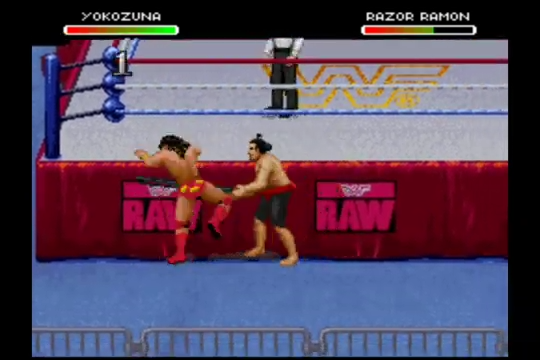
Graphically, RAW flexes the SNES’s 256-color mode. Wrestler portraits on the select screen feel ripped from WWF magazine pin-ups: Bret adjusts mirrored shades, Shawn tosses hair, Yokozuna glares as though a buffet just closed. In-ring, sprites measure around 70 pixels tall, dwarfing Royal Rumble’s smaller frames. Animation counts grew, affording individualized strikes: The Undertaker’s thrusting uppercut, Luna’s overhead chops, and Bam Bam Bigelow’s cartwheeling elbow that reminds everyone a 390-pounder can still circus-act. The background sells the Manhattan Center’s red-brick aesthetic via dithering (kids today call it pixel art). That red RAW banner coasts along the guardrail on a Mode 7 loop, hypnotizing anyone with a penchant for parallax.
Let’s highlight the roster: Bret Hart, Owen Hart, The Undertaker, Shawn Michaels, Diesel, Razor Ramon, Lex Luger, Yokozuna, Bam Bam Bigelow, Doink, 1-2-3 Kid, and Luna Vachon, the dozen gladiators of this 16-bit coliseum. It’s the best cross-section of WWF’s New Generation before the roster splintered: technical icons, muscle titans, clown anarchists, and the first female wrecking ball. Each’s mega move references kayfabe quirks: Razor’s “Last Ride” sidestep punch sends foes ricocheting like pachinko; Luna’s diving headbutt is a mid-air torpedo that would earn Chris Benoit’s nod of respect; Owen Hart’s wheel kick gains extra hang-time because little brothers everywhere needed a power fantasy.
The moment-to-moment fun ties back to that single ridiculous idea: mega moves as equalizer. You can play textbook wrestling, chain-grapple into back-suplex, working the leg for a Sharpshooter finish, or you can wait for the right spacing to hit Undertaker’s supernatural catapult and fling Diesel high enough to strike a hypothetical ceiling rafter. Matches teeter between strategy and slapstick; it’s like toggling between Fire Pro’s stoic sim and Mutant League Football’s gleeful carnage with a single shoulder button.
Legacy and Influence
Today, RAW sits at an odd crossroads in wrestling-game genealogy. It’s the final WWF title Sculptured Software developed for 16-bit consoles, closing the book on LJN’s colorful SNES tenure before Acclaim pivoted to early 3D efforts (WWF War Zone on PlayStation) and the license shuffled toward THQ and AKI on the N64. Those future classics would refine unique attributes, variable grapples, and analog counters, but RAW planted prototypes, call them proto-systems, years prior. Its tug-of-war meter, while simple, foreshadows the momentum shifts Yuke’s later mapped to analog sticks. Varied stats and move sets, Diesel’s reach, 1-2-3 Kid’s speed, prefigure WCW/nWo Revenge’s exhaustive grapple tree where Kevin Nash felt tangibly different from Rey Mysterio. Meanwhile, mega moves proved fans would embrace cartoon exaggeration inside a sports veneer, paving the runway for Midway’s WWF WrestleMania: The Arcade Game (digitized sprites breathing literal fire) and, years later, EA’s Def Jam series where rappers German-suplexed each other through chop shops.
Yet RAW never cracked mainstream memory like No Mercy or Here Comes the Pain. Partly timing: 1994’s consumer eye pivoted toward polygons; partly association: LJN’s rainbow had become a scarlet letter after an avalanche of rushed tie-ins; partly the game’s own identity crisis, half simulation, half cartoon. Collectors now covet the SNES cart for two prime reasons: Luna Vachon’s historic inclusion and the kaleidoscope mania of mega moves that spawn endless meme GIFs. ROM-hackers still mod new wrestlers, Kota Ibushi moonsaulting off a 16-bit turnbuckle is a sight to behold, and speedrunners chase “fastest Royal Rumble clear” categories where Undertaker tosses five CPUs in 19 seconds of turbo-mashing.
Academically, RAW also occupies a fascinating threshold. It’s the last major Western wrestling title to rely entirely on 2D sprites. Japan’s Fire Pro lineage kept that torch alive, but in North America every post-1994 console release pivoted to digitized captures or raw polygons. This makes RAW a museum piece of sprite craft: the subtleties of Bret’s hair sway, the pixelated flame tattoos on Bam Bam, the way Yoko’s mawashi belt flutters mid-squat. Artists squeezed personality from every outline because there was no fallback motion-capture studio. In hindsight, RAW stands as evidence that authenticity is not always fidelity; sometimes authenticity is expression, Bret’s hair bounce matters more than an anatomically perfect 3D shoulder joint.
Culturally, we can trace modern inter-gender options in WWE games back to Luna’s breakout. For years, mainstream wrestling titles segregated rosters; today, 2K’s offerings include MyFaction modes where Rhea Ripley powerbombs Edge on equal footing, and RAW deserves at least a footnote in that lineage. Did the devs set out to make history? Probably not, they needed a twelfth slot and Luna was feuding with Doink on Monday nights, but representation often arrives via budgetary happenstance, and we celebrate the outcome all the same.
Closing Paragraph + Score
So where does WWF RAW on SNES land in the cosmic rankings of squared-circle cartridges? It’s a paradox, both raucous party game and earnest attempt at depth, a conduit for nostalgia and a blueprint for future mechanics, a simulation with a clown-inflation button. Boot it up today, hook four controllers, and expect your living room to devolve into screeching one-liners about suplex altitude and clown physics. Then realize you’re describing professional wrestling in 2025 just as accurately. For its balanced blend of spectacle, surprising nuance, first-ever female inclusion, and audio-visual flair, in spite of its occasionally creaky framerate and a control scheme that could double as SAT prep, WWF RAW body-slams its way to a solid accolade.
Final Score: 7.5 / 10