Wetrix is one of those games that looks, at first glance, like somebody took a very sensible puzzle premise, dropped it down a stairwell, and then watched it come up somehow smarter and more annoying than before. I mean that as praise. On the PC version I am focusing on here, Wetrix is not interested in being neat, polite, or even especially comfortable. It wants you to sculpt land, trap water, save water, destroy water, and somehow profit from your own administrative competence. It is a puzzle game, yes, but it feels like a city simulator written by a trickster god with a weather fetish.
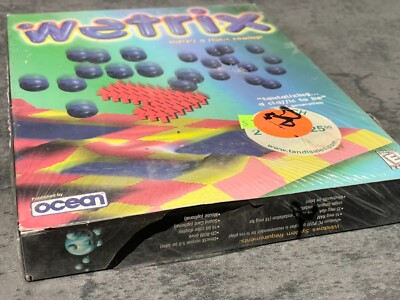
That, more than anything, is why it lingers. Wetrix is not about line-clearing, symmetry, or the clean little dopamine click of a job well done. It is about containment. It is about building bowls and basins, making tiny reservoirs out of a falling pile of terrain pieces, and then trying to manage the exact amount of chaos those reservoirs invite. Water arrives, the land changes, bombs punch holes in your carefully planned geography, fireballs evaporate water for points, and the whole thing is governed by a drain meter that turns overconfidence into a funeral. This is a game that constantly asks whether you meant to create a miracle or a liability. Usually, the answer is both.
A puzzle game with a dirty, brilliant idea
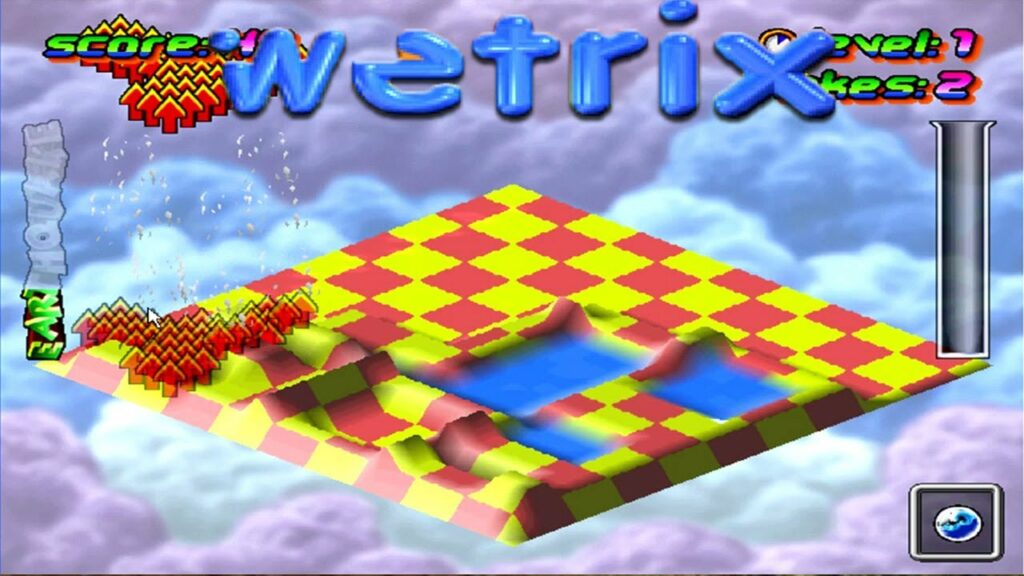
The core loop is easy enough to state and much harder to tame. Pieces fall in from above, and you can rotate them only clockwise, which is already the sort of limitation that makes a 1990s puzzle game feel like it has a personal grudge. The pieces are not just abstract blocks. You are handling terrain modifiers, uppers and downers in four shapes, plus bombs, water bubbles, and fireballs. Uppers and downers raise and lower the landscape so that pools can be formed. Bombs create holes, which sounds helpful until you remember that water loves holes the way tax collectors love paperwork. Water bubbles fill your pits. Fireballs evaporate that water so you can score points. Somewhere in the middle of all this, ducks and rainbows act as scoring multipliers, because apparently even the laws of hydrology were not going to keep Wetrix from being a little bit enchanted.
The result is a game about engineering temporary order in a system that is actively offended by your plans. Every move has consequences that cascade. Build a basin too shallow and water escapes. Build it too deep and you may preserve a pool you cannot safely empty. Let the drain meter fill and the game ends with the kind of inevitability that feels less like a loss state and more like a public reprimand. Wetrix is very good at turning simple placement decisions into a little private crisis. Should you close this gap now, or leave it open in case a better piece arrives? Should you preserve this lake for scoring, or burn it off before it becomes a problem? These are the questions that keep the game alive long after the first novelty wears off.
And the novelty does wear off, a little, because the game is not pretending to be more than it is. There is no elaborate narrative wallpaper to soften the arithmetic. There is only terrain, water, fire, and the increasingly suspicious sense that you are managing a disaster zone with colored toys. That can be immensely satisfying, especially when the board starts to resemble something like competence. You can feel the appeal of making a tidy reservoir, baiting the next water piece, then cashing it out with fireballs for a ridiculous score. You can also feel the appeal of surviving by the skin of your teeth, which is not really the same thing as elegance, but in a puzzle game it often passes for wisdom.
The genius and the irritation live in the same drawer
Wetrix is deep, but it is not always graceful about being deep. The controls, according to the review record I have, are one of the recurring complaints, and I do not find that hard to believe. A puzzle game with a clockwise-only rotation rule already has a built-in annoyance tax. That restriction can create tension, sure, but it also means you are constantly working around the interface instead of simply thinking through the board. It is the sort of friction that some players mistake for difficulty, when what it really does is increase the number of moments in which your hands feel like they are negotiating with the game rather than expressing intent. In a good puzzle game, limitation sharpens thought. In a merely obstinate one, limitation just makes you resent the furniture.
Wetrix mostly earns its friction, but not always. When it is going well, the whole thing has a manic rhythm, a kind of vertiginous little economy where you are always converting risk into reward and reward back into risk. The scoring systems, with multipliers tied to ducks and rainbows, push you toward absurdly large totals, and that in turn nudges the game away from simple survival and into a game of opportunistic greed. I admire that. I also think it is slightly unhinged, in the best possible way. The game is happiest when you are not merely trying to not lose, but are actively trying to squeeze value out of the flood before it swallows your house. That is a compelling fantasy, and one that puzzle games do not visit often enough.
But there is a sharp line between tension and fussiness, and Wetrix walks it with the confidence of a man balancing a television on one shoulder. The board can become crowded with consequences so quickly that it starts to feel less like strategizing and more like triage. This is not inherently bad, but it does mean that the game’s pleasures are often pinned to players who enjoy being punished for hesitation. If you like your puzzle games crisp and legible, with clean failure states and an easily parsed route to mastery, Wetrix may strike you as too restless, too improvisational, too eager to turn every neat idea into a swamp. Which, to be fair, is also part of its charm.
It looks like a toy and behaves like a machine
The presentation has a lot going for it. The available research describes Wetrix as colorful and bright, with amazing water effects and fitting sound, and that sounds exactly like the kind of visual identity a game like this needs. Wetrix lives or dies on the readability of its playfield. A side-view board full of rising terrain, accumulating water, and sudden eruptions of fire has to look lively without becoming visual soup, and on that score it seems to have the right kind of flashy confidence. The water is not merely decoration here. It is the whole joke, the threat, the currency, the punchline. If the effects are strong enough to make that fluid state feel alive, then the game earns a major part of its appeal before you even start worrying about scoring.
There is also something very late-90s about the whole look, in the way that bright coloration and practical interface design combine with a slightly surreal premise to produce something that feels simultaneously accessible and odd. This was an era when puzzle games often had to justify themselves with either purity or personality. Wetrix chooses personality, but not in a loud mascot-driven way. It is stranger than that, less friendly, more like an arcade cabinet that has developed a secret interest in water management. That matters. A puzzle game can be mechanically interesting and still feel emotionally flat. Wetrix, at least in the materials I have seen, seems to have a distinct mood, one that mixes cheerful surfaces with the cold arithmetic of overflow.
The sound matters too, even if this is one of those review topics people tend to wave away until a game gets it wrong. Here, the reports call it fitting, and that is exactly the right word. Not showy, not memorable in some grand melodramatic sense, just doing the job of making the board feel active and the actions feel consequential. For a game like this, that is enough, and often more than enough. Puzzle games do not need orchestras. They need timing, feedback, and a sense that the world is listening when you make a mistake.
Why it still sticks
What keeps Wetrix alive in my mind is that it understands a deliciously perverse truth: making a pool is only half the game. The other half is deciding when that pool becomes a liability. That is a more interesting problem than simple clearing, because it introduces a temporal element that most puzzle games flatten out. You are not just placing pieces in space, you are managing a sequence of transformations. Water accumulates. Fire removes. Terrain changes the shape of the board. The board you have now is not the board you will have in ten moves, and the board you want may never arrive at all. That unstable relationship between plan and outcome gives Wetrix a nervous energy that many puzzle games fake and this one actually earns.
I also admire its willingness to be difficult without dressing that difficulty up as elegance. Some puzzles are proud of their cleanliness. Wetrix is not one of them. It is messy, occasionally abrasive, and happy to make you stare at your own bad decisions. Yet it is rarely stupid. The game’s systems are coherent enough that failure usually feels attributable, even when it feels unfair in the moment. That is important. I can forgive a game for being hard. I have never forgiven one for being vague while pretending to be deep. Wetrix avoids that specific crime. It tells you, in effect, that the flood will come whether or not you have your act together, and then it waits to see if you can turn that fact into a scoring opportunity. That is a lovely, nasty little premise.
And yes, the whole thing can become frantic. That word comes up in the reception material, and it fits. Wetrix is not a meditative puzzle box. It is an anxious one. The urgency is part of the appeal, but it is also the source of its limits. If you do not enjoy games that make you feel like you are one bad placement away from a bureaucratic drowning, this is not going to convert you. If you want the serenity of a tidy logic puzzle, go elsewhere and leave the raincoat on the hook. Wetrix is for people who enjoy improvising under pressure, who like the idea of building a machine to contain a problem and then watching the machine become part of the problem.
That said, I would not call it universal. Some players will bounce off the rotation restriction, the pressure, the sometimes awkward interface, and the way its systems can feel less like a graceful dance and more like a very efficient argument with the board. I get that. I also think those irritations are inseparable from the game’s identity. Wetrix is not trying to be a soothing abstraction. It is trying to make a tiny ecological catastrophe feel like a high-wire act. In that respect, it succeeds more often than it fails.
So here is my verdict, without the usual critical handshake nonsense: Wetrix is a smart, strange, highly playable puzzle game with a real personality and a real bite. It deserves more respect than it gets, but not blind veneration. Its strengths absolutely outweigh its flaws, especially if you can appreciate tension, opportunism, and systems that generate drama out of water where most games would just render a pond and move on. It is not for players who want clean ergonomics, gentle onboarding, or the emotional safety of a puzzle game that never seems to enjoy being difficult. It is for people who want to wrestle with a clever design that sometimes feels like it is one step away from becoming a weather report. Which, in my book, is far more interesting.
Score: 8/10