I have a weakness for games that begin as a bad idea in the best possible sense: a couple of university students in Germany, a hobby project, a persistent world, and the audacity to think a graphical online role-playing game could exist without first asking permission from the genre gods. Tibia, in its original 1997 PC form, is exactly that sort of beautiful impropriety. It is not elegant. It is not friendly. It does not especially care whether you have seen an MMO before or whether you are prepared for one. It simply opens its little door, hands you a sword or a spellbook or a bow, and says, more or less, good luck, citizen, the monsters are already out there and the server is already breathing.
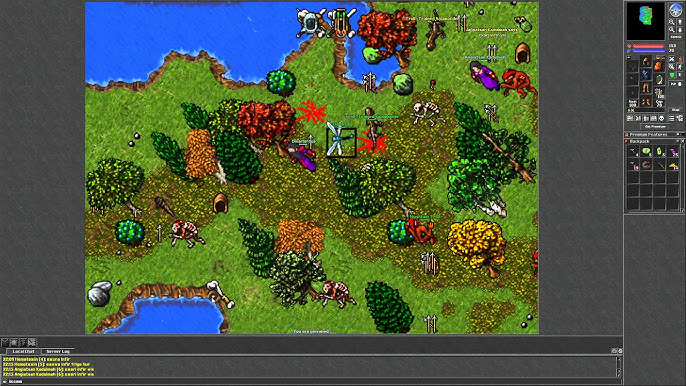
That, to me, is the core of its appeal and its problem. Tibia is an open-ended MMORPG with knights, paladins, sorcerers, and druids, built around fighting monsters, earning experience, improving skills, talking to other players, trading objects, forming alliances, and chasing quests in a persistent online world. In theory, that sounds like the standard menu of the genre. In practice, in 1997, this was still a mildly unhinged proposition. The game was emerging from a hobby project begun in 1994, then arriving in alpha form on January 7, 1997, with the first server online at the University of Regensburg. That detail matters, because you can feel the student-project energy in the bones of the thing: ambitious, a little scrappy, a little ascetic, and absolutely convinced that the real magic was not in spectacle but in the fact that other people were sharing the same fragile space with you.
And yes, before anyone starts polishing the brass plaque, this is a review of the original 1997 PC release context, not the long and sprawling later history of the game. Tibia would keep evolving, with later betas and version jumps, and its afterlife is its own industrial-sized saga. But the original release is where the personality is most exposed. It is the version where the idea is still raw enough to smell like solder. There is no reassuring modern scaffolding around it, no generous hand-holding, no elaborate illusion that the world exists for your comfort. You log in, you move with keyboard or mouse, you manipulate objects, you talk to players, and you start making decisions in a system that is open-ended enough to feel liberating and underdesigned at the same time. That tension is the whole meal.
The pleasure of being dropped into the machinery
The simplest thing to say about Tibia is that it asks you to make your own fun, but that undersells the particular flavor of the ask. This is not the lazy, cynical version of openness, where a game leaves holes in the structure and calls the emptiness emergent design. It is closer to the older online dream: a shared landscape, a set of rules, and enough friction in both that other players become the actual content. You kill monsters for experience and levels. Levels improve your properties. Skills improve through use. You interact with items, with the economy, with other people, with the architecture of a world that persists whether you are logged in or sulking at the desktop. You can buy houses, which is either a charming social reward or the kind of domestic fantasy only an MMO can turn into a status symbol.
The combat and progression loops, as documented in the sources, are straightforward to the point of bluntness. There is no need to invent mystery where the research is thin. What matters is how those loops feel when they are attached to a live server and a class-based social hierarchy. Knight, paladin, sorcerer, druid: these are not just character labels, they are little promises about role and identity inside an online ecosystem. In a later era, such class distinctions would be padded with cutscenes, skill trees, voice-over, faction dramas, and several layers of tutorialized reassurance. Tibia has none of that luxury. It gives you the world and expects you to discover the cost of existing in it. That can feel bracing. It can also feel like being handed a wrench and a map written by a man with a head injury.
The result is a game that is often more fascinating than immediately lovable. It has the old MMO virtue of making social presence matter, and the old MMO vice of making everything else feel as if it had to be earned through endurance rather than craftsmanship. If you enjoy that rawness, you will forgive a lot. If you do not, the game can seem almost perverse in its refusal to soften the edges. There is no pretense that the world is tuned around your convenience. The world is tuned around survival, accumulation, and the quiet, slightly unsettling possibility that somebody else on the server may be more cunning than you.
A graphical world when the alternatives were text
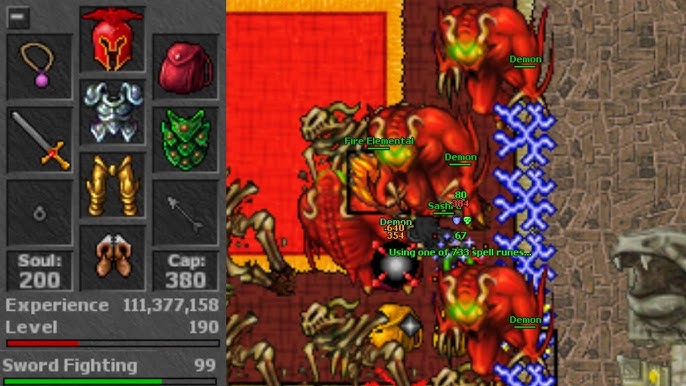
One of the most important facts about early Tibia is also one of the easiest to overlook now: it was graphical, not text-based, at a moment when MUDs still dominated the mental model for online role-playing. That alone gives it a historical charge. The game is not merely old, it is old in exactly the way that looks minor until you remember how many design assumptions had to be kicked out of the room to make it possible. The sources describe a graphical user interface, and that matters because it frames the whole project as a bridge between the old readable online worlds and the coming era of visual persistence.
Of course, the visual style is not some lavish historical reenactment of fantasy painting. We are talking about a 2D top-down game from 1997, which means practical clarity rather than painterly immersion. But clarity is not nothing. In a game built around movement, item interaction, social coordination, and an economy that lives or dies on readable spaces, the top-down presentation is less a compromise than a structural choice. It keeps the world legible. It lets the game behave like a board with consequences. If you want a grand cinematic atmosphere, you will need to look elsewhere. If you want to see how an early online world makes multiplayer feel like spatial politics, Tibia has the nerve to be quite good at it.
That said, I would not confuse legibility with charm-by-default. Old graphical online games often survive on the strength of their social imagination, not their visual seduction. Tibia falls into that category. It can be plain in the way that makes hardcore genre people call it “focused” and everyone else call it “a little cheap looking.” Both reactions are defensible. I would only add that plainness is not necessarily a defect when the game’s actual subject is persistence. The world is not there to dazzle you. It is there to continue.
The economy of effort, and the economy of other people
The real secret sauce here is not loot, or leveling, or class identity. It is the social economy, the player-to-player friction, the sense that the game is a place where goods move, alliances form, and the simple act of talking to another human being is part of the core loop. The research supports this clearly enough to say that player economy and housing are central enough to mention, and that is important because it tells you what Tibia understands about long-term engagement. It does not just want you to grind. It wants you to inhabit an ecology.
That can produce a remarkable kind of tension. A monster is never just a monster if somebody else might want the same square of land, the same drop, the same advantage, the same house, the same social footing. The world becomes meaningful because value is distributed through scarcity and dependence, not because the game flutters its eyelashes at you with cinematic storytelling. It is a stern, almost Protestant form of design: work, coordinate, accumulate, and maybe one day your name will matter to someone else on the server. I find this admirable, even if I also find it exhausting in the specific way only persistent online worlds can be exhausting. They do not merely ask for time. They ask for loyalty. Then they ask whether you have spoken to the right people lately.
That persistent structure is also why the game has endured so unusually long. Later reception data, while outside the original 1997 moment, paints the picture of a survivor rather than a museum piece: a long-running MMORPG with remarkable reach, especially in Brazil and Poland, and a player base that at its peak was anything but quaint. I mention that not to smuggle in prestige, but because it helps explain the original design’s resilience. Tibia did not survive by being ornate. It survived by building a social machine sturdy enough that people kept living inside it.
Where the charm shades into stubbornness
And yet, let us not romanticize the thing into sainthood. There is a difference between uncompromising design and merely withholding design labor. Early Tibia clearly belongs to a period when openness could cover a multitude of rough edges, and the line between “player-driven” and “under-explained” was still being drawn by people with no time for your complaints. The research does not support detailed claims about combat feel, audio texture, or every specific mechanical quirk, so I will not invent them. What I can say, safely and honestly, is that a game built this openly in 1997 will inevitably place more burden on the player than contemporary players may remember as reasonable.
That burden is part of the identity, but identity is not the same thing as pleasure. There are games I respect more than I enjoy, and Tibia is flirting with that boundary all the time. The game’s lack of a pre-defined aim, its insistence on self-direction, its dependence on other players, and its persistent-server structure all create a world that feels alive. They also create a world that can feel indifferent, opaque, and occasionally rude. If you are looking for a clean arc, a tightly authored progression, or a sense that the game has been carefully arranged to produce the right emotional beat at the right moment, you are in the wrong cathedral. This is a marketplace with traps in it.
Still, there is an honesty here I have always preferred to a lot of later genre polish. Tibia does not pretend that belonging is effortless. It makes you earn your footing socially as well as mechanically, and that gives the world an odd kind of gravity. When it works, you are not consuming content, you are participating in a durable system. When it does not, you are just wandering around a top-down fantasy workplace wondering why the goblins look like your retirement plan.
The verdict, with no polite backing away
The original 1997 Tibia is historically important, but more importantly it is unusually clear about what it wants to be: a graphical online role-playing world that privileges persistence, player interaction, class identity, and social economy over theatrics. As a design object, that is fascinating. As a playable experience, it is compelling in bursts and stubborn in ways that will absolutely separate the curious from the committed. I admire its nerve, its early confidence, and the fact that it was building a future while most people were still arguing with text windows. But admiration is not surrender. The game is rough, demanding, and occasionally too content to let the player do the heavy lifting of meaning.
If you like early online worlds that feel like communities first and products second, Tibia deserves your attention. If you want guidance, elegance, or a game that makes its own case every five minutes, this is not your island. Its reputation is earned, but not because it is universally comfortable or beautifully polished. It is earned because it understood, very early, that an MMORPG could be more than a dungeon crawl with a bulletin board. The strengths outweigh the flaws if, and only if, you have patience for a game that treats persistence as a philosophy rather than a feature. For everyone else, it will probably feel like a charmingly stern little conspiracy conducted by German students and powered by stubbornness.
Score: 7/10