Shadow Warrior, in its original 1997 PC form, is what happens when a studio looks at the post-Duke Nukem 3D landscape, grins like it has a fresh pack of fireworks in its jacket, and decides subtlety is for accountants. This is a Build engine first-person shooter from 3D Realms, the sort of game that arrives already swaggering, already joking, already convinced that if it can just move fast enough nobody will notice how familiar some of the furniture is. And, to be fair, that is part of its charm. It is also part of its problem. Shadow Warrior is not a neat little reinvention. It is an aggressive, funny, sometimes surprisingly nimble riff on the studio’s own earlier success, a game that wants to be bigger, cheekier, and more obscene in personality without always proving it is more interesting in structure.
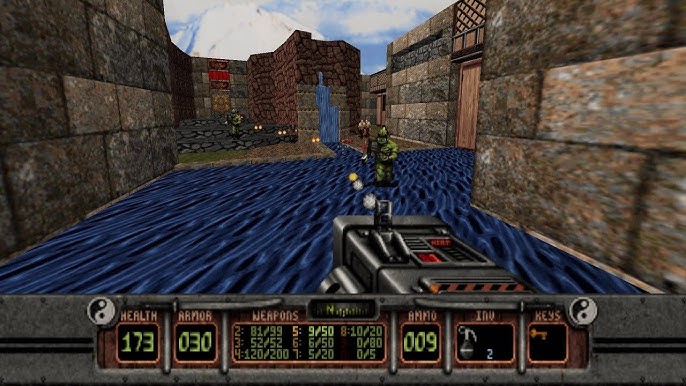
I am talking about the original DOS release here, the 1997 game, not the later Redux remaster and not the rebooted franchise that borrowed the name and ran off in a different direction wearing a new shirt. That distinction matters, because the original Shadow Warrior is very much a product of the Build engine era: dense, theatrical, technically clever in that very specific 1990s way, and occasionally so proud of its attitude that it forgets to earn all of it. The game stars Lo Wang, a Shadow Warrior with enough attitude to wallpaper a modestly sized casino, and it builds its appeal on gunplay, tongue-in-cheek humor, and a fantasy of hyperactive competence. The fantasy works often enough. The humor, well, the humor is a relic of a time when being rude was sometimes mistaken for being funny. That can be intoxicating, embarrassing, or both in the same minute.
A Build engine bruiser with a sales pitch
The historical pitch was simple enough: this was 3D Realms’ follow-up to Duke Nukem 3D, and they wanted to surpass it in features and gameplay. That is a bold claim, and one that always makes me chuckle a little when I remember how many games of the era confused louder marketing with stronger design. Still, the ambition is real. Shadow Warrior is trying to be an action playground with more edge, more weapon variety, more spectacle, more everything, and the Build engine remains a sturdy accomplice. It is one of those late-90s shooters that understands the pleasures of movement through space, of opening a level and immediately reading it as a dare. The game is singleplayer and multiplayer, though the sources I have do not give me enough to make grand declarations about the precise shape of the latter, so I will not pretend otherwise. What matters most is the way the game feels as a shooter in motion: brisk, aggressive, unapologetically arena-minded, and designed to keep you in a state of mild chaos.
There are 22 levels in the documented playthrough material, which is enough room for the game to explore its own jokes and obsessions without quite escaping them. And that is the key tension here. Shadow Warrior is not a game with a deep bag of structural tricks, at least not by the standards of the genre’s wildest experiments. It is a game that understands pace, atmosphere, and escalation, but it is also a game that often leans on the same broad pleasures: open a space, introduce hostility, let the player rough it up, repeat. When it is working, that loop is excellent. When it is merely functioning, it can feel like a very confident cousin of a better-known game making the same points with a different haircut.
The pleasure of swagger, the burden of resemblance
The problem with being a famous near-contemporary to Duke Nukem 3D is that people spend decades trying to decide whether you are a bold sibling or a copy wearing sunglasses. The answer is both, depending on the minute. There is a recurrent retrospective complaint, and it is not entirely wrong, that Shadow Warrior can feel like Duke Nukem 3D with an Asian coat of paint. That line is a little too glib, because it reduces the game to the joke packaging around it and ignores the fact that packaging is part of the whole trade in 1990s shooters. But the complaint lands because the game does trade heavily in attitude as differentiation. It wants to be remembered for Lo Wang’s persona, the cultural pastiche, the jokes, the wisecracks, the general sense that the game is trying very hard to be the rude one at the party.
Sometimes that works because the play itself is strong enough to carry the tone. A Build engine shooter lives or dies by the feel of traversal, the clarity of spaces, the speed at which a level communicates danger and opportunity. Shadow Warrior gets enough of that right to justify its confidence. It has the muscle memory appeal that makes old shooters dangerous to my productivity, the kind that nudges me toward saying, one more level, one more room, one more little burst of violent housekeeping. The best of it is not that it is revolutionary, but that it is sturdy, quick, and responsive in the ways these games need to be. The worst of it is that familiarity can become complacency. Once the novelty of the persona wears thin, you are left with the actual architecture of the game, and that architecture has to stand on its own.
That is where my affection becomes more cautious. I admire Shadow Warrior as a product of its ecosystem, as a late Build engine bruiser that knew exactly which buttons to press in 1997. I do not think it always does enough with that knowledge. Its personality is often so loud that it threatens to obscure the fact that, on a structural level, it sometimes behaves like a very polished echo. That is not nothing. In this genre, a polished echo can still be great fun. But it is not the same as originality, and the game knows it. You can feel the studio straining to outrun comparison even as the comparison keeps walking alongside it, hands in pockets, smirking.
What I can say, and what I cannot
One thing I will not do is invent mechanics the research does not securely support. The detailed sources here are solid on the broad strokes, but thin on the minute-by-minute systems, which means I am not going to start hallucinating weapon rosters or save systems just to sound authoritative. What can be said with confidence is that this is a Build engine FPS, that it is built around first-person combat, and that it was significant enough to merit shareware release, retail release, later source code release under GPL, and eventual life as a free classic on modern storefronts. It has also had source ports in the wild for years, and modern access often comes through DOSBox wrappers or community ports rather than some pristine native museum piece. That is how a lot of these games survive, really: as half-remembered treasures, half-maintained infrastructure, and half excuse to let old trouble run on contemporary machines.
That last part matters because it changes the experience. Playing the original Shadow Warrior today is not just a matter of absorbing a 1997 design artifact, it is also a matter of deciding how much wrapper you want around it. The Steam and GOG releases are pre-packaged with DOSBox, which is sensible and unromantic in the best possible way. They preserve the game without pretending it no longer needs a caretaker. That feels appropriate for Shadow Warrior, a game that is full of bravado but fundamentally reliant on the technical scaffolding of its era. Build engine shooters often live in that space between elegance and machinery, and this one is no exception. You are not here for invisible systems. You are here because the machine still makes a satisfying racket.
Mood, texture, and the era it crawled out of
What I remember most clearly from games of this type is not their plots, which were usually a decorative excuse to unlock the next room, but their texture: the way a corridor looks when it has been designed by somebody who wants you to feel clever for surviving it, the way a sound effect can make a simple shot feel like an act of minor vandalism, the way a joke lands differently when the game is already moving on. The available research does not give me a sturdy basis to talk about specific audio design or visual tricks in detail, so I will stay disciplined. But as a broader matter, Shadow Warrior belongs to that late Build engine period where these shooters were both technically mature and culturally restless. They had learned how to make spaces feel larger than their technology should allow. They had also learned how to deliver attitude at a dead sprint.
That combination is the game’s real selling point. Not the parody, not the edginess, not even the historical baggage, but the sense that this is a machine built to keep pushing. It is still a 1990s shooter, which means it is liable to inherit the genre’s occasional structural bluntness, its habit of confusing accumulation for depth, its reliance on a certain rhythm of escalation that can, after enough rooms, feel like being trapped in a very confident gymnasium. Yet when it gets the tempo right, the game has that delicious old-FPS friction: you are always a little under siege, always one quick reflex away from recovering control of the room, always bouncing between precision and panic. That is the drug. Everything else is garnish, some of it tasty, some of it deeply corny, and some of it probably deserved an editorial intervention.
The game also has the odd distinction of being one of the last significant Build engine shooters of the decade, which is a useful historical marker but not a quality guarantee. I mention it because it explains why the game feels at once polished and exhausted. The technology had been pushed far enough that craftsmanship could no longer hide behind novelty. These games had to earn their keep by being fun in rooms full of obvious ancestors. Shadow Warrior mostly manages that, but not elegantly. It is more like a loud bar argument that accidentally becomes persuasive halfway through. There is conviction, there is pace, there is enough invention to keep me from writing it off as a mere reskin. But there is also the sense that 3D Realms knew exactly how to sell this flavor of excess and maybe trusted that confidence a touch too much.
Why it still matters, and why it does not
So what, exactly, is the final verdict on original Shadow Warrior? I think it is a good game with a swaggering face and a familiar skeleton, a shooter that can still entertain if you are willing to meet it on its own loud terms. It is not a masterpiece hiding in plain sight, and it is not one of those rediscovered oddities that turns out to have been unjustly slandered by history. The reputation is partly earned, partly inflated by nostalgia, and partly preserved by the fact that there is still genuine energy in the thing. It deserves attention as a major Build engine-era release and as a game that captures the industry’s late-90s appetite for excess better than many of its contemporaries. It does not deserve automatic sainthood.
Who is it for? Anyone who likes old-school shooters that move fast, talk trash, and trust momentum to do a lot of the heavy lifting. Who is it not for? Players who need their humor to age gracefully, who want obvious originality over iterative excellence, or who mistake historical importance for guaranteed pleasure. Does it deserve its reputation? Mostly, yes, though I would trim the mythmaking around it and leave the actual game standing on its own feet. Do its strengths outweigh its flaws? They do, just enough. Shadow Warrior is not the cleaner, smarter, or more elegantly balanced version of the Build-engine party, but it is one of the rowdier guests, and in 1997 that counted for a lot. It still counts for something now, even if I reserve the right to roll my eyes while enjoying myself.
Score: 7/10