Raiden II is what happens when a shoot ’em up looks at the original Raiden, nods politely, and then comes back with more enemies, more spectacle, and a much meaner grin. On paper, that sounds like the ideal sequel strategy: keep the core loop, turn up the heat, make the screen feel busier and more dangerous, and trust that players who liked the first game will enjoy being shoved one step closer to humiliation. In practice, it is a very specific kind of arcade sequel, one that knows exactly how to sharpen the formula without reinventing it, and one that also knows it can get away with a little brutality because the cabinet, the coin slot, and the pride of the player will do most of the motivational work.
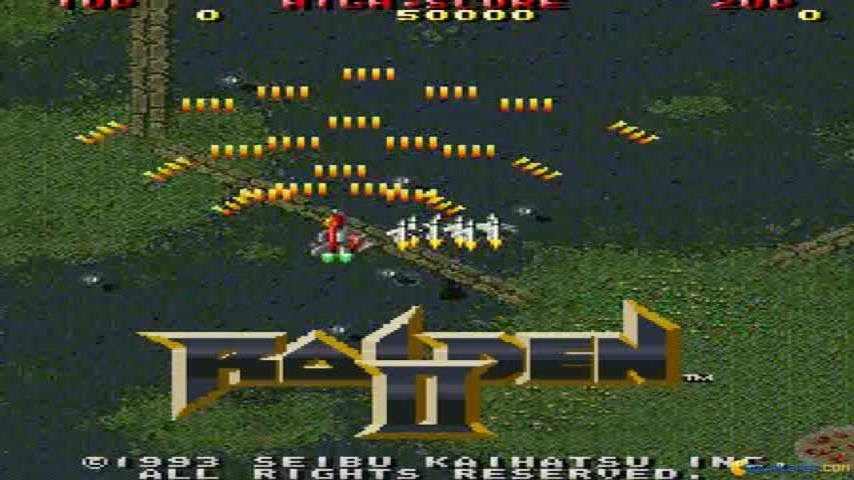
I am mostly writing here about the 1993 arcade original, because that is the version the record supports most strongly. There is also a PC port, and the available material suggests it exists in a more lightly documented, somewhat lesser form, but the exact release date for that PC version is not firmly pinned down in the sources I have. So, yes, I am staying on the safest ground: the arcade game, the thing Seibu Kaihatsu actually built to eat quarters and moods.
The simple pleasure of surviving a screen that hates you
At its heart, Raiden II is a vertical scrolling shoot ’em up in the most classical sense. You pilot the Fighting Thunder aircraft, move through waves of enemies, grab power-ups, and try not to become a tiny explosion in the middle of all the other, prettier explosions. That sounds plain because it is plain, but plain does not mean bland. The genre lives or dies on rhythm, on how well it teaches your hands to cooperate with your panic, and Raiden II understands that old arcade truth: good shmups do not merely challenge you, they seduce you into believing you can master the chaos right before the game politely proves otherwise.
The basic weapon structure is straightforward, with three weapon types identified in the research as red, blue, and purple. That already tells you the sort of game this is, because the color coding does a lot of the work that a modern action game might outsource to menus, skill trees, and seventeen tabs of explanation. You learn through contact. You experiment because the screen will not stop to mentor you. The player two setup even gives one pilot yellow cluster bombs while player one gets red nukes, which is exactly the kind of asymmetrical arcade nonsense I can admire because it is specific, memorable, and slightly theatrical. Not balanced in a contemporary spreadsheet sense, perhaps, but arcade games were never supposed to feel like an accountant’s apology.
What Raiden II does especially well is escalation. The research consistently points to denser enemy waves and more difficult modes bringing in more and nastier opposition, and that is the correct instinct for a sequel like this. You do not want a shmup sequel to be serene. Serenity is for loading screens and tea ceremonies. This game wants pressure. It wants the player to be dragged forward through multiple levels as the screen fills with hostile craft, ground targets, and the general suggestion that staying alive is a hobby for people with better reflexes than yours.
More of the formula, but tuned with a nasty little hand
This is not a radical reinvention of the Raiden template. If you come in hoping for some miraculous genre pivot, some surreal detour into experimental mechanics, you will not find it here. Seibu Kaihatsu clearly understood the value of continuity, and the sequel keeps the core formula intact while making it feel more intense and, in many places, more polished. That is both the game’s main virtue and the reason it can seem a little conservative if you are looking at it with the jaundiced eye of someone who has already seen too many sequels promise revolution and then quietly deliver a new coat of paint.
But paint matters when the paint is good. The available descriptions emphasize detailed backgrounds, explosions, and debris, along with a visual presentation that carries 2D art with some 3D traits. That is a very early-90s arcade pleasure in itself, the era when developers kept pushing the illusion of depth and motion without pretending they had the luxury of modern hardware theatre. The result, when it works, is a screen that feels alive rather than merely busy. Explosions are not just decorative, they are punctuation. Debris is not just clutter, it is part of the game telling you that your assault landed, or that your poor judgment did.
I would not oversell the leap from the first Raiden, because the research is careful about this too. The sequel is described as a marginal improvement in some respects rather than a wholesale reinvention, and that sounds right. It is not the sort of sequel that makes the original feel obsolete overnight. It is the sort that makes the original feel a little more embryonic, a little less fully dressed, which in arcade terms is a respectable achievement. You can feel the team trying to make the same machine hit harder, and that effort gives the game its character.
Sound, pressure, and the arcade need to shout back
The soundtrack gets described as new and less repetitive than the first game, which is a small sentence carrying a lot of weight. Shmups are fragile things in audio terms. A weak soundtrack can make a great one feel like a homework assignment, and a repetitive soundtrack can turn a difficult stage into a permanent migraine. Raiden II appears to avoid that trap better than its predecessor, or at least to do enough to keep the player’s attention from sliding off the cabinet and onto the nearby machine with the flashing attract mode.
That matters because this kind of game asks the player to inhabit a loop of concentration, not narrative. The mood is one of constant, elevated tension. You are not exploring. You are not role-playing. You are not collecting emotional arcs in a little basket. You are steering a plane through an argument. The better the audio and visual feedback, the more convincing the argument becomes, and this game seems to know that the chaos has to be legible as well as aggressive. The explosions have to read. The enemy patterns have to feel purposeful even when they are trying to murder you. The score-chasing brain and the survival brain have to work together, or the whole thing collapses into soup.
What it gets right, and why it still matters
The strongest thing about Raiden II is that it understands arcade escalation as a form of grammar. It is not just piling up enemies because more is more. It is arranging pressure so that every new stage feels like a slightly nastier sentence in the same language. Higher difficulties do not merely inflate enemy counts, they add challenge in a way that suits the genre’s addiction to mastery. This is crucial. A good shmup should make you feel like you are learning to read a dangerous dialect, and Raiden II seems very good at speaking in that tongue.
I also appreciate that the game does not try to fake personality through gimmicks. Its identity comes from execution, from the timing of threats, from the neatness of the projectile patterns, from the visual discipline of backgrounds and explosions doing their job without drowning the action. In 1993, that was enough to put a game near the top of the Japanese arcade charts in early 1994, according to the research. That is not an incidental success. That is the market saying, in its blunt coin-fed language, that the machine worked. And arcades, for all their mythology, were never sentimental about failures. If people were feeding the cabinet, it meant the loop was good enough to justify another coin and another mistake.
The game also benefits from the fact that it is clearly not trying to be bigger in the modern, bloated sense. It is bigger in the way a sequel should be bigger: more intensity, more variety, more confidence, less hesitation. If the first game was the proof of concept, Raiden II is the version that actually wants to be looked at by a crowd.
What keeps it from sainthood
Of course, being a disciplined sequel does not make something a miracle. The same qualities that give Raiden II its clarity also limit it. It is still very much a traditional vertical shooter, and if you do not already have some appetite for that structure, the game will not convert you with charm alone. Its pleasures are direct, not decorative. It is about managing threats, reading screens, and surviving the onslaught. That is enough for me, but I have spent too many years with this genre not to recognize that some players will bounce off it the way a badly aimed bullet bounces off a boss’s armor.
There is also the old sequel problem of refinement without revelation. The research keeps pointing to improvements over the original, but not a dramatic break. So my judgment has to stay honest: this is a strong follow-up, not an epochal reinvention. If you wanted the sequel to tear the rulebook in half and set the scraps on fire, this is not your machine. If you wanted a better-armed, better-looking, better-paced version of a proven formula, it lands much more convincingly.
And I should not pretend the documentation is richer than it is. Some version details remain fuzzy, especially around the PC release, and the source material does not support elaborate claims about exact port behavior, control feel, or technical quirks. That absence matters, because it means the cleanest and most reliable picture of Raiden II remains the arcade one. This is a game whose reputation is built on the cabinet, the screen, the rhythm, and the quarter-eating temperament of 1993 arcade design. Anything beyond that is where the record starts to thin out and the confident essays begin making up for missing evidence with personality. I have personality, but I do not need to lie with it.
Verdict
Raiden II is for players who want a straight, hard, expertly managed vertical shmup that respects the old arcade contract: learn quickly, fail loudly, improve grudgingly, and enjoy the fireworks if you can spare the attention. It is not for anyone who needs sprawling systems, generous tutorialization, or a game that confuses itself with a lifestyle. Its reputation is deserved, though I would phrase that carefully. Deserved as a serious, effective sequel, yes. Deserved as some sacred monument that floats above criticism, no. The game earns admiration because it knows what it is and executes it with enough style, pressure, and mechanical clarity to make the repetition feel disciplined rather than lazy.
Its strengths outweigh its flaws. It is not revolutionary, but it is confident, energetic, and hard enough to matter. The arcade original is the real deal here, and even with the usual home-port caveats hovering in the background, the core design still speaks clearly: better than the first in some useful ways, less repetitive in sound, more intense in feel, and still perfectly happy to blast you apart for hesitating half a second too long. Which, honestly, is exactly what I want from a sequel that dresses itself in bomber pilot bravado and comes armed with a screen full of consequences.
Score: 8/10