Quake II is the kind of sequel that arrives wearing a hard face and pretending not to care what anyone thought of the first one. The 1997 Windows 95 original, from id Software and published by Activision, is less a simple follow-up than a statement of technical intent: no MS-DOS, native OpenGL support, client/server multiplayer, and a future-shock metallic war against the Strogg on Stroggos. In other words, it is a game that looked at the mid-90s PC shooter boom and said, quite coldly, yes, but make it shinier and meaner.
That is the promise, anyway. The reality is a little messier, and more interesting for it. Quake II is not one of those games whose reputation can be justified entirely by historic significance, sales charts, or the general awe of people who remember installing graphics drivers like they were defusing bombs. It matters because it was part of id Software’s transition into the Windows era, because it was their first game not to live on MS-DOS, because it sold well enough to matter commercially in the US in 1997, and because it helped lock in the vocabulary of late-90s PC shooters. But importance is not playability, and playability is not holiness. A game can be influential and still feel like it was assembled by engineers who were having a very different kind of fun than you were.
A machine with a war in it
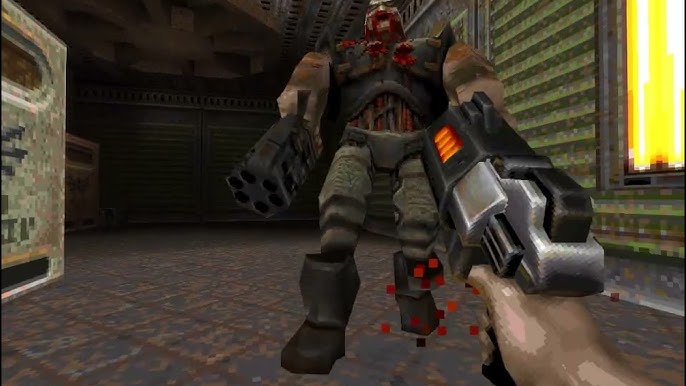
The most striking thing about Quake II, even at arm’s length, is how deliberate it seems about being an object of technology. The research points to native OpenGL support at release, to .md2 model files, .pak archives, and the sort of asset packaging that tells you the machine matters as much as the monster. This is not a fuzzy artisan’s sketchbook of a game. It is a system. It has the air of a product designed by people who understood that by 1997, the PC shooter audience wanted more than just speed and gore, it wanted proof that the future had arrived and that its accelerator card was invited to the party.
And yes, the future here is all industrial surfaces and alien militarism, the human invasion of Stroggos against the Strogg, which gives the whole thing a brute-force narrative clarity. There is no whimsy in the setup, no suggestion that anyone involved was trying to charm you. The mood is all steel, containment, machinery, and hostile architecture. It is a sequel that took the name Quake and then immediately tried to grow a chinstrap beard.
The beautiful coldness of new hardware bragging
What Quake II does well, and what still makes it worth thinking about, is transform technical prestige into atmosphere. The native OpenGL support was not just a feature checkbox, it was part of the pitch, part of the identity. This was a game saying, with all the confidence of a company that knew people would line up to watch polygons, that software could look like a future you had to purchase. In the context of 1997, that mattered enormously. I remember the era as one long argument between aspiration and compatibility, between the dream of smooth real-time 3D and the grim practicalities of getting your drivers to behave. Quake II sits right in the middle of that argument, smugly clean and a little expensive-looking.
It also helps that id Software was not some brand-new outfit trying to bluff its way through the transition. This was the studio that had already made itself synonymous with the PC shooter, now moving into a more mature, more standardized hardware world. Quake II was, according to the research, developed by a 13-person team over about a year. That is a tiny amount of human labor for a game that ended up carrying so much technological and commercial weight. If there is a conspiracy here, it is simply this: the industry has always preferred to dress engineering work in heroic mythology so that nobody notices how many exhausted people it actually takes.
The result is a game that feels less handmade than engineered, but not in the sterile sense. More like an industrial instrument. That can be a virtue. It can also leave me cold in the way certain immaculate machines leave me cold, the way a showroom sports car does when all I want is a scarred old hatchback with actual personality. Quake II has confidence, but not much warmth. It has the hard sheen of something built to impress, and it does impress. The question is whether it seduces after the first look.
What it is not
Let me do the honest thing and avoid the fake certainty that often ruins retro criticism. I am not going to pretend I can recite its exact internal rhythms from this material alone. I am not going to invent a beloved quirk, a secret route, or a tiny system that I have no business claiming as fact. There is enough real texture here without me turning into a man in a tie explaining a game he only half-remembers.
What I can say is that Quake II’s place in the lineage is meaningful precisely because it shifts the tone of id’s work toward a more overtly industrial and militarized science-fiction identity, while also marking a technological break from the company’s MS-DOS past. It was the first id Software game not on MS-DOS. That detail might sound like one for museum placards, but it is actually the sort of thing that changes how a game feels. A new platform philosophy has a way of changing the soul of a project, even when everyone involved insists they are only talking about hardware.
And then there is the matter of its historical performance. Quake II sold 240,913 copies in the US by the end of 1997, reached #2 on the monthly sales chart for December 1997, and placed #22 for the year. Those are not just trivia numbers, they are evidence that the thing landed. It was not a niche act of technical one-upmanship, it was a real commercial event. The market looked at this metal corridor of a shooter and said yes, more of that, please, preferably with a graphics card attached.
The strange dignity of being a transitional object
Sequels often have the hardest job in games because they must satisfy both memory and appetite. Quake II had to follow Quake, carry the name, and still justify its own existence. That it became the second installment in the series matters, because the title itself carries expectations of speed, abstraction, and aggression. Instead of pretending to be a mere extension, Quake II feels like a recalibration. It is less mythic than Quake in reputation, more overtly technological, more visibly tied to the present tense of PC hardware culture.
This is why I find it interesting even when I am not wholly in love with it. It is a transitional object in the best and worst sense. It captures a moment when id Software was adapting to the reality that PC gaming was no longer just a DOS preserve, and when the whole medium was beginning to reorganize itself around acceleration, drivers, and 3D APIs. Quake II is part game, part proof of concept, part marketing demonstration, and part durable action title. That mix can feel exhilarating or slightly disingenuous depending on your mood. Sometimes both at once.
The source material also hints at the strange afterlife of these assets. There is a demo file, q2-314-demo-x86.exe, which later surfaced on Steam before being removed, and there is the Quake II Complete archive release. The source code was public domain by 2004, which explains why the game continued to matter to modders and researchers long after the retail moment had passed. That sort of afterlife is typical of important PC games, but Quake II’s case feels especially apt: a game so tied to system architecture that it naturally becomes a machine people keep reopening to see how it works.
My verdict, with no polite smiling
So where do I land? Respect first, affection second, reservation third. Quake II deserves its reputation as a major 1997 shooter and as a milestone in id Software’s history. It also deserves credit for doing something many supposedly smarter sequels fail to do, which is identify the era it belongs to and commit to it without embarrassment. The metallic alien-war aesthetic, the native OpenGL debut, the move away from MS-DOS, the networked structure, the commercial success, all of it adds up to a game that understood what the PC audience was becoming and aimed straight at that future with an engineer’s grin. But I would not call it an automatic all-timer on reputation alone. The research available here does not support a myth of total elegance, and I am not inclined to manufacture one. Quake II looks like a machine built to perform authority, and sometimes that is thrilling. Sometimes it is just a little joyless, the way so many technologically proud games can be when they confuse crispness for character. If you want a landmark of late-90s shooter design culture, this is essential. If you want warmth, surprise, or a game that feels like it was made by people delighted to be silly in public, you may find the steel too clean for comfort.
In the end, Quake II is for players who appreciate a first-person shooter as a piece of technical and cultural history, and who do not mind that history occasionally wearing a hard hat and talking in a monotone. It is not for anyone looking for airy charm or a loose, improvisational spirit. Its reputation is deserved, yes, but in the specific way a forged steel beam is deserved: because it holds up, because it changed the shape of the building, and because you can still feel the weight of the thing when you stand underneath it. Its strengths outweigh its flaws, though not by the landslide its legend sometimes suggests. It is a fine, important, sometimes icy beast, and I remain fond of it even when I catch myself longing for a little more mess in the machinery.
Score: 8/10