Panzer General II is the kind of wargame that looks, from a safe distance, like it should be cold, clinical, and a little smug about its own seriousness. Instead, it turns out to be a game about appetite, momentum, and the terrible pleasure of nudging a line of tanks, infantry, and artillery into just the right shape so the enemy collapses like a folding chair. This is the original 1997 Windows PC release I am talking about here, because with old strategy games the version matters, and the paper trail on this one is messy enough that I am not going to pretend otherwise. The release date itself is even a little argumentative, with sources pointing to September 22, October 15, and archival metadata later still. That sort of bureaucratic static feels oddly appropriate for a game whose entire appeal is the conversion of historical mud into something satisfyingly legible.
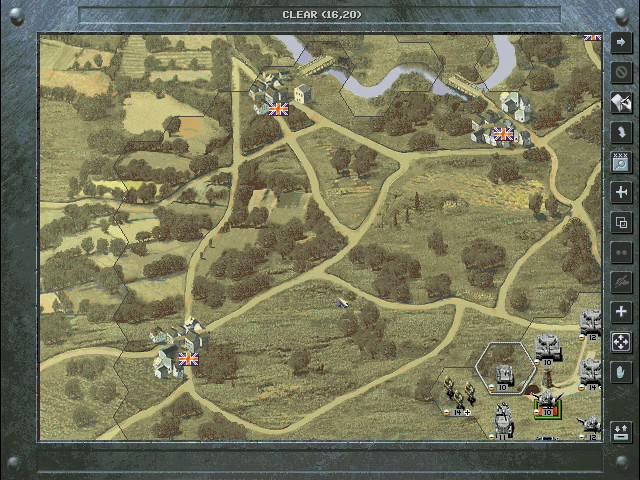
And yes, it is legible. That is the first thing I respect about it. Panzer General II is not interested in drowning you in the sort of faux-realism that makes some wargames feel like filing taxes in a bunker. It wants you to understand a battlefield as a system of pressures and choices. The research here is annoyingly thin on exact mechanics, so I am not going to invent phase structures, visibility rules, or stat formulas just because my reviewer instincts itch for certainty. What is clearly established is the broad shape: turn-based, top-down, combined-arms warfare, with infantry, artillery, and tanks all part of the same ugly little machine. That alone tells you a lot. This is a game where the joy is not in singular heroics but in the arrangement of force, in making one unit cover another, in turning an attack into a little demolition project rather than a fistfight.
The series pedigree matters here because Panzer General II is not arriving out of nowhere, pretending to invent the wheel and asking for applause. It is the sixth SSI Panzer General title, and the first entry in the so-called Living Battlefield subseries. That sounds like something a marketing department would engrave onto a brass plaque and mount in a lobby, but in practice it suggests a game trying to stay alive by keeping the war in motion instead of embalming it. The campaign structure is real enough, with references to a German long campaign, and the scenario range stretches from the Spanish Civil War in 1938 through hypothetical 1946 battles. Which is a deliciously audacious bit of historical permission. You start in the dirt of the late 1930s and then the game gives itself leave to ask, in effect, what if the war had continued to evolve into stranger machinery and later desperation? That kind of setup is catnip to a strategist and cat litter to a pure historian, which is to say it is exactly the sort of compromise a commercial wargame makes when it wants both plausibility and toys.
The pleasure of the push
What Panzer General II understands, better than many of its descendants and a distressing number of its peers, is that tactical war games live or die on friction. Not realism, not complexity for its own sake, friction. The good kind, the kind that makes every move feel like it has weight. The research confirms a combined-arms emphasis and user discussion points toward artillery and coordinated attacks being viable, which is exactly the sort of thing that turns a battlefield from a math exercise into a little chain of threats. You do not merely drive tanks at people and hope for a patriotic miracle. You shape the engagement. You soften, pin, probe, and then exploit. If that sounds like war as chess, well, yes, but with mud on the board and someone yelling about ammunition.
That is where the game earns its reputation. It is not just that units have roles, it is that the game seems to want you to think in terms of complements rather than favorites. The artillery is not there as a decorative afterthought. Infantry is not there to be stepped over by glamorous armor. The whole appeal is in the mix. This is the sort of design that can make a player feel clever for noticing a simple fact, and there is a real generosity in that. Too many strategy games assume the player wants to be punished for curiosity. Panzer General II appears to reward the opposite, or at least it does not seem to resent you for trying to make the map obey a human plan.
That said, the game is still a wargame from the era when clarity often wore a stern face and called itself depth. There is a reason these things inspire devoted little cults of people who can talk about frontage, attrition, and force composition as if they are discussing the stock market. The appeal is obvious once you are in it, but the barrier is also obvious: if you do not enjoy studying the shape of a fight before you start moving pieces, this is going to feel less like command and more like homework in a military academy where nobody smiles. I do not say that as an insult. I say it because the game knows exactly what sort of brain it is feeding.
Historical strategy, genre theatrics
There is also the matter of tone, which matters more in these games than their defenders sometimes admit. A good wargame can be dry without being dead. Panzer General II sits in that productive middle zone where the subject matter is grim, the interface is presumably businesslike, and yet the entire enterprise has that slightly gaudy computer-game shimmer of the 1990s, when even serious simulations still wanted to be the cool poster on the wall rather than the binder in the drawer. The research I have here does not give me a reliable technical autopsy of the visuals or sound, so I am not going to hallucinate VGA nostalgia like a fool inhaling from an old magazine rack. But the game clearly occupied that era of top-down military readability, where the map had to tell the story and the player had to love scanning it.
What keeps this from feeling like pure abstraction is the scenario framing. Moving from the Spanish Civil War into a hypothetical 1946 gives the game an arc that is both historical and speculative. It is a clever trick, really. The early material anchors the fantasy in recognizable conflict, while the later material lets the game indulge in escalation and alternate-path machinery without having to apologize for being a little toyish. I have a soft spot for this kind of structure because it admits the secret truth of most war games: they are not museums. They are argument machines. They ask what would happen if one doctrine met another, if one supply chain outlasted another, if one commander had more artillery and a better plan. The historical shell gives the speculation enough weight that it does not float away.
That is probably part of why the game was well regarded in its day. The contemporary reception noted in the research is strong enough to matter, with PC Gamer US naming it the best computer wargame of 1997 and Computer Gaming World placing it as runner-up for wargame game of the year. Those are not tiny honors handed out by a sleepy committee at the back of a banquet hall. They suggest a game that landed with authority among the people most likely to notice whether it had the goods. And from the evidence at hand, it did. Not because it was flashy, but because it had a coherent tactical grammar and the confidence to stick to it.
Where it starts to show the screws
Still, I am not going to romanticize the thing into sainthood. This is an old tactical wargame, which means some of its virtues may also be its limitations depending on what kind of player you are. The available research does not document all the mechanical specifics, but it does make one thing plain: this is a game built around a fairly defined tactical framework, not a sprawling sandbox. That gives it focus, which is good, but focus can harden into repetition if the scenarios do not keep forcing meaningful decisions. I cannot responsibly claim exactly how often that happens in this specific release, because the source material here does not give me enough to pretend otherwise. But I can say that the structure invites a familiar risk, the risk of a system becoming elegant enough that the player starts seeing the seams.
That is the old problem with many respected strategy games. Once you understand the engine, you can begin to feel the engine. Sometimes that is the magic, sometimes it is the crack in the wall. If the campaign and scenarios keep throwing interesting configurations at you, the game stays vital. If not, the player is left admiring a very competent machine while waiting for it to surprise them again. The research hints at a long German campaign, which suggests the game does have enough content to lean on, but I am not going to overclaim variety that I have not verified. The safe and honest reading is that Panzer General II seems built for sustained tactical engagement, and whether that becomes thrilling or merely dutiful depends on your tolerance for solving battlefield puzzles for their own sake.
Another limit, which is less about the game than about the documented record, is that there is very little reliable detail here on interface texture, audiovisual presentation, hardware demands, or later compatibility. There is a Steam listing, but the provided sources do not give me enough to talk sensibly about that version as if it were the same object. So if you are hoping for a forensic comparison of editions, I cannot honestly give it to you. What I can say is that the original 1997 Windows release is the one supported by the research, and that the regional title differences, Panzer General IIID in Germany and Operation Panzer in France, are documented as naming differences rather than confirmed mechanical divergences. Which is probably the right level of caution for a game from an era when regional cataloguing often feels like it was done by three different offices and a sandwich.
The verdict, with no saluting
Panzer General II deserves respect because it knows what it is: a compact, intelligent combined-arms wargame that values readable tactical pressure over theatrical noise. It is not trying to be everything, and that restraint is one of its best qualities. When it works, it gives the player the deeply satisfying sensation of having made a battlefield behave, of having turned chaos into sequence through a handful of clean decisions. That is not a small achievement. Plenty of strategy games drown in their own ambition and never reach this level of clarity.
But the praise comes with asterisks, and not the decorative sort. The game’s exact mechanics are not fully documented in the material I was given, so I am not going to embellish them into legend. More importantly, the very thing that makes it appealing to wargame people, the disciplined tactical structure, may make it feel narrow or relentlessly managerial to anyone who wants richer systems, more dramatic presentation, or the kind of strategic spectacle that blurs into fantasy. This is not a game for the player who wants their war to come with fireworks and handholding. It is for the player who gets pleasure from positioning, from combined arms, from seeing a plan survive contact with the map because the plan was actually decent.
Does it deserve its reputation? Yes, on the evidence available, it does. Not because it is mythic, not because it is untouchable, but because it seems to have done the hard thing well: making a serious tactical war game that was actually worth playing, not merely worth respecting. Its strengths outweigh its flaws if your idea of fun includes patience, pattern recognition, and the slightly unhealthy thrill of arranging destruction with a ruler-straight mind. If you want immediacy, drama, or a system that seduces rather than instructs, look elsewhere. If you want a smart, stern, occasionally glorious 1997 wargame that knows how to make steel look like thought, this one still has business to attend to.
Score: 8/10