Little Big Adventure 2 is one of those late-’90s PC adventures that looks, from a safe distance, like a charming oddity and, up close, like a charming oddity that was absolutely determined to make you work for it. It is a bright, story-driven 3D action-adventure about Twinsen wandering through a world that keeps escalating from local mystery to planetary nonsense to full-blown space opera, and it has the exact kind of personality that made magazine writers in the era either swoon or start sharpening their knives. Me, I land somewhere in the middle, with affection in one hand and a complaint ledger in the other.
For this review, I am talking about the original 1997 PC release, the one that appeared in Europe as Little Big Adventure 2 and in North America as Twinsen’s Odyssey. The naming split matters mostly as a reminder that this was a real boxed-PC artifact of its time, not a neat modern reissue designed to flatter you. It came out on MS-DOS and Windows 95 PCs, and it feels like a game built right at that awkward historical hinge where adventure design had ambitions, 3D had novelty, and control schemes were still being invented by people who had not yet been forced to apologize for them.
A sequel with a brighter coat of paint and the same deliciously stubborn bones
The premise is simple enough to mock and sturdy enough to carry the whole thing. Twinsen, returning from the first game, is now pulled into a new crisis after a seemingly friendly alien visit starts revealing much less friendly intentions. From there the game stretches outward, first across Twinsun, then into larger, stranger spaces. That escalation is one of its better tricks. It does not just enlarge the map, it enlarges the feeling of the story. The early stretches keep you grounded in towns, islands, and local problem-solving, while later material pushes toward alien and space-set conflict without completely abandoning the eccentric domesticity that gives the world its flavor.
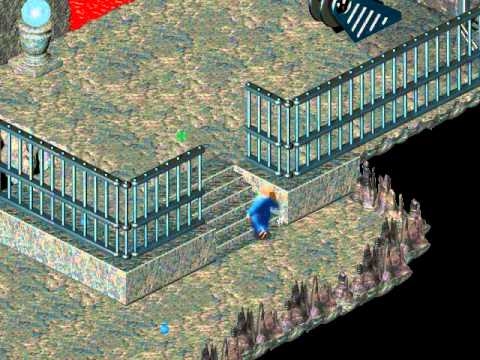
That flavor matters. Little Big Adventure 2 is not a grim, dour quest for salvation. It is whimsical in the old European PC way, where imagination is abundant but manners are slightly off, like a children’s book illustrated by somebody who also knew how to solder. The game is bright, stylized, and often genuinely lovely to look at, with cartoonish characters moving through low-poly 3D spaces under fixed or semi-fixed camera angles. It has the confidence of a game that knows it is strange and assumes that should be enough. Sometimes, to be fair, it almost is.
How it plays, and how often it asks you to wrestle the camera like a swamp creature
Structurally, this is a 3D action-adventure with exploration, light puzzle-solving, dialogue, and real-time combat. That sounds clean on paper, which is how these things always start before the input scheme arrives and starts a small fire. Twinsen moves through environments with keyboard controls, talks to NPCs, opens containers, flips switches, uses items, and fights in real time. A magic-ball style projectile is part of the arsenal, and it can ricochet around the environment, which is the sort of thing that feels wonderfully clever right up until a room geometry decides to betray you. There is also evidence, in gameplay footage, of the familiar behavior-mode idea inherited from the first game, but the exact labels and mechanics are not firmly documented in the material I have, so I am not going to invent a confident little taxonomy just to sound learned. Some things ought to remain partially mysterious. Some things are merely under-documented because old PC games were not built for posterity, only for shipping.
The real truth of Little Big Adventure 2 is that it wants you to think like a wanderer and play like one too. You are not blasting through discrete levels so much as threading through connected spaces, talking to people, hunting for access, learning where the game will let you go, then circling back once the next story beat has opened a door somewhere else. This gives the whole thing a pleasant sense of journey, especially when the world keeps widening, but it also means the pacing depends heavily on whether you enjoy backtracking through fixed-camera spaces while the game withholds the exact next nudge. I do, to a point. I have a weakness for games that make the world feel like a place rather than a sequence of test chambers. But there is a line between organic structure and administrative wandering, and Little Big Adventure 2 occasionally blurs it with the enthusiasm of a child smearing jam across a tablecloth.
Combat is real-time and serviceable, which is not faint praise in this era. Serviceable is often the highest ceiling a mid-’90s action-adventure reached before tripping over its own feet. Twinsen can strike in melee and use his projectile attack, and the game gives enough physicality to encounters that they feel like more than menu-driven errands. But the controls and camera are very much of their era, and if you have the memory of an arcade rat, as I do, there is a particular kind of irritation this produces: the irritation of knowing exactly what you want to do and feeling the game translate that intention through a bureaucratic middleman. It is not broken, precisely. It is just old enough to make every turn, jump, and angle adjustment feel like a negotiation.
That awkwardness is not a footnote, it is part of the experience. PC Gamer’s retrospective called out the clunky, awkward ’90s feel, and yes, absolutely, that is the right diagnosis. The game is charming in motion, but its motion is not always charming. There is a difference. The fixed viewpoints help the world look distinctive, but they can also make navigation a little like moving furniture through a narrow hallway while someone keeps changing the hallway. This was a common design compromise of the time, of course, but common does not mean excused. A game can be historically understandable and still mildly infuriating in the present tense.
The sweet spot, where the game remembers to be an adventure first
Where Little Big Adventure 2 excels is in the union of mood and motion. The best moments are not the ones where you are technically performing at maximum efficiency, but the ones where you are drifting through a strange little civilization, listening, rerouting, taking in the architecture, and slowly understanding how the world holds itself together. The game likes environmental interaction. It likes NPC chatter. It likes puzzles that emerge from spaces rather than from abstract logic grids. That suits it. It gives the whole adventure a tactile, hand-built quality, even when the 3D tech itself is showing every seam and low-resolution shortcut.
The story, too, has enough momentum to keep you moving. It starts with a mystery, widens into conspiracy, and eventually swells into something much larger, which is exactly the kind of escalation that an action-adventure with a talkative world needs. Twinsen is a good anchor for it all, too, because he is not a generic heroic slab of pixels. He belongs to a specific sort of ’90s protagonist, earnest and a little odd, not quite winking at the player but aware enough to feel human. The result is a tone that sits somewhere between fairy tale, Saturday-morning adventure, and imported European comic strip. That is catnip to me when it works.
And yes, it often works. There is a sincerity here that keeps the game from collapsing under its own quaintness. Too many contemporary adventure games mistake whimsy for a personality transplant. Little Big Adventure 2 actually has a world with social texture, even if the footage and surviving documentation only sketch the specifics. It feels lived in. It feels like people, creatures, and institutions exist off-screen and the player has wandered into a place that was already busy before the interface asked for attention. That is a real achievement, especially in a 1997 PC game whose ambitions were clearly larger than its hardware-era grace.
The problem, because there is always a problem, and this one wears a fixed camera
The compromise is that the same qualities that make the game distinctive also keep it from becoming effortless fun. Every late-’90s 3D adventure had to decide how much friction it wanted between the player’s intention and the avatar’s obedience. Little Big Adventure 2 does not exactly choose friction, but it certainly does not flee from it. The result is a game that can feel endearingly handmade one minute and needlessly stubborn the next. Movement, camera framing, and interaction all carry that faint sense of being mediated by systems that were not yet elegant enough to disappear.
That matters more here than in a straight platformer or shooter because the game keeps asking you to observe, traverse, and solve rather than simply overpower. If the camera or controls stumble, the whole structure wobbles with them. I would not call this a disaster, because a disaster is a game that stops you from appreciating it at all. Little Big Adventure 2 is more annoying than disastrous. There is a difference, and a subtle one at that. Annoying games can still be good. They can even be great, if their ideas are sharp enough. This one is good, sometimes very good, but never so nimble that you forget the era’s hardware and interface limitations were doing battle with the design at every turn.
The saving and options side of the game is less clearly documented in the material I am using, beyond the obvious presence of menu functionality in gameplay footage. So I will not pretend precision where the record is muddy. What I can say is that the game’s interface feels like the kind of mid-’90s PC setup where you expected configuration to live in a separate administrative dimension, and that alone tells you something. These games were often built by teams trying to make 3D adventures feel accessible before anyone had worked out a satisfying common language for doing so. Little Big Adventure 2 is caught in that weather system, and it wears the drizzle.
Presentation, sound, and the peculiar luxury of earnestness
Visually, the game is a pleasure in the way old PC art often is: not because it is polished by modern standards, but because it commits to a look with enough consistency that the limitations become style. The world is colorful, the characters are stylized, and the overall effect is one of bright adventurous fiction rather than grim technical demonstration. The 3D environments are obviously of their time, with simple lighting and low-resolution textures, but that does not stop them from having identity. In fact, the roughness helps the fantasy. It keeps the world feeling like an imagined place rather than a brochure for graphical progress.
The audio supports that tone well enough to deserve mention. Gameplay capture shows orchestral-style music and ambient tracks, plus sound effects that give the action a bit of physical snap. Nothing in the available material suggests a revolutionary soundscape, and I would not dream of claiming that. But the music and effects do their job with enough confidence to keep the mood afloat. In a game like this, that is not trivial. If the sound had gone limp, the whole affair would have felt like a museum exhibit with enemies in it. Instead, it feels animated, alive, and slightly too earnest for its own good, which is precisely the sort of energy I miss when people say games from this period were all mud-colored chaos.
There is also a broader charm to the fact that this game clearly expected you to meet it on its own terms. It was released on PC in the DOS and Windows 95 world, during a time when a lot of software asked a little more patience and a little more curiosity from the player. That patience can be romanticized beyond reason, so I will not do that. But I will say this: Little Big Adventure 2 comes from a moment when designers still believed a game could be weird, specific, story-led, and mechanically idiosyncratic without sanding itself down for universal consumption. That belief alone gives the thing a pulse.
The verdict, with both hands on the rail
So where do I land? I land on a solid recommendation with caveats attached like luggage tags. Little Big Adventure 2 deserves its cult reputation because it is imaginative, atmospheric, and willing to build a full adventure around a tone that most publishers would have found too peculiar to market cleanly. It has real personality, a coherent sense of escalation, and enough environmental and narrative texture to make exploration feel meaningful rather than merely decorative. When it is working, it has that elusive quality that makes you forgive old games their technical stiffness, because the underlying design object is still interesting enough to outlive the hardware friction.
But I am not going to call it effortless, and I am not going to pretend its controls and camera are quaint in some adorable, museum-piece way. They are part of the bargain, and sometimes the bargain gets a little expensive. If you like adventure games that make you think, backtrack, decode spaces, and tolerate a degree of clumsiness in exchange for charm and structure, this is very much your alley. If you want clean modern responsiveness, or if you confuse historical importance with immediate pleasure, you will bounce off it and possibly develop a grudge. Honestly, I would understand.
My final judgment is that Little Big Adventure 2 is a better game than its stiffness would suggest, and a less universally lovable game than its reputation sometimes implies. Its strengths do outweigh its flaws, but only if you are willing to meet it halfway and accept that halfway, in 1997 PC adventure land, was often a little awkward, a little finicky, and occasionally brilliant anyway.
Score: 8/10