Machine Hunter is one of those 1997 shooters that looks, at first glance, like it was assembled in a lab where somebody had just finished playing Loaded, staring at the ceiling, and muttering, “But what if the robots were also the weapons?” Which, to be fair, is a pretty decent pitch. On the original Windows 95 PC release, Eurocom’s overhead sci-fi brawler is not a subtle game, not a polite game, and not a game that seems especially interested in winning the approval of people who need their action titles to sit still and behave. It is a game about infiltrating Martian colonies, shooting through hostile mechanical chaos, and hijacking enemy robots by reprogramming them on contact. That central idea is strong enough to carry a lot of weight. Unfortunately, the rest of the machine is a little less elegant than the sales copy would like you to believe.
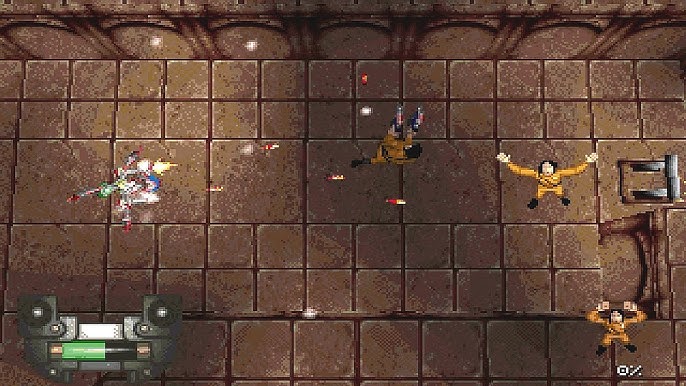
Let me say the nice thing first, because it matters: the takeover mechanic gives Machine Hunter an identity. This is not just another top-down shooter where you collect a bigger gun, endure a louder explosion, and call it progress. Here, the fantasy is more impish. You are not merely destroying the enemy line, you are commandeering it, turning the enemy’s hardware into your temporary emotional support murder vehicle. The research consistently describes nine robot types, each with distinct weapons and abilities, and that is the kind of structural hook that can make a generic action game feel like a small conspiracy against genre boredom. It gives the combat a bit of laboratory weirdness. It also means the game is, at least in theory, about adaptation instead of simple trigger discipline. You are supposed to read the battlefield and decide which chassis will best help you survive the current mess. That is a good problem to have.
And yet, because this is an overhead shooter from the late 90s, the game cannot resist surrounding that clever core with the usual period clutter: busy arenas, objective lists, hostile camera assumptions, and the sort of action pacing that mistakes constant motion for constant excitement. The sources describe it as a top-down, multi-layered 3D shooter with a fixed or rotating camera, depending on the moment, and that sounds exactly like a game trying to look more advanced than your average 2D violence dispenser while still preserving the old arcade habit of making you squint at the floor plan. In practice, that means Machine Hunter often feels like a miniature war zone viewed from an operator’s desk, except the operator is half-blind and the desk keeps catching fire. There is pleasure in that, but also friction.
The best idea in the room is the one stealing the room
The robot possession system is where the game earns its keep. The fiction says Earth has created Machine Hunters, operatives in special suits capable of reprogramming robots on contact, and that bit of pulp nonsense does useful work. It turns a mechanical gimmick into a story justification, which is always welcome, because nothing dates a game faster than a clever mechanic wrapped in a shrug. Here, the fantasy is coherent enough to matter. You are not an all-purpose superhero. You are a specialist with a very specific, very invasive skillset, and the whole game seems built around the question, “What if the best way to survive the enemy was to become a more useful enemy?” That is the sort of idea that immediately gives a shooter a nervous smile.
What I appreciate most is that this is not just cosmetic swapping. The sources make clear that the different robot forms come with distinct weapons and abilities, so the game is asking you to think in terms of utility, not just fire rate. That can be genuinely intoxicating when the level geometry, enemy placement, and objective structure line up. Suddenly the game has a tactical pulse. You are not merely clearing a room, you are trying to decide which machine body will let you cross the room without becoming minced machine paste. In a more disciplined game, this would be the basis for a cult favorite that people defend with actual diagrams. In Machine Hunter, it is the spark that keeps the whole thing from collapsing into anonymous pyrotechnics.
But, and this is where the game starts showing its teeth, the elegance of the hook does not always survive the mess of execution. Top-down action is merciless about readability. If the camera, enemy silhouettes, and environmental clutter are not pulling in the same direction, the player spends too much time interpreting the screen instead of reacting to it. Machine Hunter wants to be visually rich, and it is, to a point, but richness in this era often means “there is a lot going on, and not all of it is helping.” The overhead perspective, the 3D environments, the lighting effects, the blood-and-metal spectacle, all of that gives the game attitude, but it also risks turning combat into a kind of violent archaeology. You dig through the scene to find the actual danger.
Objective play, or how to make a shooter do chores
The research describes the missions as objective-driven: rescuing hostages, obtaining keycards, planting or defusing bombs, meeting time limits, teleporting to different locations on planets, and moving through a spread of stages rather than just grinding through identical arenas. On paper, I like this a lot more than I often do in practice, because it suggests a game trying to escape the doldrums of pure attrition. On the other hand, there is a reason so many shooters keep returning to “shoot everything until it stops moving” as a design foundation. Once you introduce fetch tasks and timed objectives, you begin to discover exactly how much your level design is carrying the mood, and exactly how patient you are willing to be when the mission wants you to act like a machine operator instead of a destroyer.
Machine Hunter seems to live in that tension. The objective structure adds texture and the sense that you are operating in a bigger conflict than your own trigger finger, but it can also flatten momentum if the level scripting is not especially smart. I can imagine the intended rhythm: advance, seize a better robot, solve the current problem, move deeper into the colony, repeat. I can also imagine the less flattering reality: wandering through a murky 3D maze trying to remember whether the bomb needs planting, defusing, or merely making your afternoon worse. These sorts of missions are the genre’s old way of pretending that repetition is depth. Sometimes it works. Sometimes it is just admin with explosions.
The reported seventeen stages make the game sound substantial, though I would treat that number with a little caution because it comes from a single non-official description and the wider reference record does not independently lock it down. Still, even without hanging too much weight on the count itself, the structure clearly points to a fairly long-form arcade campaign rather than a compact one-sitting blast. That has consequences. In a game like this, length can be either generous or exhausting depending on whether the fundamental action keeps evolving. If the robot types and mission structures are doing genuine work, great. If not, then seventeen stages becomes a long parade of the same headaches in slightly different hats.
Presentation, or the beauty of weaponized clutter
Visually, the game is repeatedly described as a multi-layered 3D affair, with heavy lighting and a gore-forward aesthetic. That puts it squarely in that late-90s lane where developers were desperate to convince us that overhead action could still feel modern if they just gave the floor enough polygons and the screen enough glow. There is a crude charm to that. It is not elegant in the manner of a well-composed arcade sprite game, and it is not clean in the modern sense of clarity first, spectacle second. It is noisy. It wants to be noisy. The noise is part of the point.
I respect that, even when it gets on my nerves. The game appears to aim for the same sort of ugly, overcharged energy that made contemporaries like Loaded memorable for people who wanted their action with a side order of bad manners. The difference is that Machine Hunter hangs its identity on a more interesting mechanical conceit. The lighting and bloodshed are the wrapping paper; the robot takeover is the actual gift. When the presentation and the mechanic reinforce each other, the whole thing clicks into a pleasingly trashy sci-fi fever dream. When they do not, the game falls back on the era’s favorite trick, which is to make everything darker and busier and hope that counts as atmosphere.
As for sound, the surviving research is thin. No reliable composer credit or detailed audio breakdown turned up in the sources I trust here, so I will not invent a verdict where the record is shy. What I can say is that the game’s overall presentation clearly leans hard into action spectacle, and that usually means the audio’s job is to keep up with a screen full of metal, blood, alarms, and impending error. I would not call that a subtle task. I would call it a practical one.
Where it trips over its own metal feet
The most useful thing I can say about Machine Hunter is that it feels like a game built around one very good idea and several slightly compromised supporting systems. That does not make it bad. It makes it familiar. The late 90s were full of these things, confident on the title screen, less confident everywhere else, carrying a strong hook like a forged passport while the rest of the design hoped nobody would ask too many questions. Here, the questions are obvious. How readable is combat when the screen is packed? How clean is the control feel when you are moving among multiple robot forms? How much of the challenge comes from smart encounter design, and how much comes from the usual overhead shooter aggravations of perspective, clutter, and spatial guesswork?
The available sources do not give me a manual, nor a tidy technical postmortem, so I am not going to invent precise grievances about save systems or multiplayer or difficulty curves. But the overall profile is clear enough. This was a game that got some middling reviews at the time, and that sounds exactly right for something with an appealing premise but an uneven grip on execution. The strongest compliment I can give it is that it seems committed to its own oddity. The weakest criticism I can level is that commitment alone does not make the moment-to-moment action consistently satisfying. A clever suit that lets you steal robot bodies is a lovely idea. It does not automatically rescue a mission structure that can still feel like work.
There is also the matter of historical halo, that maddening force that makes old curiosities seem more interesting than they necessarily are. I understand the impulse. This is a 1997 Windows 95 shooter from Eurocom, tied to the same era of chunky, ambitious, sometimes overbuilt 3D action that constantly wanted to prove the future had already arrived in a box. It is easy, decades later, to smile at the ambition. But ambition is not the same thing as rhythm, and rhythm is what makes these games sing. Machine Hunter does have rhythm in spots, especially when the robot-swap mechanic produces a satisfying tactical shift. It does not sustain that grace often enough to become a neglected masterpiece.
The verdict from the Martian salvage pit
The original PC Machine Hunter is worth remembering because it has a real idea at its core, not because it flawlessly expresses that idea. That distinction matters. I would rather play a flawed game with an actual thesis than a polished one with the personality of wet cardboard, and this one at least knows what it wants to be: a top-down sci-fi shooter about taking enemy hardware and making it yours, set amid Martian colonies and mechanical hostility. When its systems align, it is genuinely fun in that old, slightly unhinged arcade way, the way a good cabinet can make you forgive ugly lighting and think, for a brief glorious moment, that all design problems are solvable by more plasma.
But I would not recommend it to anyone looking for a smooth, modern, or especially clean action experience. If you do not have patience for late-90s overhead shooter fussiness, for visual clutter, for objective-driven detours that can feel like errands wearing combat boots, this game will irritate you faster than it charms you. If, however, you enjoy archaeology with attitude, if you like games that feel like they were conceived by someone who got very excited about one mechanic and then let the rest of the structure follow at a cautious distance, Machine Hunter has enough bite to justify a look. It does not deserve myth. It does deserve attention. Its strengths outweigh its flaws, but only by the width of a stolen robot chassis.
Score: 6/10