Need for Speed II, at least the original 1997 Windows version, is what happens when a racing game falls in love with a showroom and forgets to make the driveway forgiving. It is a glossy, aggressively aspirational machine, a sequel that swaps out the first game’s rougher identity for something more decorative, more international, and, yes, more obviously corporate in the way only late 90s car fetishism could be. On paper, that sounds like a victory lap. In practice, it is a curious beast: half toy commercial, half speed-chasing arcade racer, with enough style to keep you looking and enough friction to remind you that the designers still wanted this thing to be a game, not a brochure.
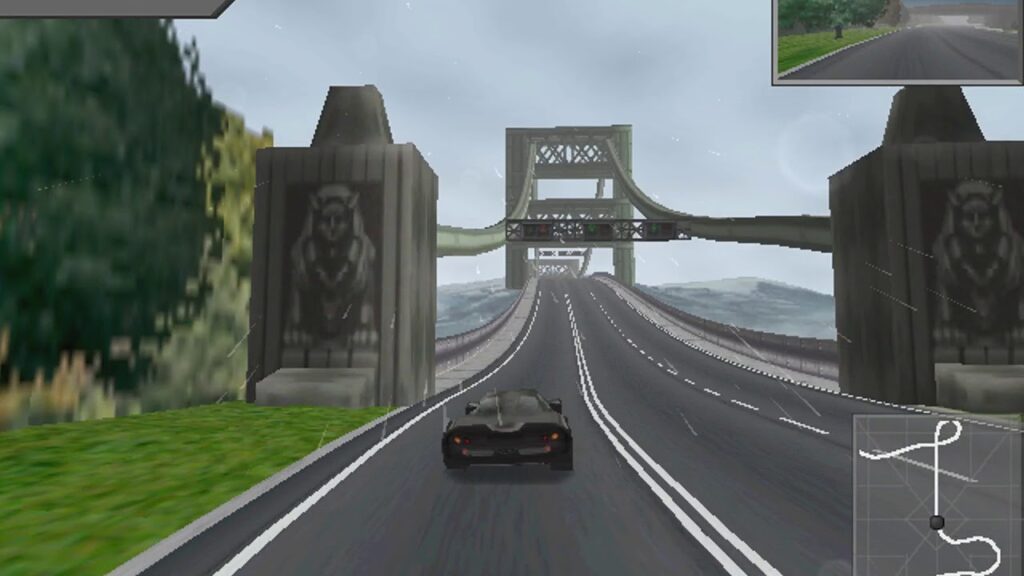
I should be clear about which beast I am talking about. The title Need for Speed II can mean a few different things, and the 1997 PC release is not quite the same animal as Need for Speed II: Special Edition, the later updated Windows version that adds extra cars, a new track, a new driving style called Wild, and 3dfx Glide support. That Special Edition is the version that gets most of the retrospective polishing cloth these days, which is understandable, because computer history is often written by the patch that improved things. But the original release matters, because it shows the design before the fix-up crew arrived, before hardware acceleration was folded in as salvation, before the game gained the extra baggage that made it feel more complete. The base game is the one I am reviewing here, and it is very much a product of its moment: thrilling, fussy, and faintly self-important in the way only a high-end racing game can be.
A race game that thinks it is a catalog
The most distinctive thing about Need for Speed II is not the racing, which is good to decent depending on your tolerance for arcade handling and old-school track logic, but the presentation of cars as objects of desire. This is a game stuffed with licensed exotic sports and concept cars, and it knows exactly what it is doing with them. Before you even floor it, the game invites you into a showcase mode, a little museum of speed with photos, videos, technical specs, and company or car histories. That is not merely menu dressing. It is the game’s thesis statement. These cars are not generic vehicles with fancy skins, they are little metallic gods, each one preened and lit like it should be resting behind velvet rope.
And honestly, this is where Need for Speed II still has a pulse. It understands that a racing game can sell fantasy without pretending that fantasy has no texture. The fantasy here is not “become a mechanic,” or “build a perfect garage from scrap,” or “earn your way to the top with scrappy underdog grit.” No, this is the other fantasy, the 90s import-magazine fantasy, the one where the value of the machine is half engineering and half myth. You want the outrageous hypercar, the concept thing that looks like it escaped from a design studio’s private joke, the vehicle that seems to have been invented for magazine centerfolds and teenage bedroom posters. Need for Speed II serves that longing with a straight face, which is why it works.
The tracks, meanwhile, are themed around North America, Europe, Asia, and Australia, which gives the game an international polish that was catnip in the era of polygon racers. The roads are closed circuits rather than open-world fantasy, and that matters. There are no police chases here, no sirens ruining the mood, no comic pursuit systems trying to turn a race into a stunt-scene hostage situation. This is the second Need for Speed, but it is also the first one to leave police behind entirely, and that gives it a very specific flavor: less outlaw melodrama, more pageant of expensive machines in controlled environments. Whether that is an improvement depends on your appetite. I like the purity of it, even when the game itself occasionally forgets to make purity exciting.
How it drives, and where it starts to sweat
Mechanically, Need for Speed II is an arcade racer with some tuning options, not a deep simulation pretending to be casual for weekend warriors. The player can adjust gear ratios, tires, spoilers, and car color before races, which is enough to make you feel involved without forcing you into a spreadsheet cult. That light setup menu is one of the game’s smarter choices. It gives the illusion of mechanical literacy, and, just as importantly, it lets the cars feel like individualized projects rather than interchangeable speed shells. You are not merely picking a vehicle, you are making a little pre-race judgment about how much you think you understand the road. That can be intoxicating, especially when a game’s car lineup is already doing most of the seduction for you.
The core modes are straightforward enough, with single races and multi-race tournaments against AI, plus multiplayer support through split-screen and various network or connection modes, including LAN, modem, and serial connection. That is very much the late 90s in one sentence: “Sure, you can race a friend, but first please decide what kind of cable civilization deserves.” The game’s structure is sensible, almost conservative. It does not keep reinventing itself every five minutes. It hands you a car, a circuit, and a reason to care, then asks you to prove that excitement can survive repetition.
Sometimes it does. When the cars are moving cleanly and the track layout gives you enough room to read the corners, the game has a brisk, almost breezy rhythm. The fantasy of speed lands because the cars are desirable, the circuits are varied, and the whole thing has that bright, confident, showroom sheen that makes you believe you are participating in something upscale. But arcade handling is a tightrope act, and Need for Speed II occasionally leans too hard into slipperiness or too hard into correction, depending on the car and your expectations. It is not the sort of game that wants to be admired for its chassis simulation. It wants you to feel fast, then punishes you when you notice how much of that feeling comes from presentation rather than physical nuance.
That tension is the whole review, really. The game is constantly negotiating between spectacle and solidity. It likes to pretend the road is an invitation, when it is often more of a polite threat. And because the circuits are closed and the opponents are AI, the game can start to feel like a high-gloss loop of the same embarrassment with different scenery. A good racing game teaches your hands to believe in the fantasy. A merely interesting one teaches your eyes to forgive the fantasy’s rough edges. Need for Speed II is somewhere in between, usually in the handsome middle lane, occasionally swerving into “yes, but why does this corner feel like it was drawn with a ruler and resentment?”
The PC problem, or how glamour meets hardware reality
The original Windows version has a reputation, repeated by retrospective sources, for lacking 3D hardware acceleration support, with the later Special Edition adding 3dfx Glide support. I am deliberately keeping that phrasing cautious, because the archival record I have here is stronger on the existence of that split than on the exact technical consequences in every configuration. Still, the practical point is obvious enough: the base PC release is the less pampered version, the one that asks your machine to carry the whole burden in software while the upgraded SE arrived to put a little chrome on the engine bay.
That difference matters because Need for Speed II is a game that wants to look expensive. The irony is almost too neat. The whole fantasy is luxury machinery, and the original PC edition can reportedly behave like a machine that is itself a bit underfed. This is not a catastrophic mismatch, but it is a meaningful one. A racing game built around pristine cars and exotic locations absolutely lives or dies by presentation, and if the technology is not cooperating, the illusion begins to feel patched together out of good intentions and hardware prayers. The Special Edition, by contrast, is often treated as the “final form” precisely because it plugs some of those holes. But the base game still deserves judgment on its own terms, and on those terms it is a polished idea running on less than polished plumbing.
I also cannot resist noting that this era of PC racing games often had the vibe of an expensive suit worn over a skeleton made of driver conflicts, accelerator quirks, and hardware demands. You sat there in front of the monitor, adjusting settings, hoping for decent frame rates, feeling like an unpaid technician in your own entertainment ecosystem. That is part of the charm if you are the sort of person who remembers the satisfaction of making a temperamental game behave. It is also part of the annoyance if you just wanted to drive a beautiful concept car without entering into a tacit contract with your motherboard.
What it gets right, and what it cannot quite escape
Need for Speed II gets the fantasy of exotic racing exactly right at the level of mood. It is not gritty, and it does not want to be. It is sleek, aspirational, and borderline smug about the pedigree of its machines. The showcase mode is a brilliant little act of self-mythology, because it turns the game into a car museum you can wreck at 180 miles per hour. That is a lovely contradiction. The game worships the object, then asks you to treat it like a projectile. This is the sort of contradiction that makes arcade racing worth caring about at all.
It also benefits from being a sequel that knows what it is not. By dropping police pursuits, it avoids the structural clutter that can sometimes turn racing into a comedy of interruptions. There is no gimmick here trying to dominate every other system. The game is about circuits, competition, and the pleasure of moving an absurdly expensive object through a stylized environment as if you have no earthly responsibilities. That focus is admirable. In a genre that often confuses escalation with improvement, restraint can look downright radical.
But restraint is not the same thing as depth, and this is where the game’s weaknesses settle in and start adjusting the curtains. The track themes are broad rather than deeply characterful, the racing can feel flatter than the fantasy implies, and the whole package depends heavily on whether the handling and visual experience click for you. If they do, you get a stylish, brisk arcade racer with a memorable obsession. If they do not, you are left staring at a very attractive chassis while wondering why the engine note never quite kicks you in the ribs.
There is also the minor but persistent issue that the game’s greatest selling point, its licensed car roster, can become a kind of trap. When a racing game is this invested in prestige machinery, it risks making every other design decision feel like support staff. The cars are the headline, the showcase is the feature article, and the racing itself can end up in the embarrassing position of being the thing that merely justifies the rest. That is not a fatal flaw, but it is a structural one. Need for Speed II is so enamored with the idea of desire that it occasionally forgets to be urgently fun in the moment-to-moment sense. You admire it as you play, then realize you are admiring it a little more than you are loving it.
The verdict, after the smoke clears
As a 1997 Windows release, Need for Speed II is a very good-looking racing game with a very clear idea of its own appeal: exotic cars, globe-trotting circuits, light tuning, and a presentation that makes the whole thing feel like automotive propaganda in the best possible sense. It is also a game whose original PC incarnation is, by the evidence available here, less technically complete than the later Special Edition, which matters because racing games live or die by how gracefully they move and how convincingly they occupy the screen. The Special Edition seems to be the better-known and better-equipped version, but the base release still has enough identity to be judged without mercy and, occasionally, without sadness.
I respect it more than I love it. That may sound harsh, but it is actually a compliment of a particular sort. I respect the confidence, the presentation, the way it turns a licensed car lineup into a tiny, glossy religion. I respect that it is not trying to be a cop-chase soap opera or a simulation in fake sneakers. I respect the international track fantasy and the showcase mode’s nerdy, earnest seduction. What I do not fully respect is the way the actual racing can feel like it is always one degree less thrilling than the package surrounding it. The game is good at wanting speed, not always as good at delivering exhilaration in the hands.
Who is this for? People who like their racing games wrapped in chrome, who enjoy the ritual of car selection as much as the race itself, who remember the era when a good loading screen could sell you an entire identity. Who is it not for? Anyone wanting deep handling nuance, relentless mechanical drama, or a PC version that feels technically effortless. Does it deserve its reputation? Mostly, yes, though a lot of that reputation is really the halo of the series and the charm of the concept rather than the pure brilliance of this specific release. Do its strengths outweigh its flaws? They do, but not by a landslide. Need for Speed II is a stylish machine with enough bite to justify its existence and enough roughness to keep me from bowing before the altar. In other words, it is exactly the sort of game I would have rented, argued about, and then spent two more afternoons trying to love for reasons that were never entirely rational.
Score: 7/10