NFL Blitz is the kind of football game that arrives wearing shoulder pads over a leather jacket, cracking its knuckles at simulation, and daring anyone to call the cops. The version I can responsibly talk about here is the PC release that followed the game’s 1997 arcade life, because that is what the available record supports. And that matters, because NFL Blitz is not just “football, but louder.” It is a whole argument about what football games could get away with when they stopped pretending they were textbooks and started acting like rowdy, fluorescent arcade cabinets with an NFL license slapped on the front.
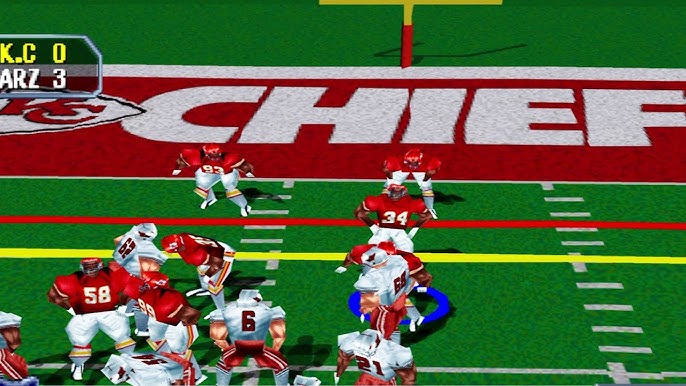
That is the heart of it. NFL Blitz is a fast, exaggerated, arcade-style American football game built around speed, big hits, and high-scoring chaos. It was a Midway production, and that pedigree tells you plenty before you even put a coin in, or in this case, boot the PC version and hope the adaptation does not sand off the personality like some joyless legal department filing through a buffet of fun with a clipboard. The arcade original landed in 1997 and, by contemporary retrospective accounts, became a smash hit. Later home releases followed, including console ports in September 1998 and the PC version shortly after. So if you are looking for a pristine, settled, always-easy-to-pin-down release history, this is not your glamorous museum piece. It is a late-1990s sports bruiser with a chronology that already hints at how the industry treated arcade hits once they started getting invited indoors.
What it actually wants to be
NFL Blitz does not want to simulate football so much as weaponize its basic grammar. The playbook is not the point, not really. The point is momentum, collision, and the deliciously juvenile thrill of watching a football game behave like it spent the afternoon huffing battery acid behind the pizza counter. Everything in the premise pushes toward immediacy. You are supposed to feel the pace, the contact, the score climbing faster than your embarrassment can keep up. This is football as a bar fight with referees, football as a carnival attraction, football as the sort of thing a kid on a greasy arcade floor would describe to another kid with both hands flailing in midair because the memory is too loud to contain.
That design goal is the game’s great strength, and also the source of its limits. It knows exactly what lane it wants, which is more than can be said for many sports games, but that lane is narrow. A game so committed to spectacle gives up the gentle complexities that make real football interesting over a longer stretch. That is not a flaw in the abstract, because nobody loads up NFL Blitz expecting the measured dignity of a coaching manual. But it does mean the game’s pleasures are immediate and blunt. If the chaos lands for you, it lands hard. If it does not, then the whole operation can feel like a licensed riot with a scoreboard.
The arcade DNA is the whole story
I do think it is important to say, plainly, that this is a game best understood through its arcade identity, even when discussing the PC release. The research available to me is clear that the PC version came after the 1998 console ports, not in some neat little 1997 PC package, so if your memory insists otherwise, your memory may be mixing the game up with the broader fever dream of late-90s sports conversions. That chronology matters because arcade games are built around a different kind of honesty. They are not pretending to be comprehensive. They are selling velocity, noise, and the sensation that every possession could become a highlight reel or a misdemeanor.
That arcade design philosophy gives NFL Blitz its personality. It is not trying to wear realism like a rented tuxedo. It is trying to elbow past realism, order another round, and challenge realism to a rematch outside. The NFL license makes the whole thing even funnier, because there is always something slightly conspiratorial about an officially sanctioned sport being filtered through a style that feels like it escaped from a cabinet row and learned to grin at authority. That tension, between corporate branding and gleeful overstatement, is part of why NFL Blitz still sticks in the mind. It feels like a game that was smuggled through the front door in a fake mustache.
How it plays, in the broad strokes that matter
The core loop, as the research allows me to describe it, is straightforward: fast arcade football, big hits, rapid scoring. That may sound almost insultingly simple, but simplicity is not automatically a crime. In fact, for an arcade sports game, clarity is an asset. The best moments in these games come when your brain does not have to negotiate a tax code of systems just to enjoy a tackle. You read the field, you fire off the play, and the game tries to convert every possession into a punchline with cleats. That is the appeal. It is aggressive by design, and it wants your attention in short, sharp bursts rather than long strategic sermons.
The danger, of course, is that a game built on repetition can begin to sound like its own hype reel after the first few warm possessions. Arcade sports live or die by how much texture they can squeeze out of a simple loop. Does the collision system keep making the same joke, or does it keep finding new ways to amuse you? Does the scoring rush still feel mischievous after the novelty wears off? The source material I have does not give me enough PC-specific detail to pretend I can audit every mechanic with forensic precision, and I will not fake it for the sake of grandeur. What can be said, safely, is that the game’s identity rests on pace and spectacle, not on the slow burn of simulation mastery. If you want the mental pleasure of diagnosing offensive schemes like a doctor with a whiteboard, this is probably not your church.
Where it earns the reputation
The reputation is not mysterious. NFL Blitz was a late-1990s arcade hit because it offered something loud, legible, and instantly shareable. You did not need years of football literacy to understand the joke. The game lets you feel the shape of the sport in compressed, exaggerated form, then turns the volume up until the whole thing sounds like a steel drum being hit with a folding chair. That accessibility is a real achievement. So many sports games in that era were trying to prove they were serious. NFL Blitz had the courage, or the recklessness, to be fun first and respectable never.
That is why people remember it. Not because it was polite, but because it was specific. The market was full of games that took football and wrapped it in cautious authenticity, as though the main fear was that someone in a blazer would discover the joystick. NFL Blitz went the other way. It leaned into exaggeration and made a feature out of being the loud kid in the room. There is a real design virtue there, one that still reads even when you strip away the nostalgia varnish. A game does not need to be profound to have a strong identity. It just needs to know what it is doing and do it with conviction. This one knows. Loudly.
Where the chassis starts creaking
But let us not become the sort of person who mistakes volume for depth, because the arcade style can also expose how little structural room there is underneath the showmanship. A game so committed to speed and spectacle risks flattening itself into one long adrenaline loop. If every play is trying to be a highlight, highlights stop feeling special. And when the core fantasy is this transparent, the game has to rely on feel, pacing, and moment-to-moment delight to keep from evaporating into the same joke repeated with different uniforms.
That is where I become cautious. The available research does not give me enough to make claims about the PC version’s technical quirks or any version-specific compromises, and that restraint is not a cop-out, it is discipline. Still, any late-1990s arcade-to-home transition invites suspicion, because the original cabinet experience and a PC adaptation are not identical species. Home versions often have to account for different expectations, different hardware realities, and the unpleasant fact that a game designed to buzz in a noisy public space may feel smaller when reduced to a monitor in a bedroom. Even without claiming a specific flaw, I can say this much: the personality of an arcade sports game is tied to presentation and pacing in ways that are easy to blunt if the conversion is timid. If the fire is still there, great. If not, you are left with a noisy football skeleton.
Its historical value is not the same as its lasting value
One of the oldest traps in criticism is pretending that important games are automatically great games. They are not. Sometimes a game matters because it caught a cultural current, because it distilled an era’s taste, because it was the right machine in the right room at the right moment. NFL Blitz has that kind of importance. It is a major late-1990s arcade sports artifact, and the fact that it became a standout hit tells you it hit a nerve. But historical impact is not a hall pass. If I am being strict, and I am, the game’s reputation should be understood as the product of a very strong premise executed with confidence, not as proof of infinite depth.
That distinction matters. A lot of games from this era are remembered through the amber glow of youth and noise, as if the cabinet itself blessed them into permanence. But when you pull the magic trick apart, you want to find design underneath, not just adrenaline and branding. NFL Blitz does have design underneath. It is a concise, arcade-first football fantasy that knows exactly how to deliver its promise. Yet I would stop short of calling it expansive or subtle, because it is not either of those things. Its appeal is real, but it is also tightly bounded. The game excels at being what it is. It is less convincing when asked to be more than that, which, to be fair, is not a request it ever seemed eager to entertain.
Verdict
So here is my clean verdict, with no smoke machine and no nostalgia fog. NFL Blitz on PC is for people who want football stripped down to pace, hits, and absurdist swagger, people who remember arcade sports as a place where design had to make an immediate first impression or get politely ignored. It is not for anyone seeking simulation, nuance, or a deep strategic feast. It is not for the player who wants the sport to behave like a spreadsheet with helmets. And if the version history matters to you, it should, because the research points to the PC release as a later port following the 1998 console conversions, not a neat standalone 1997 PC debut.
Does it deserve its reputation? Yes, though with a raised eyebrow and a referee’s whistle in my mouth. Its strengths outweigh its flaws because the game understands the simple, ancient truth that arcade football lives or dies on feel, and this one has feel in spades. It is brash, memorable, and shameless about its own agenda. But it is also narrow, and the narrowing is the price of admission. I respect it more than I love it, and I suspect that is exactly how it should be judged. If you want a disciplined sports simulation, go find one and bring a calculator. If you want a loud, mischievous, sometimes ridiculous football game that treats realism like a rumor, NFL Blitz still knows how to throw a punch.
Score: 7/10