If you want a polite hockey game, this is not your stop. NHL Open Ice: 2 On 2 Challenge is what happens when Midway looks at the sport and decides that nuance, structure, and restraint are all somebody else’s problem. The version I care about most here is the PC release tied to the 1996-1997 roster update. What matters is the design idea: take NHL hockey, strip it down to two skaters and a goalie per side, then pour arcade syrup over the whole thing until it becomes a fast, shrieking argument in skates.
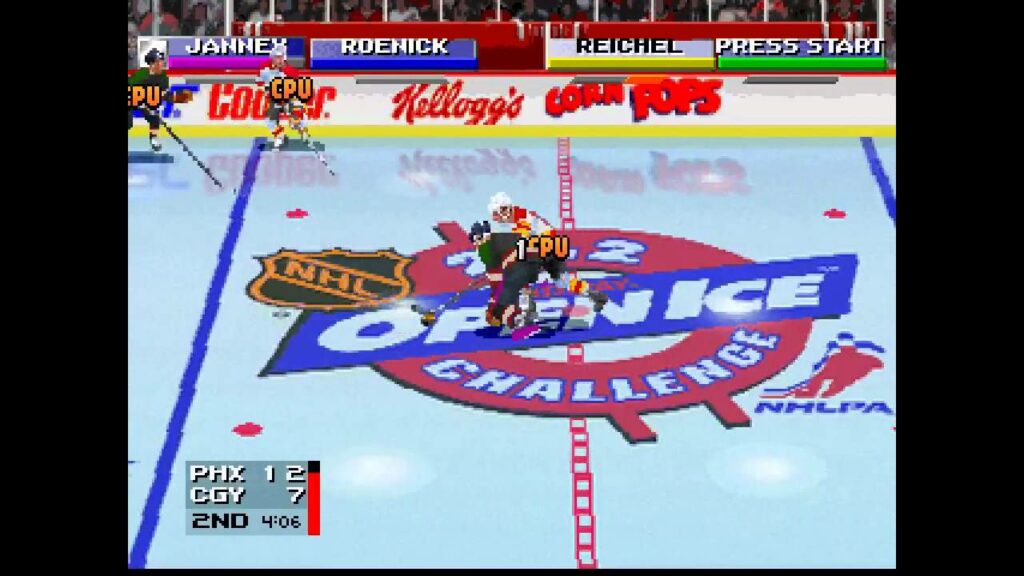
That is also the game’s greatest strength and its biggest limitation. Open Ice is not interested in simulating the sport so much as weaponizing its broadest joys, the slapshot, the body check, the deke, the one-timer, the ridiculous scramble in front of the net. It is the ice-hockey equivalent of NBA Jam, which is both a useful comparison and a warning label. Useful, because that is plainly the lane it wants to occupy. A warning, because once a game announces itself as the hockey cousin of a beloved arcade brawler, it inherits a nasty burden: if the jokes stop landing, the whole stunt looks thinner than it should.
Two-on-two, all gas, very little brake
In play, the premise is almost embarrassingly clean. You control two skaters and a goalie, with the focus squarely on quick multiplayer action, either teaming up or going head-to-head. The research is consistent on the broad structure, and the video evidence shows the obvious result: matches move fast, hits come hard, and the whole thing is built around constant motion rather than elaborate systems. This is hockey boiled down to its loudest instincts. You are not managing a roster, nursing line changes, or peering at strategy screens while pretending you are having fun. You are chasing the puck, throwing checks, and trying to create enough chaos that one of your slapshots sneaks through before the opposing goalie can recover.
That simplicity is not automatically a virtue, but here it suits the game’s personality. Open Ice wants to feel like an after-school machine that has had too much caffeine and no adult supervision. The controls, whether on keyboard or connected controllers in the PC version, are built to support quick reactions and exaggerated offensive bursts rather than delicate setup play. You get the expected arcade vocabulary, and the game clearly wants you to chain it all together into a kind of improvised hockey vandalism. Body check, loose puck, one-timer, repeat. If that sounds shallow, well, yes, at a certain level it is. But shallow can still be sharp, and arcade games have always depended on the quality of their first thirty seconds more than the virtue of their seventh season.
What I appreciate most is that the game does not pretend to be anything else. It is not one of those sports titles that tosses in a few silly flourishes and then retreats into a conservative core. Open Ice leans into the absurdity. The matches are simplified, the action is fast, and the personalities on the ice are more cartoon logic than coaching manual. That gives the game a breezy, immediate appeal, especially in multiplayer, where the whole thing becomes a shared act of mischief. You are not so much playing hockey as bickering with a puck-shaped thunderstorm.
The Midway showman’s instinct
Midway knew exactly what it was doing in 1995. The arcade original was built to shout, not whisper, and the PC port keeps enough of that attitude to matter. The presentation is described, accurately enough, as vibrant and over-the-top, and the audio leans into digitized voice commentary, comic sound effects, and energetic music. That combination matters more than it sounds like it should. A stripped-down sports game can feel punishingly bare if it lacks spectacle, but Open Ice understands that the joke is the presentation. You need the thwack, the yelp, the announcer bark, the visual excess. Without those ingredients, the whole thing becomes an undersized rule set in a rink costume.
Fortunately, the game does not skimp on that front. Even on PC, it preserves the arcade look well enough to keep the fantasy intact. The result is not subtle, but subtlety was never the assignment. This is the design lineage of Midway at its most recognizable, where every successful action should feel like a minor act of public vandalism. A body check should sound like somebody just got introduced to a filing cabinet. A goal should feel like a small riot. The game’s audio and visual energy do a lot of heavy lifting, and they do it with the shameless confidence of an arcade machine that knows it only has to entertain you for the length of a lunch break and a few extra quarters.
There is a reason contemporary reviewers reportedly saw it as a faithful, fun arcade translation. That does not mean it is deep. It means the thing it was trying to be survived the move from cabinet to home computer with its personality mostly intact, which is not a trivial accomplishment in a period when a lot of arcade ports arrived home looking like they had been left outside in the rain. Open Ice keeps the basic Midway posture: bright, aggressive, a little stupid in the best way, and perfectly happy to turn a sports match into a cartoon brawl with skates.
Where the ice gets thin
Still, I would be lying if I said the game’s limitations were merely academic. The same simplification that makes it immediately readable also narrows its range. When the novelty of the two-on-two format settles, you begin to notice how much of the experience rests on repetition and tempo rather than strategic expression. That can be fine, even ideal, for a short burst. But over longer play, especially if you are not actively enjoying the multiplayer back-and-forth, the game can start to feel like it has only one loud joke and no second act.
There is a particular strain of arcade sports design that mistakes constant motion for constant interest. Open Ice does not completely fall into that trap, but it can hover around it. The game gives you action, certainly, but not always variety. The body checks, slapshots, dekes, and one-timers form a compact loop, and the appeal depends on whether you like that loop enough to keep circling it. I do, to a point. I also know that some afternoons in the arcade were made for exactly this sort of thing, while others were made for a deeper game that could hold your attention after the first adrenaline spike faded.
This is where historical context matters, but only a little. The game is often treated as the hockey answer to NBA Jam, and that comparison is flattering because it places Open Ice in a very successful design family. It is also unfair, because NBA Jam had a way of turning every possession into a miniature punchline, while Open Ice sometimes settles for being fast and noisy without always being equally memorable in its moment-to-moment structure. It absolutely understands arcade pacing. It just does not always know how to keep the jokes escalating once you have learned the basic rhythm. That is the difference between a game that still feels alive after an hour and one that mostly survives on the strength of its premise.
The research does not support me inventing elaborate technical complaints, and I won’t. The one compatibility note worth mentioning is that a fix exists for Windows XP and later, which tells you the PC version has lived long enough to need the usual old-sportscar maintenance. That is less a criticism of the game than a reminder of its vintage. As for the exact PC release year, the record is inconsistent, with sources giving 1996, 1997, or a 1996-1997 range. I mention that not because it affects play, but because this kind of mid-1990s documentation wobble is part of the landscape. Sports ports, especially arcade ones, often arrived in a haze of dates and publisher labels, and Open Ice is no exception. The factual fog around it is almost genre-appropriate.
Rosters, revisions, and the small consolations of specificity
The more interesting version detail is the roster update. The PlayStation and PC releases were updated to 1996-97 season rosters, with Winnipeg Jets represented as the Phoenix Coyotes, which gives the home versions at least one concrete hook into a specific hockey moment. That matters because licensed sports games can become interchangeable soup if they do not anchor themselves in a recognizable season or roster identity. Here, the updated lineups keep the thing from floating entirely free of context. You are not just skating through a generic arcade hall of mirrors. You are, at least in part, looking at a mid-1990s NHL snapshot reframed for a faster, rowdier format.
That said, I would not oversell the roster angle as some grand source of depth. The game is still fundamentally about arcade immediacy, not simulation fidelity. The names on the ice are there to increase the fantasy temperature, not to build a management labyrinth. And that is probably the correct choice. If Open Ice had tried to become a serious hockey sim, it would have exposed itself as a fraud almost instantly. Its entire value proposition rests on being brash enough to get away with less. In the hands of a studio with less confidence, this could have been merely a stripped sports license. Midway, to its credit, knew how to make a simplified rule set feel like an event.
There is also something pleasantly unsentimental about the game’s existence. It is not trying to be a reverent tribute to the sport. It is trying to be a usable piece of arcade nonsense with recognizable NHL branding, and that honesty gives it more charm than a lot of more elaborate sports titles with their fake television polish and their earnest claims to realism. I trust a game that knows it is a racket. I do not trust a game that spends twenty minutes explaining itself and then turns out to have the emotional range of a clipboard.
Verdict
NHL Open Ice: 2 On 2 Challenge is a strong idea executed with enough conviction to survive its own simplicity. The arcade original had the right attitude, and the PC version preserves the essential shape of that experience: fast, loud, exaggerated two-on-two hockey built around multiplayer skirmishes and the satisfying stupidity of slapshots, checks, and one-timers. It looks the part, sounds the part, and understands that an arcade sports game lives or dies on whether the action feels immediate and slightly unhinged. On those terms, it succeeds more often than it fails.
But I also think its reputation should be kept in proportion. This is not a hidden masterpiece that secretly outclasses the genre. It is a very good piece of Midway showmanship, and that already puts it ahead of a lot of sports curiosities from the era. Still, the design is narrow, the joke is one-note if you stay too long, and the game leans heavily on the appeal of its pace and presentation rather than on any deep tactical satisfaction. If you want a brisk, noisy arcade hockey fix, especially with another human being involved, this is worth your time. If you want a layered hockey game with lasting strategic range, keep skating. This one is for people who like their sports with the rules shaved down and the volume turned up until the machine starts to rattle. For that audience, it deserves its modest reputation. For everyone else, it is a charming, brash diversion that knows exactly how far its own ice will hold, and no farther.
Score: 7/10