Reader Rabbit’s Reading 2 is not trying to seduce the jaded adult in the room, which is frankly one of its virtues. This 1997 The Learning Company reading game, best supported here in its Windows PC form, is a no-nonsense piece of children’s software built for ages 5 to 8, the sort of thing that wants to teach phonics, vocabulary, and comprehension without pretending it is secretly an action epic or a moral fable with jump buttons. It is an educational title, yes, but one with enough color, charm, and theatrical confidence to avoid feeling like homework wearing a cartoon hat. Mostly.
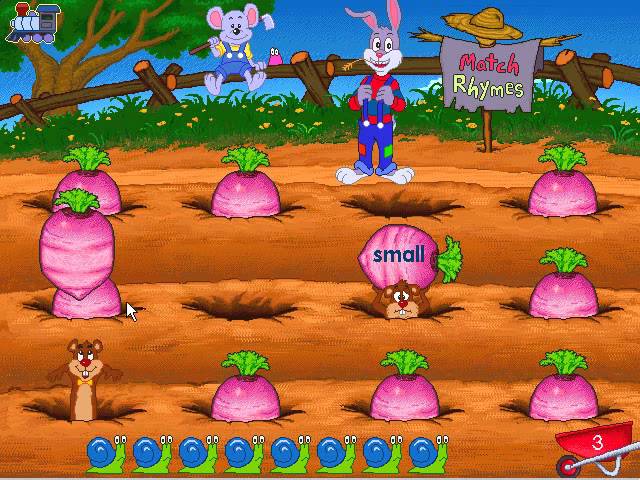
What I appreciate, right away, is that it understands its assignment. Reader Rabbit’s Reading 2 is about reading in the plain, unfussy sense: matching words to pictures, working through simple puzzles, listening, repeating, recognizing patterns, and building confidence through small successes. There is no combat system lurking behind the oak tree. No grim inventory puzzle. No late-game revelation that the rabbit was dead all along and the moon was a metaphor for commas. It is a kids’ learning game that believes literacy can be made into play by wrapping it in inviting worlds and manageable challenges. That is not glamorous design. It is, however, honest design, and honesty is rarer in software than it ought to be.
The version that matters most here is the 1997 Windows original, though the research also points to Windows 3.x and Mac releases, and that is where I have to be careful not to overstate specifics the record does not firmly nail down. What is clear is the broad shape: a mouse-driven educational adventure with flip-screen and side-view activity spaces, presented as a sequence of themed environments and mini-games. The Learning Company was very good at this particular sleight of hand, making lessons feel like you were wandering through a storybook instead of drilling flash cards in disguise. Reader Rabbit’s Reading 2 sits squarely in that tradition. It is not revolutionary, but it is fluent in the old language of educational design, where the trick is not to hide the lesson entirely, but to make the lesson feel like a toy box instead of a lecture hall.
A reading game that actually wants to be looked at
Visually, the game lands where a lot of mid-90s children’s software lived at its best: colorful graphics, friendly characters, and animation with just enough charm to keep a child leaning forward instead of reaching for the box of crayons. Sources describe a fantasy setting, and that matters more than it sounds, because the fantasy wrapper gives the reading tasks a sense of place. You are not merely identifying words in the abstract, you are moving through a world that wants those words to mean something. That little bit of contextual dressing is the difference between a workbook and a game. It is also the difference between a child feeling like they are being evaluated and a child feeling like they are exploring.
The interface, as described in the available material, leans on mouse control and simple side-view or flip-screen structure. In other words, this is not a game asking for reflexes, hotkeys, or a doctorate in ergonomic patience. It is built to be legible to its audience. That may sound obvious, but a surprising number of children’s products from this era behaved as if clarity were an optional luxury. Here, the presentation appears to be doing real pedagogical work. The game keeps the action readable, the characters approachable, and the tasks neatly bounded. For the target age range, that is not simplification as a compromise, it is simplification as craft.
There is, naturally, a ceiling to how much sparkle any reading lesson can sustain. Reader Rabbit’s Reading 2 is charming in that slightly municipal way many educational games are charming, where the town square is brightly painted and every resident is unfailingly polite. But it never becomes saccharine enough to collapse under its own friendliness. The animations and world design seem aimed at keeping momentum moving from one little reading problem to the next, and that momentum is the whole game. If it works, it works because the presentation keeps the child in motion. If it falters, it is usually because the underlying activity is too slight to support the wrapper for very long.
How it plays, or, the noble art of making phonics feel like a quest
The research points to four activities, or at least that general number of recurring exercises, built around phonics and reading practice. There are word-picture matching tasks, simple puzzles, and read-aloud exercises, all in service of early literacy. That is the core loop, and it is as straightforward as it sounds. You are not here to master a complicated systems web. You are here to reinforce recognition, listening, and comprehension through repetition that is hopefully masked by variety. Sometimes the variety comes from the activity type itself, sometimes from the thematic environment, and sometimes simply from the fact that the game is trying very hard to make the child forget they are learning something on purpose.
This is where Reader Rabbit’s Reading 2 is either admirably focused or frustratingly modest, depending on what you want from a game. If your standards are those of a conventional entertainment title, the whole thing will look like a carefully arranged pile of tiny chores. But that would be a little like criticizing a piano for not being a trumpet. The point here is not breadth, nor dramatic escalation, nor surprise in the modern design sense. The point is reinforcement. The game wants to build confidence in early readers, and it seems to do that by keeping the activities approachable enough that the child can cycle through success, correction, and success again without feeling flattened by failure.
I can respect that. I can also admit that such restraint has a built-in risk: once you understand the structure, the game can start to feel like it is repeating its own thesis in increasingly cheerful fonts. Educational software from this era often had to choose between depth and accessibility, and Reader Rabbit’s Reading 2 appears to make the very sane choice of accessibility first. That choice helps the target player, which is the point, but it also means the adult observer, or the older child who has already outgrown the basics, may start to see the seams faster than the game would like. The machine is gentle. Perhaps too gentle, if you demand novelty from everything with a disc in it.
Still, I would rather have this than one of those cynical edutainment products that sneers at its own audience by hiding bad game design behind thinly justified lessons. Reader Rabbit’s Reading 2 seems to understand that repetition is not automatically a vice when the goal is literacy. Repetition is the curriculum. The real question is whether the game can keep that repetition tolerable, and the evidence suggests it can, at least long enough for the intended player to absorb the point without feeling like they have been sentenced to a phonics gulag.
The Learning Company formula, sharpened but not transformed
Placed in the broader Reader Rabbit context, this is familiar territory: early literacy, grade 1 to 2 material, fantasy scaffolding, mini-games that exist to serve learning rather than ego. The series had a knack for making the educational pitch feel kinder than the market deserved. Reader Rabbit’s Reading 2 is very much part of that lineage, and it does not appear to be the entry that redefined the formula. It refines it. It tightens the focus on reading skills, and that narrowness is probably the reason it can be so effective at what it does.
That same narrowness is also why it may not linger in the memory as vividly as the stronger, broader, or stranger children’s games from the period. There is a certain reassuring competence to it, but not a lot of unruly personality. Reader Rabbit himself, and the game’s cast of friendly figures, do the job of softening the educational edge. The game seems designed to keep children from feeling watched by a curriculum. Fine. Sensible. But the cost of that comfort is that the game rarely threatens to become weird in the way that the best old educational software sometimes did (those beautiful accidental oddities where a lesson would suddenly feel haunted by a budget cut and a programmer’s dream). Reader Rabbit’s Reading 2 stays in the lane.
That is not a complaint exactly, though it is the sort of fact that separates competence from memorable excellence. I do not need a reading game to be delirious. I do need it to be alert to the danger of boredom, because boredom is the enemy lurking behind every well-intentioned worksheet in a costume. The available evidence suggests this game keeps enough movement, visual charm, and activity switching to avoid total dead air. That counts for a lot. It is also, in a perverse way, the highest praise one can give some educational software: it does not get in the child’s way while pretending to be more important than it is.
What it lacks, and why that matters
The limits are not mysterious. The research is thin on technical notes, so I am not going to invent a horror story about compatibility gremlins or a save system that requires lunar alignment and a mouse wheel from 1998. What I can say is that the game appears to have no officially documented complexity beyond its educational structure, and that simplicity becomes both its strength and its ceiling. There is no evidence here of a particularly flexible difficulty system, no elaborate branching structure, no dense set of options that would let an older child or adult tune the experience into something more demanding. It is built for a very specific developmental window. That is appropriate, but it also means the game’s success depends heavily on whether you are inside that window.
That is the eternal issue with children’s software, isn’t it? The best of it feels almost invisible to the age group it serves, because it has done its job so cleanly that the child never sees the mechanics as mechanics. The adult reviewer, meanwhile, sees everything. I see the scaffolding. I see the repetition. I see the gentle insistence. And I can still admire it while acknowledging that it is not the sort of game that generates lifelong obsession in the way a great platformer or adventure might. It is a tool, but a pleasant one, and there is no shame in a tool being a tool.
If anything, the biggest risk is that later readers, looking back from a more cynical era, may underestimate how carefully made this kind of software had to be. To teach without nagging, to be structured without feeling rigid, to be playful without becoming noise, that is harder than it sounds. Reader Rabbit’s Reading 2 seems to meet that challenge with a light hand and a bright face. That does not make it profound. It does make it respectable, and sometimes respectable is the exact right word for a game that exists to make first graders less intimidated by words.
Verdict
Reader Rabbit’s Reading 2 is a solid, neatly aimed piece of educational software, and one that understands its audience better than most games understand theirs. It is colorful, approachable, and built around reading practice that seems thoughtfully organized rather than lazily slapped together. I respect its restraint, I respect its clarity, and I respect the fact that it does not try to counterfeit excitement by stapling a fake adventure to the lesson plan. At the same time, it is still a narrowly scoped children’s learning game, and if you are not the target age or at least the nostalgic ex-child revisiting the machinery of your earliest literacy, its pleasures will feel modest and its structure repetitive.
Who is it for? Children ages 5 to 8, especially early readers who benefit from phonics, vocabulary, and comprehension practice presented as interactive play. Who is it not for? Anyone looking for deep systems, broad challenge, or the sort of feverish invention that makes a game transcend its category and start muttering in your dreams. Does it deserve its reputation? Within the niche of The Learning Company’s reading games, yes, insofar as it appears to be a confident, well-judged example of the form. Do its strengths outweigh its flaws? For its intended audience, absolutely. For everyone else, it is a pleasant artifact rather than an essential plaything, but that is still more than can be said for a lot of loudly marketed software with bigger ambitions and far less sense.
Score: 7/10