Star Trek: Generations is the kind of licensed game that makes me want to salute the ambition, then immediately ask whether anyone in charge had actually played a first-person shooter in 1997. The PC version, released by MicroProse in May 1997, is not content to be merely a movie tie-in. It lurches toward something stranger, mixing shooter segments with adventure and strategy elements, then parking a major chunk of its personality in Stellar Cartography, where you are supposed to think like a Starfleet officer while also, at other moments, doing the ordinary licensed-game business of running, aiming, and praying the interface behaves itself. That is a noble mess. Sometimes it is even a good mess. But it is still a mess.
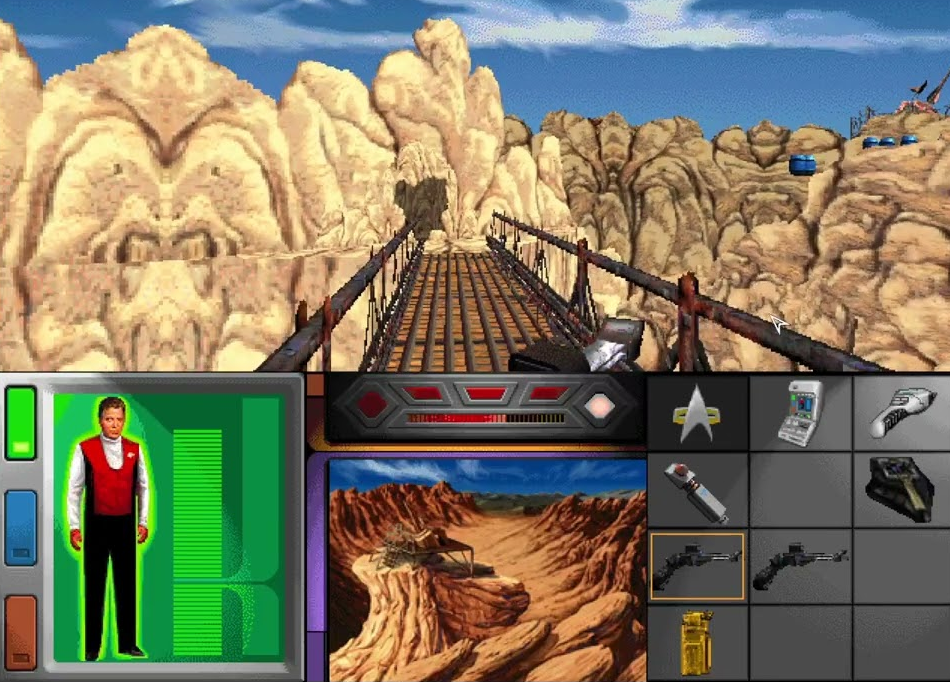
The basic pitch is delicious on paper, the sort of pitch that would have sold me a magazine cover story back when I was young enough to believe the next license might secretly be the one that respected me. It is based on the 1994 film, but the game arrives three years later, which already gives it that faintly untrustworthy aftertaste of product planning by committee. Still, it does have the right toys. Patrick Stewart, William Shatner, and Malcolm McDowell lend their voices, and the game includes film footage, which means it understands the central temptation of every movie adaptation: if you cannot be elegant, at least be recognizable. It knows what you bought the ticket for. The trouble is that recognition is not the same thing as dramatic momentum, and a game can only lean so hard on the glamour of familiar faces before the seams start showing.
What matters here is the shape of the experience, and the shape is a little odd. The game is described, accurately enough, as a first-person shooter with adventure and strategy elements, but that phrase undersells how much the whole thing depends on the contrast between two different fantasies of Star Trek. One is the fantasy of action, of moving through hostile environments and confronting danger directly. The other is the fantasy of procedure, of scanning, calculating, planning, and solving problems like a disciplined space bureaucrat with a dramatic haircut. Generations tries to live in both houses. Its most interesting idea, at least as reported in contemporary descriptions and later discussion, is the Stellar Cartography section, where you plan moves and estimate Soran’s location in order to reach him before whatever system he is endangering gets itself destroyed. That is a very Star Trek way to frame a mission, and it is also the part that suggests the designers were aware that pure blasting would not be enough to carry the license. The Federation, after all, is not just a federation of lasers.
And yet the shooter side is where the game most clearly reveals its age. Contemporary reception called the FPS component outdated, which sounds harsh until you remember the year and the genre’s particular habit of evolving by attrition. By 1997, players had seen enough first-person action to know when a game was merely borrowing the camera and when it was actually built to exploit space, pacing, and interaction. Generations sits in that awkward middle ground where the perspective is present, the ambition is present, and the confidence is only intermittently present. It is not enough to wear the shell of an action game. A licensed shooter needs a pulse, and this one too often feels like it is waiting for someone to find the right diagnostic panel.
That does not mean it is dead. In fact, the game’s awkwardness is often what makes it watchable. There is something perversely compelling about a Star Trek adaptation that refuses to behave like a clean action fantasy and instead keeps stumbling back toward systems, planning, and the bureaucratic anxiety of saving sectors before they blow up. That is a much more interesting instinct than merely shouting phasers and calling it strategy. If the game had been all noise, I would have dismissed it faster. Instead, it keeps dangling the possibility that the best way to adapt Star Trek is to make the player feel slightly overqualified and slightly underinformed, which is, honestly, not a bad approximation of being on a bridge under pressure.
The problem is execution, and the problem is old enough to have its own pension plan. The sources I have do not give me a reliable manual-style breakdown of controls, difficulty, or save systems, which means I am not going to invent the usual list of minor martyrdoms that attach themselves to older PC games like static cling. What I can say is that the game’s presentation has the unmistakable texture of a mid-90s adaptation trying very hard to be cinematic while the hardware underneath it is doing a pretty convincing impression of a municipal photocopier. The visual style is dated for 1997, the footage and voice work are there to prop up the fantasy, and the whole package leans on the comforting illusion that if the cast is speaking at you, the experience must be expensive. Sometimes that works. Sometimes it just reminds you that a good license is not the same as good design.
There is also the peculiar issue of immersion, or rather the lack of it. One review from the period described the game as perhaps the best Star Trek game yet, while still noting that it lacked immersion. That sounds like the kind of compliment only a licensed game can earn, the sort of backhanded praise that arrives wearing a clean uniform and carrying a dented lunch tray. I can see what that means. Generations appears to have enough Star Trek identity to reassure the fan brain, enough cast involvement to feel sanctioned, enough mission structure to suggest purpose, and enough strategic planning to differentiate itself from a random corridor shooter. But identity is not absorption. The game does not, from the available evidence, fully disappear into its own fiction. You remain aware of the machine, the adaptation, the compromise, the whole machinery of translation from film to playable object. That awareness can be productive, but it is not immersion. It is architecture.
And yes, architecture matters, because this is one of those games whose better ideas are mostly structural. The promise of multiple paths and endings has been reported in later discussion, though that detail is not firmly confirmed by official documentation, so I will not pretend to know exactly how far the branching goes. Still, even the possibility matters because it suggests the game was reaching for replayable mission logic instead of simple movie reenactment. That is smarter than the average tie-in. It implies a game that wants to preserve uncertainty, not just retell plot points. But the repeated story of Star Trek licenses in the 90s is that they were forever trying to smuggle design intelligence through the customs line of branding. Some got through. Some got searched, stripped down, and sent back with the labels still attached.
What I keep circling back to is the weird dignity of the Stellar Cartography premise. It is the one bit that feels like a designer looked at the franchise and said, no, the fun is not only in shooting the enemy, the fun is in knowing where the enemy is before you arrive. That is gloriously unflashy. It is also, in a very Star Trek way, the sort of thing that makes the action feel earned rather than automatic. The problem is that this kind of play lives or dies on clarity, pacing, and the player’s sense that the information matters. When it works, it grants the game a brain. When it falters, it leaves you staring at a fancy map and wondering if the whole exercise has become an interactive filing cabinet. I suspect Generations spends time on both sides of that line.
As for the technical side, the record we have is mostly modern compatibility fuss, which is hardly a glamorous subject but is often the truest one. PCGamingWiki notes compatibility modes and 640 by 480, 256-color settings being tried, and forum discussion mentions installation issues on modern systems, including no intro playback. That is the ancient PC condition in a nutshell: the game existed, and then later the game required diplomacy. I am not going to punish a 1997 title for not anticipating every future operating system tantrum, but I will note that the modern survival kit is already part of the game’s story. The most reliable way to preserve some old PC games is to treat them like temperamental reptiles. Warm enclosure, correct lighting, minimal disturbance. Try to remember they were once marketed as entertainment.
The key thing, though, is that the game is not a curiosity only because it is old. It is a curiosity because it is torn between contradictory design ideals that are both sincere. One side wants to be an action movie. The other wants to be Starfleet paperwork with better lighting. That contradiction gives it more character than many smoother games of the same era, even if character is not the same as quality. I have a real affection for works that reveal the strain of their own ambitions, provided they are trying to do something more specific than simply occupy shelf space. Generations is trying to make a Star Trek game that respects the franchise’s obsession with data, navigation, and judgment calls. It also wants to be thrilling. Those are not incompatible goals, but the game does not always know how to make them sing together instead of taking turns at the microphone.
So where does that leave it? In a decent, slightly battered middle ground. I would not call Star Trek: Generations a lost masterpiece, because that would require a level of control and consistency the available evidence does not support. I would not call it a disaster, either, because that would ignore the intelligence of its structure and the sincerity of its presentation. It is one of those licensed PC games from the 90s that clearly wanted to do more than cash the check, and that effort is visible in the strategic layer, the cast voices, the footage, and the attempt to make planning feel as dramatic as firefights. But the FPS side is dated, the immersion never fully clicks, and the whole thing sounds like it is forever one design revision away from becoming the game it wanted to be.
If you are the kind of player who enjoys rummaging through old PC adaptations for the one bizarre, half-successful idea they protected from the process, this is worth a look. If you want a polished first-person action game, or even a Star Trek game that fully binds its fiction to its systems, this is not your shuttle. Its reputation, such as it is, seems earned mostly by comparison and nostalgia: best in class for some observers, still compromised by the limitations of the era and the genre. In the end, the strengths do outweigh the flaws, but only just, and mostly because the strengths are unusual rather than smooth. It is a game with a good uniform, a clever briefing room, and a tendency to trip over the corridor on the way to the mission. I respect that more than I admire it. Which, for a licensed 90s PC game, is almost a compliment.
Score: 6/10