Tanarus is one of those late-90s online games that feels less like a neat product than a dare. It is a first-person tank combat game for Windows PC, originally released in December 1997, and it arrives with all the confidence of a studio that has decided the future will forgive a lot if you put enough metal boxes in a 3D space and call it tactical. Sometimes it does forgive. Sometimes it just squints at the whole affair and asks why your tank is moving like it has been left out in the rain.
What makes Tanarus interesting, even now, is not that it invented tank combat or online deathmatching, because it plainly did not. It is interesting because it sits at the odd intersection of novelty and compromise that defined a lot of early commercial online play. This was Sony Online Entertainment’s first online title, a subscription game with a $19.95 box price and a $9.95 monthly fee, and that business model matters because it tells you what kind of seriousness the game wanted to project. This was not meant to be a curiosity. It was meant to be a service, a little armored society with ranks, factions, and recurring dues. The fact that it remained operational until June 2010 gives it the aura of a stubborn industrial relic, the kind of machine that keeps humming long after better-looking rivals have gone to the scrapyard. But longevity is not the same thing as brilliance, and Tanarus is much too honest, and too repetitive, to let anyone confuse the two.
Big idea, small tank
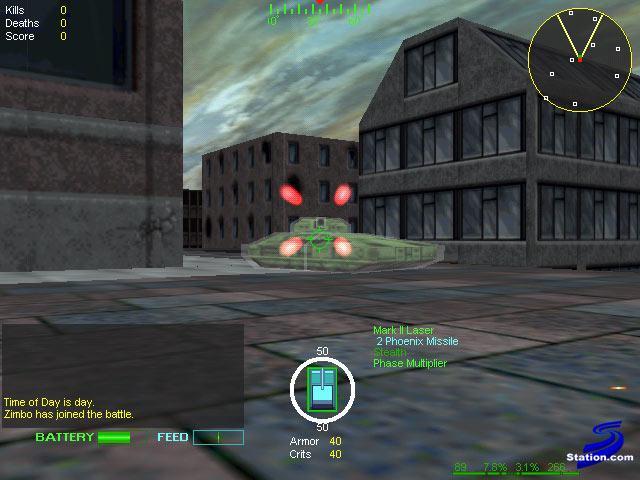
The pitch is clean enough to fit on a flyer from an alternate 1997 where the arcade never died. You choose one of five tank models, customize it with weapons and support modules, and roll into multiplayer arenas for deathmatch, team battle, duel, or capture-the-flag. Up to 20 players can be split across four factions in an arena, which is already a stronger social fantasy than the average shooter was offering at the time. The game is first-person, seen through the turret, so the whole world becomes a tunnel of streets, buildings, ramps, and tactical embarrassment. You are not a hero. You are a noisy appliance with a gun.
That little joke of scale is one of Tanarus‘s better qualities. Tanks are slow enough to make positioning matter, but not so ponderous that the game turns into a geological survey. The five models carry distinct personalities. The Lightning is quick and light, the Vanguard is your baseline, the Devastator is heavy and slow, the Chameleon is slow but stealth-capable, and the MagRider, despite the messy capitalization in some sources, is the maneuverable one. The names are not exactly subtle, but I have a soft spot for a game that is willing to call its bluff so openly. This is not a military simulation in the mud-and-clipboard sense. It is a competitive cartoon of armored roles, and the game is happiest when it leans into that simple, readable combat grammar.
The customization system gives that grammar some welcome friction. Tanks are not just shells with different top speeds. They are built around weapons, support modules, and power enhancements, and the battery system turns every shot and burst of movement into a little accounting problem. Fire too much, move too much, and your charge drains. If your battery hits zero, your tank crawls at 30 percent of normal speed. This is the sort of rule that can feel like a nuisance on paper and like a genuine personality in play. It means aggression costs something. It means a reckless driver can basically tax themselves into becoming a helpless metal shopping cart. It also means the game keeps reminding you that war machines, in this world, are held together by budgetary anxiety.
Some of the special modules are delightfully specific. Cloak hides you from the eye, stealth hides you from radar, Night Vision lets you function in the dark, and there are other power and utility options in the mix. The result is a game that wants players to experiment with loadouts and movement patterns rather than simply drive forward and trade shells like a pair of offended lawn tractors. That is the good news. The less glamorous news is that the design never fully escapes the orbit of its own premise. You do a lot of the same things, in the same kinds of spaces, with the same limited range of outcomes. The game is solid, yes, but it is also one of those solids that becomes a cube if you stare at it long enough.
What it feels like to play
The control scheme immediately announces the era and does so without apology: keyboard or joystick only, no mouse support. That is not a cute historical footnote, it is a shape-defining limitation. In a first-person tank game, where fine steering, turret alignment, and situational awareness all matter, refusing the mouse feels like being asked to paint a mural with a screwdriver. You can do it, eventually, but you will spend a lot of time wondering who thought this was dignity. The answer, of course, is 1997, a year when PC control conventions were still wobbling around like newborn deer. Still, the absence of mouse support is not merely quaint. It affects how the game breathes, how quickly it lets you correct mistakes, and how often you feel one step behind the action.
Once you adapt, the loop is straightforward. Spawn, choose your chassis, outfit it, enter the arena, watch your battery, try not to become a decorative ruin. The game’s rank structure, based on points rather than persistent tank progression, gives the matches a ladder to climb, with ranks ranging from private to general at 300 million points. In theory this supplies a long-term incentive. In practice it is the kind of arc that can feel gloriously absurd or faintly exhausting depending on your mood. Capture-the-flag sounds especially important in this system, because it pays substantial points and even shames the opposing faction, which is exactly the sort of old-school competitive pettiness I respect. Nothing motivates a multiplayer population like numbers and humiliation.
What Tanarus does well, for a game of its vintage, is make each match feel like a small logistical argument. Batteries matter. Tank class matters. Radar and vision tools matter. The battlefield is not just a shooting gallery, but a place where visibility, movement, and resource management can all turn on you at once. That is enough to give the game texture. It is also enough to make the repetition more obvious when you settle into the loop for too long. The sources are fairly consistent on this point: the gameplay is solid, the concept was novel, but the whole thing is not exactly a swamp of hidden depth. This is a game that can keep you busy, not necessarily a game that keeps revealing new layers like some paranoid onion of design genius.
And then there is the matter of scale. Reviews mention eight arenas, and those arenas are cities with buildings, ramps, and streets. That sounds promising, and it is, but the emphasis is on arena combat rather than exploratory complexity. You are not touring a grand military theater. You are driving through a series of urban mazes with shooting lanes. That is fine. It is also exactly the sort of environment that makes a weak camera or sluggish control scheme feel like a personal insult. The game mostly gets away with it because the concept is strong enough to carry the frame. Mostly.
Look, smoke, and the little lies of 3D
Graphically, Tanarus belongs to that late-90s school of 3D where the promise of technology is doing a lot of unpaid labor. The backgrounds are rendered in real time, there are day and night cycles, and transparent smoke and lighting effects help sell the battlefield mood. On a Direct3D-capable card, the game can produce enough visual trickery to make its low polygon tanks seem endearingly chunky rather than merely undercooked. Without that hardware, the illusion thins out, and the night fights in particular lose some of their drama because lighting effects drop away. That is not trivial. In a game where visibility and stealth are part of the vocabulary, missing visual effects are not just cosmetic omissions, they are design amputations.
I am charmed, in a grim little way, by the fact that the tanks are described as looking foolish. They do, apparently. Good. They should. A tank game that takes itself too solemnly becomes a military showroom. Tanarus at least keeps a slightly ridiculous silhouette. The problem is not that it is ugly. The problem is that its ugliness sometimes feels like an unresolved draft. There is a difference between stylized roughness and the visual impression of something still trying to remember whether it wants to be a simulation or an arcade game. Tanarus lives in that gap. Often that makes it interesting. Occasionally it just makes it awkward.
Performance, by the available reports, was decent enough, with smooth frame rates when the connection behaved and a stable experience under ordinary conditions. But there is also the documented slowdown when five or six tanks are on screen at once. That is the sort of detail that mattered then and still matters now, because multiplayer games live or die by how gracefully they handle clustered chaos. A tank battle is not supposed to become a slideshow just as everyone decides to converge on one point. If the game coughs when the action gets dense, then the battlefield starts auditioning for a museum exhibit. Even so, I would rather a game strain under its own ambition than coast on empty polish. That does not make the strain elegant, only honest.
Subscription as a design feature, or maybe a warning label
The monthly fee is impossible to ignore because it changes the emotional contract. A subscription online shooter in 1997 was not merely asking for money. It was asking for faith. It was saying, in effect, trust us, we will keep this little armored nation running, and you will pay rent to exist within it. That gives Tanarus a strange aura in retrospect. It was one of the early commercial online games, and unlike many of its contemporaries, it stayed alive under SOE for a long time. That is impressive as an operational fact. It also means the game had enough of a community, enough of a shape, and enough of a business case to survive years after the initial novelty cooled.
But again, survival is not the same as greatness. The game was later folded into Station Pass alongside other SOE titles, which sounds exactly like the sort of bundle strategy corporations invent when they have several aging online games and one very large spreadsheet. I do not mean that as a sneer. Well, not only as a sneer. It is just that this kind of longevity often says as much about service inertia as it does about design power. Tanarus endured because it had a workable core and a place in the early online ecosystem, not because it was secretly reinventing the species. The species was still figuring out how to stand upright.
The verdict hidden in the battery meter
So what do I actually think of it? I think Tanarus is a clever, sturdy, occasionally amusingly awkward online shooter that gets more credit from history than from pure pleasure, but not by much. The tank customization is genuinely the game’s best argument. The battery system gives combat a draining, literal pressure. The class distinctions are readable and useful. The faction and rank structure gives matches a sense of belonging to something larger than a one-off skirmish. When the game is working, it offers that rare late-90s online sensation of being part of a living machine that has not yet been overdesigned into misery.
And yet I cannot pretend it rises above its limits. The keyboard-or-joystick control setup is a real drag. The visuals depend heavily on hardware support and can lose their best tricks. The action, while solid, does not seem built to sustain endless fascination. It is the kind of game that can turn a handful of matches into an evening, then turn the next evening into a negotiation with your patience. You can admire the structure without mistaking it for depth. You can enjoy the novelty without pretending novelty is destiny.
If you want a historical curiosity that is also genuinely playable, Tanarus is worth your time. If you want a deep competitive shooter, a polished control scheme, or a game that keeps reinventing itself after the third hour, this is not your armored miracle. Its reputation as an early online oddity is deserved, and its status as Sony Online Entertainment’s first online title gives it some museum-glass glow, but the stronger truth is simpler: it was a good idea with enough execution to matter, and enough repetition to keep it from becoming essential. The strengths outweigh the flaws if you are interested in the era, the format, or the joy of watching a subscription service masquerade as a war game. They do not outweigh the flaws if you are just looking for fun that arrives without a fight.
Score: 7/10