The Space Bar is the kind of adventure game that makes me forgive a lot of sins and then immediately demand better behavior from everybody involved. It is a 1997 Windows PC graphical adventure, released on three CDs, and it has the kind of brainy, overstuffed structure that now feels almost indecently confident: a murder in an alien bar, a shapeshifting killer, a detective named Alias Node, about forty oddballs to interrogate, and a central gimmick that lets you dive into other characters’ flashbacks to solve self-contained little nightmare toys of puzzles. On paper, that sounds like a designer’s dare, the sort of thing built by people who had inhaled too many magazine previews and not enough sleep. In practice, it is both smarter and messier than that. Which is to say, it feels like a proper adventure game from the era when adventure games still believed they could be gloriously, gloriously awkward and get away with it.
My recommendation, right up front, is simple enough: I admire The Space Bar more than I love it, but I do love enough of it to think the admiration is earned. This is not one of those polite late-90s adventures that mistake smoothness for substance. It is a game with a real appetite. It wants you to poke through the alien equivalent of everybody’s dirty laundry, listen to suspects talk themselves into corners, and then throw you headfirst into a series of empathy-telepathy flashbacks where the rules change just enough to keep you slightly off balance. When it works, it has the delightful smell of a designer actually trying to outwit the player instead of simply standing there in a trench coat and calling that ambition.
The bar is the whole joke, and the whole point
The setup is shamelessly pulpy: Detective Alias Node is investigating a murder at the Thirsty Tentacle, an alien bar with the kind of name that tells you the game is not going to be bashful about its own weirdness. The killer is a shapeshifter who imitates aliens, which is a wonderfully obnoxious premise because it gives the whole investigation a paranoid, slippery quality. You are not merely gathering clues, you are trying to determine who is who in a room full of species, routines, body language, and excuses. The game reportedly gives you around forty characters to deal with, and that number matters less as trivia than as atmosphere. This is not a compact whodunit. It is a social swamp.
The main structure is built around pressure, which is probably why the game still feels lively even when it is being fussy. You have four hours in the bar, with time advancing one minute per location move. That timer is not decorative. It is the game’s little boot on your neck, the one that says, politely but firmly, move faster, ask better questions, and stop wandering off because the background art is pretty. Fail to arrest the killer by the end, and the game treats that as a real failure state rather than an optional embarrassment. This is the sort of design choice that some players call cruel and others, with a suspicious gleam in their eye, call old school. I call it effective when the puzzle logic supports it and infuriating when it does not, which is pretty much the adventure game experience in miniature.
And then there is the emp-tel system, the game’s strongest trick. Alias Node can enter and, in some cases, control flashback worlds belonging to alien patrons, turning the investigation into a sequence of miniature adventures. These are not just cutaway story dumps. They are puzzles in their own right, self-contained little logic traps involving things like shady characters, teenage tree-creatures, and robots, each with its own internal nonsense to decode. That is the good stuff. That is the sort of structure I miss when people talk about adventure games as if they were only about inventory items and moon logic. Here, the game understands that the real fun is not simply collecting a weird object, but entering somebody else’s memory and discovering that their personal disaster has its own rules.
Point, click, rotate, and try not to be late
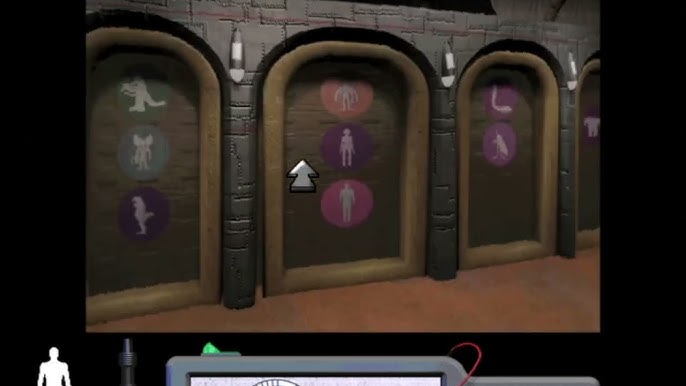
Mechanically, The Space Bar is very much a product of the pre-rendered adventure era, but it is not content to sit there looking glossy and inert. You move through pre-rendered backgrounds, and the game uses 360-degree rotating views at hotspots, which gives the spaces a more physical presence than the usual slideshow of flat screens. That matters. A lot of mid-90s adventure games felt like a collection of postcards pinned to a corkboard. This one tries to feel like a place, or at least a bar full of awkward lifeforms who would very much prefer you not keep staring at the ceiling vents.
The interface is built around context-sensitive menus for zooming and interacting, plus conversation commands that let you order actions, ask about topics, and assume attitudes. I appreciate any game that understands conversations should not just be yes/no machines with the personality of a receipt. Here, talking is part of the puzzle apparatus. You are not merely draining dialogue trees for exposition, you are trying to deploy questions and attitudes in the right order, with the right target, under a time limit that does not care about your emotional readiness. That is a good combination on paper, and often a good combination in practice, because it forces the player to think like a detective rather than a tourist.
Still, there is a difference between elegant pressure and friction for its own sake. The timer can sharpen the whole experience, but it also means missed interactions are not just possible, they are practically guaranteed on a first run unless you save like a nervous burglar. The research available to me points pretty clearly toward multiple saves being essential, and I believe it, because this is exactly the sort of game where one distracted conversation can cost you access to a clue, a puzzle branch, or a whole chunk of the intended route. That is not automatically bad, but it does mean the game asks for discipline from the player while occasionally behaving like a half-trusted accomplice.
In other words, it is not a comfort-food adventure. It is a machine that wants you alert, suspicious, and willing to backtrack. Some people will find that thrilling. Others will bounce off it with the grim certainty that the game is making them do office work in a funny hat. Both reactions are justified.
The flashbacks are where the game earns its keep
The bar sections are the spine, but the emp-tel flashbacks are the ribs, lungs, and several of the game’s better jokes. They work because they break the social-investigation rhythm just enough to keep the experience from becoming a checklist of interrogation and wandering. Entering a memory world means the game can reframe its logic, tighten its puzzle design, and make you approach a character from the inside rather than from across a table. That is a delicious idea, and the execution, according to the available material, is strong enough that the game has developed a kind of retro reverence among adventure fans.
What I find most appealing is that the flashbacks seem designed as actual adventures, not just decorative minigames. They are self-contained, they have inventory and logic elements, and they appear to vary in character rather than merely reskinning the same basic obstacle course. A game like this lives or dies on whether its side structures feel meaningful. If the flashbacks were only there to pad the runtime, the whole thing would curdle into a self-important puzzle buffet. Instead, they appear to function as the game’s main course. The bar is the frame story, yes, but the frame story exists to funnel you into stranger and more intimate spaces.
That said, the timer and the structure together also create a kind of cruel geometry. The game is apparently built so that failing to manage your time can lock you out of material, and since the flashbacks are embedded in the broader investigation, every mistake feels like it has consequences beyond a single puzzle room. I respect that ruthlessness more than I enjoy it. There is a thin line between tension and sabotage, and The Space Bar sometimes leans right up to that line with a swaggering grin, as if daring you to call the cops.
Presentation, or how to make a trashy future feel elaborate
Visually, the game’s pre-rendered backgrounds and rotating hotspots do a lot of heavy lifting. The research mentions detailed alien rooms, including species-specific bathrooms, which is exactly the sort of detail that separates a generic sci-fi backdrop from a place with teeth. A good adventure environment should tell you as much through clutter and architecture as through dialogue. This one apparently understands that alien life is best suggested not by shiny chrome nonsense, but by the oddly specific practicalities of living. Bathrooms, after all, are where worldbuilding either becomes believable or collapses under its own decorative fumes.
The three-CD structure is part of the texture too, even if it is the kind of texture that used to make you mutter at your computer. One disc for the bar, two for the flashbacks, plus the inevitable swaps, plus the additional strain of complex animations and sounds, all of it conspiring to remind you that CD-ROM adventure gaming was never exactly frictionless. On the original release, that meant the game’s ambition came with a lot of waiting around and a little ritual of disc management. The Steam re-release is relevant here only because it apparently preserves the original mechanics, including the timer, though naturally it removes the physical disc-swapping misery. That is an improvement in the way indoor plumbing improves castles.
The audio and interface reportedly use a PDA two-way radio for killer taunts, which is a neat bit of narrative flavor. The game wants to keep the murderer present even when the killer is absent, and a persistent taunting line is a fine way to do that. It adds menace without needing a full action-game apparatus. I like when adventure games understand that atmosphere can be delivered through interruptions. A well-timed message, a taunt, a half-heard exchange, these are the equivalents of footprints in the mud. You do not need a gunfight if the game can make you feel watched.
What it gets right, and what it absolutely overcommits to
The best thing The Space Bar does is trust its own eccentricity. It does not flatten itself into a generic science-fiction adventure template. It is committed to the alien bar as a social engine, committed to the detective premise as a puzzle structure, and committed to the flashback system as a way of turning empathy into mechanics. That last part matters. The game is not just about gathering facts, it is about inhabiting other beings’ experiences in order to understand the crime. That is more interesting than the usual adventure-game excuse for wandering through drawers and vent shafts, and it gives the whole affair a thematic coherence that, frankly, many more famous games never bothered to chase.
Its sense of humor also seems to be properly weird, not merely quippy. The setting itself is a joke that keeps expanding, and the game apparently plays that straight enough to let the absurdity land. That is harder than it sounds. If a game with this premise winked too hard, it would turn into a smug Sci-Fi Channel original. If it played everything too grimly, it would become intolerable. The sweet spot is to let the alien nonsense be normal within the fiction, which in turn makes the detective work feel like actual labor in a ridiculous world. That is the right choice.
Where it stumbles is where so many ambitious adventure games stumble: the friction of its own structure. The timer is conceptually strong but inevitably punishing, the missable content encourages anxiety over exploration, and the game’s complexity can feel less like elegant density and more like a stack of things that could have gone wrong if you breathed on them. That is not a fatal flaw, but it is the price of admission. This is not a game that wants to be breezed through. It wants to be managed. Sometimes, when a game wants to be managed this much, I can feel my patience filing for divorce.
And yet, the part of me that spent too many afternoons in arcades and too much of the 1990s reading import magazines cannot dismiss a game like this. It has the rare quality of being overdesigned in a way that reveals personality. You can feel somebody, somewhere, arguing for stranger ideas in the meeting. You can feel the project resisting standardization. That does not make every decision wise. It makes the game memorable, which is often the more difficult trick.
Verdict
The Space Bar is a clever, stubborn, sometimes aggravating adventure that deserves to be remembered for its imagination more than for its polish. If you like investigative adventures that treat conversation, memory, and structure as real mechanics, it is worth your time, especially if you enjoy the sort of 1990s design that assumes you can keep up with its odd little universe. If you want a relaxed, contemporary-friendly tour through a sci-fi setting, this is not your bar. The timer will glare at you, the puzzles will demand attention, and the game will occasionally feel like it is hiding clues in the pockets of your own panic.
Does it deserve its reputation among adventure-game devotees? Yes, mostly. Not because it is flawless, and not because rarity has inflated its legend, but because it genuinely tries to do something intricate with a familiar format and gets enough of it right that the effort still crackles. Its strengths outweigh its flaws, though not by a landslide. I would call it a smart, distinctive, and slightly self-punishing piece of late-90s adventure design, the kind of game that rewards curiosity, discipline, and a willingness to forgive some rough edges in exchange for a structure with actual ideas. In the eternal war between ambition and convenience, The Space Bar sides firmly with ambition, then makes you clean up the mess. I respect that, even when I am grumbling through my own save files.
Score: 8/10