Virtua Cop 2 on PC is one of those late-90s port jobs that looks, on paper, like a compromise and, in motion, like a small act of stubbornness. Sega took a 1995 Model 2 arcade light gun shooter, shaved off the gun, shoved in a mouse, and still wound up with a game that understands its own rhythm better than a lot of bigger, louder shooters that came swaggering in with full-price confidence. The North American Windows version even wore a different name, Virtua Squad 2, which is appropriate in the way a fake mustache is appropriate: technically distinguishable, spiritually the same face, and not fooling anyone who actually knows the drill.
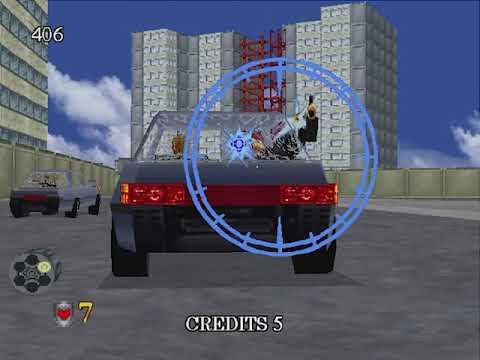
My thesis is simple enough to fit inside the arcade cabinet it came from: this is a very good conversion of a very specific arcade idea, and it remains a better game than its compromises deserve. That is not the same thing as being immaculate. The PC port asks you to accept a mouse in place of a gun, a disc that must stay in the drive, and at least some reports of copies that arrive without music (which is a cruel little joke for a game whose whole appeal partly rests on punchy, propulsive presentation). Yet once you are past the museum-label trivia, what you find is a sharp, fast, highly readable rail shooter that still knows how to make a player flinch, lean, and grin like an idiot in the space of a few seconds.
The joy is in the choreography
Virtua Cop 2 is not interested in being a simulator, nor does it pretend to be some grand tactical police fantasy. It is a fixed-path shooting gallery, a first-person rail shooter where enemies keep appearing in front of you, behind cover, on ledges, behind windows, and in all the places your reflexes are trying to ignore. You move forward automatically, because of course you do, and the game’s entire personality comes from the timing of what it throws at you and when it throws it. Gangsters, soldiers, loaders, whatever hostile prop department Sega has sent out to ruin your afternoon, they do not just stand there like target mannequins. They react. They fall off things. They crash through crates. They burst into the scene with that Model 2 swagger that made polygonal bodies look less like geometry and more like an argument.
That is the real pleasure here, not merely shooting things, but watching the game answer your shots. Virtua Cop 2 is obsessed with context-sensitive little bits of drama, the kind that make a hit feel like a tiny piece of slapstick punctuation. A good shot is not just a point value, it is a moment of physics theater. Shoot the right thing and the environment joins in on the gag. Shoot the background targets and the score rewards you for behaving like the suspicious, twitchy arcade obsessive Sega was clearly hoping to create. The game keeps reminding me that, in the right hands, a rail shooter is basically a timing puzzle dressed as a police action movie that got rewritten by a pinball table.
The PC version keeps that structure intact. The mouse stands in for the arcade gun, which is not quite the same as standing in front of a cabinet and physically jabbing at the screen, but it preserves the essential contract: aim, fire, react, repeat. On a good run, the controls are quick enough to keep the game’s pace intact, and that matters because pace is the whole bloodstream here. If you hesitate, the game does not become harder in some noble, strategic sense. It simply becomes less fun, like a joke told by someone who keeps stopping to check if you are still listening.
A home conversion that understands the assignment
What I respect most about the 1997 Windows port is that it does not behave like a timid apology for not being in an arcade anymore. The research on this version points to a straightforward adaptation rather than a reinvention, and that is exactly the right call. There is no evidence here of some grand attempt to transform Virtua Cop 2 into a sprawling PC action game with menus, inventories, and a tragic interest in immersion. Sega knew what had to survive the trip, and the answer was the thing that made the original worth caring about: the cadence of the shooting and the clean visual hierarchy of threats.
That matters because the original arcade game was built on Model 2 technology, with texture-mapped polygons and a visual style that made enemies and stages easy to read at speed. On PC, that clarity is still the star of the show. The game does not need lush detail. It needs enemies to pop, hit reactions to land, and the screen to remain legible while everything else is moving at arcade speed. When a home port preserves that, I do not care if it comes bundled with a little period-specific jank around the edges. In fact, I almost expect it. The late 90s were full of conversions that treated arcade fidelity as a rumor, so seeing one that actually respects the source material feels less like an achievement and more like a recovered crime scene report.
There is also something deliciously stubborn about the disc requirement, which sounds annoying because it is annoying. Having to keep the disc in the drive is exactly the sort of detail that instantly dates a PC game to the era when software still treated your desktop like a suspicious teenager needed to be supervised. But that little inconvenience also tells you what kind of product this is, a commercially serious, hardware-bound conversion from an age before digital storefronts turned every game into a ghost. It wants to be physical. It insists on being present. It is mildly rude about it.
Presentation, noise, and the small matter of missing music
When Virtua Cop 2 is working properly, its presentation does a lot of heavy lifting. The game is built out of polygonal people and hard-edged spaces, but what you actually perceive is motion and intent. Enemies do not just occupy the screen, they perform for it. The action is built so that you can understand what a threat is almost the instant it appears, which is a far more valuable skill in an arcade shooter than technical flourish for its own sake. That is one reason the game survives scrutiny better than some of its peers, including the ones that confuse complexity with excitement and end up feeling like they are throwing office furniture at the player.
Sound, though, is where the PC version invites a little suspicion. Some copies reportedly lack CD audio or music, and I do not say that lightly because the absence of music in a score-driven shooter is not a small matter of mood. It is the difference between a confident ride and one conducted by a secretary with a broken intercom. The sources I checked do not present this as universal, so I will not overstate it, but the possibility is enough to matter. Virtua Cop 2 thrives on momentum, and momentum likes a soundtrack. Without it, the game can feel more clinical, less like an arcade machine with a pulse and more like a carefully assembled demonstration unit that escaped from a trade show.
Even so, the underlying design is strong enough to survive some presentation wobble. That says something important about the game and, frankly, about Sega AM2 at the time. This is a studio that understood the arcade as a place where readability, timing, and spectacle are not separate virtues but the same virtue wearing different jackets. The result is a game that still feels purposeful, not merely preserved. A lot of old arcade ports are interesting because they are old. Virtua Cop 2 is interesting because it still knows how to hit you in the reflexes.
What it does not have, and why that still matters
The biggest caveat, which is also the thing nobody can politely fix, is that the PC port cannot truly replace the physical gun feel of the arcade cabinet. That is not a moral failing. It is a hardware reality, and one that any honest review has to acknowledge. The mouse approximation works, but approximation is the keyword. You are translating a gesture, not inhabiting it. The difference is smaller than it sounds during a fast run, and larger than it sounds the first time your wrist reminds you that it is not a light gun, it is an office implement with delusions of action-movie grandeur.
That said, I would rather play Virtua Cop 2 with a mouse than not play it at all, because the game’s essential pleasures are not dependent on an exotic control scheme. They come from target recognition, reaction time, and the elegantly vulgar thrill of popping enemies before they get a shot off. The limited lives and damage system, as documented by the sources, keep the pressure on in the expected arcade way, but the pressure is more about accuracy and composure than endurance. The game wants your attention, not your devotion. It is merciful in the exact way arcade design is merciful: it lets you feel clever right up until you are not.
And yet I cannot pretend the whole package is pristine. The record on some version details is inconsistent, especially around features that are not well documented in the available sources, so I will not invent conveniences the game may or may not have offered. What is clear is enough: this is an arcade-style shooter adapted for Windows in 1997, with a mouse-based control scheme, multiplayer support for up to two players, and a reputation for being a strong home conversion. That reputation is deserved, but not because the port magically solves the mismatch between gun and mouse. It is deserved because the underlying game is so confidently built that even the compromise feels workable instead of tragic.
Verdict
Virtua Cop 2 on PC is for players who want an arcade shooter that actually remembers why arcades were exciting in the first place: immediate comprehension, short-burst intensity, flashy reactions, and the delicious sense that every good shot is both a practical action and a small act of humiliation directed at the screen. It is not for anyone seeking deep systems, generous content layering, or a home conversion that disguises its origins in the grand manner of a prestige remake. It is also not for the control purist who cannot abide the idea of a mouse standing in for a light gun, because yes, the difference is real and yes, you will feel it.
But does it deserve its reputation? Absolutely, with the usual footnotes. It deserves praise as one of Sega AM2’s better arcade ideas translated into a home format with real care. It deserves credit for staying readable, fast, and satisfyingly reactive. And it deserves a little skepticism for the awkwardness of the PC trappings, the disc requirement, and the occasional reports of missing music, which prevent it from becoming the fully effortless no-compromises version fantasy catalog copy would like you to imagine. Still, the strengths outweigh the flaws by a comfortable margin. Virtua Cop 2 remains the rare old shooter that is not just historically important, but genuinely fun in the present tense, which is a much harder trick than the industry likes to admit.
Score: 8/10