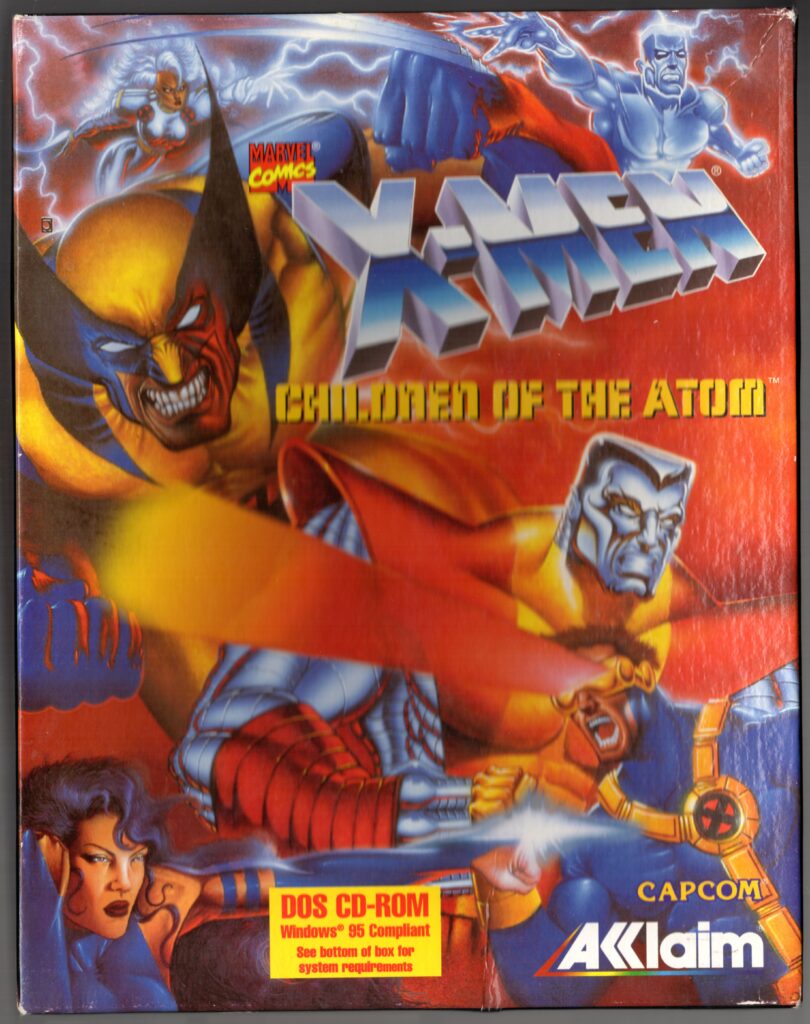
The PC version of X-Men: Children of the Atom is the sort of fighting game that arrives with its fists already clenched. It is a direct arcade translation of Capcom’s 1995 X-Men fighter, and that is both its great virtue and its main problem. Virtue, because Capcom was in one of those suspiciously efficient moods where the sprites were crisp, the animation was lively, and the whole thing moved like it had swallowed a bottle of adrenaline. Problem, because an arcade game built to extract coins does not suddenly become a courteous houseguest just because you install it on a beige PC and point a keyboard at it. It still wants pressure. It still wants you uncomfortable. It still wants you to learn faster than it feels polite to learn.
That is the core of it, really. Children of the Atom is not a contemplative fighter, not a technical chess match in a tuxedo. It is a loud, aggressive, comic-book riot built on six buttons, super jumps, air combos, multi-hit specials, and the X-Power gauge, which functions as the game’s special and super meter. The design leans hard into speed and aerial chaos. Footsies matter, sure, but they are not the main religion here. This is a game that would rather launch you upward, keep you there, and then crack the screen open with one more flashy nonsense attack before you have quite processed the first one. In the 1990s, that kind of thing felt like progress. Sometimes it still does.
A fighter with a plan, and the nerve to stick to it
What Capcom made here was, at the time, a very specific proposition. Take the logic that made Street Fighter II a machine for obsession, then tilt it toward Marvel comic-book exaggeration and let the match pacing get a little more airborne, a little more extravagant, and a little more feral. The result is a one-on-one fighter with a small roster, a versus mode, and an arcade mode that sends you through a run of random AI opponents before dumping you into the inevitable company of Juggernaut and then Magneto. That final stretch matters because it tells you exactly what sort of game this is: one that understands escalation as a form of theater. You are not just clearing stages. You are being led, by design, toward bigger nonsense.
The six-button structure gives the game its proper Capcom pulse. Light, medium, heavy, punch, kick, all the usual grammar is there, and the game uses it to build a fairly dense offensive language. According to the research, it is combo-heavy and fast-paced, with an emphasis on aerial aggression and special move pressure rather than measured, footsie-first patience. That matches the feeling of the thing as described across the sources: this is a fighter where the screen seems happiest when it is busy. You jump. You super jump. You tag opponents with multi-hit specials. You try to keep momentum from leaking out of the match like air from a badly patched tire. If you enjoy fighters that reward momentum and cruelty in roughly equal measure, the game has plenty to offer.
Cyclops is the easiest example to explain because he sits closest to the familiar shoto template, with optic blast and a rising attack analogue to the old fireball and uppercut vocabulary. That gives the game at least one anchor point for players who want a recognizable center of gravity. But the broader appeal lies in the fact that the cast is built for variation, not sameness. The game is not trying to make everyone behave like a duplicate martial artist with a funny costume. It wants a comic-book roster to feel like a comic-book roster, which means exaggerated movement, big hit reactions, and the kind of attack patterns that turn a round into a short-lived public incident.
And then there is Magneto, who serves as the final boss and, according to the available material, the sort of nightmare that gives arcade AI a bad name and a career. Juggernaut is typically the sub-boss. That structure tells you plenty about the difficulty curve: the game does not so much ramp up as it does stand behind you, whispering, and then shove you down the stairs. The AI is described as tough, and the balance as uneven, with Magneto in particular a dominant presence. This is not a bug in the social sense, it is an intentional artifact of arcade-era challenge design. Still, there is a line between demanding and disagreeable, and Capcom was often interested in walking right up to it and then taking a photo.
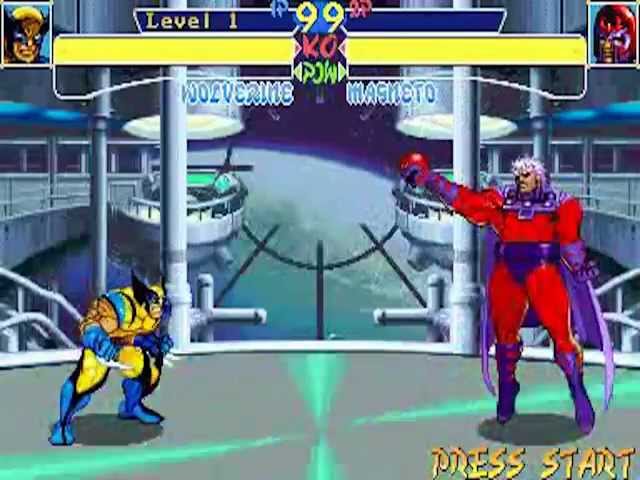
It looks fantastic, because of course it does
One of the reasons people forgive old fighting games their sins is that they knew how to sell the fantasy with images. X-Men: Children of the Atom is heavy on vibrant 2D sprites, detailed character art, and smooth animation that aims to make the cast look comic-accurate without falling into stiff imitation. The research repeatedly points to the characters being instantly recognizable and fully detailed, and that feels like the right praise. Capcom understood that these games live or die on silhouette and readability. If Wolverine does not look like Wolverine in motion, what exactly is the point of all this violence?
The stages help too. X-Men-themed arenas, including things like a Sentinel factory, create the proper feeling of comic-book escalation, where the setting is never just a backdrop but a sign that the battle has already escalated beyond reasonable civic administration. The game is not subtle, but subtlety would be a waste of time here. These environments are there to frame the action, not to distract from it, and they do their work with the dry confidence of a machine that knows the money is in the animation. The visuals are one of the reasons the game still retains its aura. Even now, it has that old Capcom brightness, the kind that makes everything look as if it has been lit for a Saturday morning program by somebody who also collects arcade boards.
The audio, while not described in the sources as some legendary achievement on its own, contributes usefully to the package. There is pumping stage music, crunchy punch effects, and voice lines and grunts that help keep the comic-book mood intact. Some of the voices apparently come from animated series actors, which is exactly the sort of detail that makes a licensed fighter feel a bit more committed to the bit. Nothing in the research suggests the soundtrack is the main reason to remember the game, but it does what a good arcade fighter soundtrack should do, which is keep the blood pressure up and make every round feel like it has a smoke machine hidden just off-camera.
The PC port, where the real 1990s begin
The specific version under discussion here, the 1997 PC port, is important because it preserves the arcade game with a kind of stubborn devotion that borders on comedy. The research describes it as a direct translation from the arcade, and even notes that it retains the arcade memory check function, which is exactly the kind of thing that makes me laugh in the sour, affectionate way only old PC gaming can inspire. Here is a game trying to keep the arcade intact, right down to the housekeeping that no home user really wants to think about. It is as if the cabinet has been packed into the machine and is still checking whether it has enough cash in its pockets.
That directness is a strength, especially for players who want the arcade game as originally intended, not some softened approximation. The same fast action, the same aggressive AI tendencies, the same six-button structure, the same general refusal to become polite, all of it survives the trip. But the port also belongs to a period when even a faithful conversion had to negotiate with hardware reality. The research does not give me enough to make grand claims about compatibility beyond the fact that the port is a direct arcade translation, so I will not invent drama where the record is thin. What I can say is that the PC version exists as a snapshot of that era’s ambitions, when “arcade perfect” was less a guarantee than a dare.
And yes, the game has no tutorial, at least none documented in the research, which means it expects you to learn by poking it until the system reveals itself. That is a very arcade thing to do, and not always a charming one. Older fighters often confused opacity with honor. Sometimes that yields mastery and appetite. Sometimes it yields people mashing buttons in a rental shop while pretending they meant to do that. This game leans toward the former, but it does not exactly take your hand. The lack of any documented save or password system fits the same temperament. This is not a game that wants to be preserved in little bite-sized domestic sessions. It wants you present, focused, and slightly under siege.
Small roster, big attitude
The limitation that keeps nibbling at the edges of the praise is the roster. The sources describe it as small, and that matters more than it might in a more sprawling fighter. A compact cast can be a virtue if every character lands hard enough to justify the total. Here, the cast does its job, but the game still carries the faint feeling of being a first argument rather than the final one. It is exciting because it is dense and clear, but the select screen is not exactly overflowing with the sort of depth that keeps people arguing in arcades until closing time and then continuing in the parking lot. The game’s focus on aggression and air movement makes it lively, but the small roster means it cannot rely on endless match-up variety to stretch its lifespan.
That said, I do not want to pretend this is a flaw in the same category as actual incompetence. It is more a structural limit, and one that the game mostly compensates for with personality. Each fight is designed to feel like a burst, not an extended opera. The problem is that bursts eventually end. If you value a fighter for the way it compresses spectacle into short, combustible rounds, this can feel exhilarating. If you want a deep, endlessly revisitable competitive ecosystem, you will probably start noticing the walls sooner than the game would like. A lot of 1990s fighters depend on the player being charmed by the shape of the system before they get too good at seeing its seams. This one is no exception.
Balance follows the same logic. The research mentions both innovation and imbalance, and that is not a contradiction so much as a diagnosis. Capcom was doing interesting things here with super jumps and air combos, but innovation in fighting games often arrives in the company of rough edges. Some characters will plainly enjoy the system more than others. Magneto’s dominance at the end of the arcade ladder is part of that story, and it gives the game a distinctly old-school flavor, where the boss encounter does not merely test your skill, it exposes the game’s taste for favoritism.
What survives, what stings, what I admire anyway
I admire this game because it knows exactly what kind of spectacle it wants to be. It is not ashamed of its comic-book origins. It is not trying to be elegant in a minimalist sense. It is trying to be physically exciting, visually legible, and mechanically noisy. In the best rounds, it achieves that with a clean, almost rude efficiency. You get the sense of momentum building in your hands, the sense that the game is inviting you to keep taking risks because the reward is usually a better-looking form of violence. That is a strong feeling, and not every fighter can produce it.
But I also keep coming back to the fact that this is an arcade game first, and a home PC game only because the world insisted on translating it. The direct arcade nature is part of its appeal, but it also means the game has a hard edge where a domestic audience might prefer a little padding. No tutorial, a small roster, a tough AI curve, a final boss who behaves like he has been paid per interruption, and a structure that prizes speed over comfort, all of this adds up to a game that is exciting more often than it is hospitable. I do not think that is a disaster. I do think it limits the audience.
So here is my clean verdict, without the museum dust. X-Men: Children of the Atom is for players who want an early Capcom Marvel fighter in its raw arcade form, with all the flash, aggression, and sprite-work swagger that implies. It is not for anyone looking for a forgiving entry point, a rich roster buffet, or a single-player mode that behaves like a gentleman. It deserves its reputation as an important and influential fighting game, but historical importance is not the same thing as universal pleasure, and luckily this one has enough actual pleasure to back up the legend. Its strengths outweigh its flaws, though not so overwhelmingly that I would call it easy company. It is a thrilling, slightly bullying piece of 1990s fighting-game culture, and I mean that as praise.
Score: 8/10