Tom Clancy’s Politika is the sort of game that makes me suspect the late 1990s were being governed by an escaped committee of risk analysts, Cold War novelists, and people who believed every box on a store shelf should contain at least one map of a collapsing nation. This is the 1997 PC adaptation of Red Storm’s own board game, and it is very much that: a digital board game about factions fighting for control in a fictional post-Yeltsin Russia, dressed up with Clancy’s name, a stern introductory video, and the sort of managerial ambition that sounds impressive until you actually have to sit through another turn.
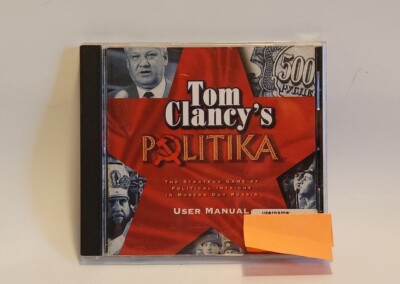
I should be clear about the version here, because the record matters. The game I am talking about is the original 1997 PC release, the computer translation of the board game, not some later revival or slick reimagining. If you came in expecting a conventional strategy game with the usual PC-era conveniences, Politika has a grin on its face and a ledger in its hand. It is a turn-based contest of influence, movement, trading, and opportunistic sabotage, played over a map of Russia with 3 to 8 factions jostling for position. The fantasy is not conquest in the grand wargame sense, but political survival, which is a neat idea. The execution, however, is the kind of neat idea that has been left too long near a radiator.
The best thing about Politika is its premise, which is also its trap
Politika’s setup is deliciously cynical. Russia, 1999, a pile of competing powers are all elbowing each other out of the way: military, KGB, Mafia, Church, Reformers, Communists, and whatever other political weather system the game decides to throw into the room. Each faction begins with a couple of representatives, a scattering of influence tokens, and a country already seeded with uprisings. Over the course of 6 to 10 rounds, you produce money, move your pieces, launch challenges, trade, bluff, bargain, and try to keep your enemies from turning your region of the map into a smoking mess. There are faction-specific abilities too, which is exactly the sort of thing that can make a political board game sing, because asymmetry is where these designs either become deliciously nasty or collapse into abstract stationery.
And Politika does have the right instincts. It wants to be a game about leverage, not raw force. The challenge phase, with its dice-driven fights for influence, is the sort of system that can produce dramatic reversals and deeply annoying outcomes in the same sitting, which is frankly the correct emotional temperature for a game like this. Cards and inflation modify those struggles, which gives the whole thing a grubby, transactional feel. You are not rolling armies across continents; you are constantly trying to make the other person blink first, then paying them, then stabbing them with a procedural smile. That is good politics, or at least good board-game politics.
There is even a wry sort of elegance to the faction abilities. The KGB can steal a random card. The Military can move uprisings more freely. The Communists get extra challenges. The Reformers have a more productive phase. These are not subtle, and I do not think they are meant to be. They are the sort of broad-stroke powers that tell you immediately what fantasy you are inhabiting, which is useful in a multiplayer game where the whole point is to let human paranoia do the heavy lifting. If everybody at the table is sharp, Politika can absolutely become a little geopolitical knife fight, all posturing and counters and grudges.
The problem is that the computer version keeps insisting on being a board game when it should be helping me forget that
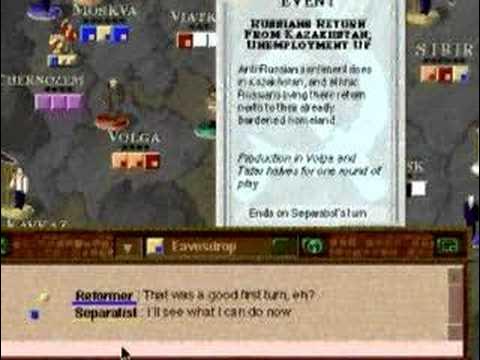
Here is where the rose-colored nostalgia goggles start sliding off my face and onto the floor. Red Storm’s PC version is, by most accounts and from the available material, a rather unadorned translation of the board game. That alone would not be fatal. Plenty of digital board games survive by being direct, even austere. The issue is that Politika inherits the worst habits of tabletop administration without fully earning the conveniences a computer should provide. Turns are phase-based and timed, and the manual skip is needed for AI turns, which means single-player sessions can sink into a kind of bureaucratic molasses. You watch the machine conduct its little diplomatic rituals, wait for the next phase, wait for the next phase after that, and eventually begin to wonder whether you are playing a strategy game or shadowing a junior clerk at the Ministry of Annoying Delays.
This is the central contradiction of Politika. Its design wants social friction, tradeoffs, and negotiation. Its PC implementation, at least in the solo experience, turns those same qualities into dead air. In a living room with three or four human beings trying to outwit one another, the timing, the bluffing, and the alliances might feel tense, even gleefully nasty. Against the AI, the whole affair becomes exposed as a mechanical process with very little personality to prop it up. Sources are fairly consistent on this point: the artificial intelligence is shallow and tedious, and the single-player mode does not conceal that weakness. The game can be played alone, yes, but that is more a concession to practicality than an invitation to delight.
And multiplayer was supposed to be the answer, the grand selling point, the virtual living room pitch that made the internet sound like a place where friends would gather and enact the collapse of a fictional Russia over modem lines. In theory, that is a fine ambition. In practice, a multiplayer-only vibe is a dangerous thing to hang your life on, because it means the game is only as alive as the number of other people willing to suffer its pacing with you. The research notes that finding opponents was difficult, which is hardly shocking for a niche board-game adaptation with a political theme and a UI built like it was intended to be explained by a patient uncle.
What it feels like to play, moment to moment
Politika’s mouse-driven interface and phase structure give it the feeling of operating a laminated strategy manual. You are not coaxing a living simulation, you are stepping through a series of administrative rituals. Production, movement, challenge, trading, uprisings, repeat. The map of Russia gives the game a strong visual spine, and I do appreciate that the board is there in plain sight, because at least the game knows what it is. There is no fake cinematic fog, no desperate attempt to turn a board game’s abstract bones into some goofy pseudo-realistic battlefield. The pieces are pieces, the regions are regions, and the fight is over influence tokens, not heroics.
That honesty is probably Politika’s most likable trait. It is not embarrassed by its own tabletop ancestry. The problem is that honesty is not the same thing as momentum. Games like this live or die by tempo, by the feeling that each decision opens one door and slams another. When the timing bogs down, when the AI spends your precious minutes performing invisible administrative labor, the design starts to feel less like a political thriller and more like a spreadsheet that has learned to roll dice. I do not mean that entirely as an insult. Some of the best strategy games of the era absolutely are glorified spreadsheets with a sense of humor. But they usually know how to keep the blood circulating.
The challenge system, again, is where the game briefly remembers to be fun. Dice introduce uncertainty, cards shift the odds, and inflation, that wonderfully dreary force, adds another layer of pressure. It gives the game a flavor of instability that suits the setting and the premise. Every faction is trying to turn chaos into advantage. Fine. Excellent. That should be fertile ground. Yet the further the game gets from that core tension and into the administrative handling of turns, alliances, and AI processing, the more it feels like a compelling idea trapped inside an overformalized machine.
Presentation, mood, and the peculiar charm of low production values
The available coverage does not suggest a lavish presentation, and that low-end texture actually fits the game better than a glossy treatment would have. There is an introductory video with Tom Clancy, which is exactly the kind of branding flourish that makes a 1997 strategy game feel like it was assembled under the watchful eye of a marketing department determined to prove geopolitical seriousness by force. Beyond that, the package sounds sparse. Functional map, straightforward interface, not much else. No one is coming to Politika for orchestral thunder or lavish animation, and honestly I respect a game that does not fake a personality it does not have.
Still, there is a difference between austere and underfed. Politika seems to have fallen on the wrong side of that line, at least in its PC form. The presentation does the minimum needed to communicate the board, the factions, and the turn structure, but the result is more chore than drama. A good political strategy game can make a map feel like a powder keg. Politika makes it feel like a meeting room with too many chairs. The atmosphere is there in the premise, not in the texture. That is often the case with these board-game conversions: the theme arrives intact, then the life gets shaved off in the translation.
I keep coming back to the weirdness of having Tom Clancy’s name on this thing, because it gives the whole product a faint scent of executive seriousness. Not seriousness of thought, mind you, but seriousness of presentation. Clancy as brand, Clancy as gravitas, Clancy as an endorsement stamp that says, in effect, yes, this is about important men in important places making important threats with important maps. Meanwhile the actual game is a digital argument over influence tokens and uprisings. Which is funny, in a dry and slightly suspicious way. It feels like the kind of branding that assumes the customer will be soothed by the presence of a famous name and not notice that they are, in fact, still playing a board game.
The reputation is small, but not mysterious
Politika has the sort of cult shadow you would expect from a niche multiplayer strategy oddity. There is a little curiosity value in seeing Red Storm, a company better known for other kinds of tactical and military fare, translate its own board game into PC form. There is also historical interest in the way it sits among late-1990s strategy experiments that treated board-game diplomacy and digital play as a perfectly sensible marriage. But history is not a forgiveness machine. A game can be interesting as an artifact and still be tiring as a game, and Politika lives right in that uncomfortable overlap.
The record is a little inconsistent on small details, such as the exact minimum player count, which sources vary on, and the specific faction list, which is clearly not fixed in every account beyond the major examples. That is annoying if you are trying to write a catalog entry and mostly irrelevant if you are trying to decide whether the thing is worth your time. The answer, unfortunately, is still governed by the same large truth: Politika is at its best when it is being negotiated by actual people, and at its worst when it is forcing you to wait for the computer to do bookkeeping.
I do not think this is a bad idea badly conceived. I think it is a good board-game idea awkwardly housed in a PC shell that never quite learns how to make the medium work for it. That is a subtler failure, and in some ways a sadder one. If the game had been nonsense, I could laugh and move on. Instead, it keeps flashing the outline of a smarter, nastier, more playable version of itself, then turning around and asking me to sit through another phase while the AI shuffles its papers.
So who is Politika for? Mainly the patient, the curious, and the people who genuinely enjoy multiplayer political backstabbing more than they enjoy smooth solo strategy. Who is it not for? Anyone looking for a brisk, polished, reliably entertaining PC strategy game, because this one is more likely to test your tolerance for pacing than your tactical imagination. Does it deserve its reputation? In a narrow sense, yes, as a remembered oddity with a cult multiplayer afterglow and a distinctly late-1990s sense of ambition. As an actual game to recommend without caveats, no, not really. Its strengths are real, but they are too often buried under tedium, and tedium is the one opponent no faction ability can plausibly bribe away.
Score: 5/10