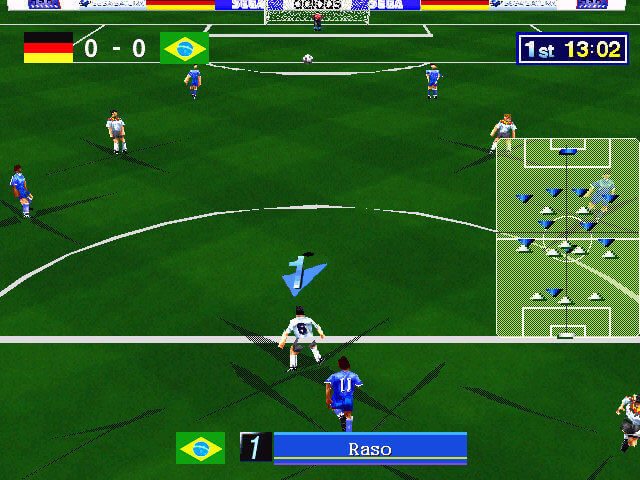
SEGA Worldwide Soccer ’97 is the kind of football game that arrives wearing a shiny arcade jacket and then, halfway through the first match, quietly admits it has a limp. On paper, that sounds like a deal breaker. In motion, it is more complicated, and more interesting, than the usual retro sports memory lane nonsense. This is a Sega soccer game built for speed, spectacle, and instant emotional contact, but the version I am focusing on here is the PC release, which the record treats as a separate context from the better documented Saturn version. That distinction matters. The PC edition is visually weaker than its Saturn sibling, and since most of the available commentary is Saturn-heavy, I have to read the game through that slightly foggy window, with the appropriate amount of caution and side-eye.
What you get is an arcade-style football game with unlicensed teams and players, support for one to four players, and a design that wants momentum to feel dramatic rather than simulation-perfect. That already tells you the house philosophy. Sega was not trying to build a cathedral of tactical purity here. It wanted sprints, collisions, star performers, and the basic thrill of seeing the ball move like it has someplace to be. In that sense, the game has a very mid-90s confidence about it, the sort that says realism is optional so long as the match feels alive. The trouble, as several contemporary and retrospective comments make plain, is that feeling alive is not always the same thing as feeling responsive.
The promise and the problem
The most appealing thing about SEGA Worldwide Soccer ’97 is also the thing that makes it vulnerable to criticism: it aims for arcade immediacy. Reviews and gameplay writeups describe fast-paced action, dynamic play, and star players who move faster and handle the balance of a match with a noticeable edge. That is the good bit. It means the game has personality. It wants certain players to matter. It wants bursts of speed to feel like events. It wants the pitch to turn into a stage, not a spreadsheet.
But then comes the phrase that keeps sticking in my teeth: delayed. One source characterizes the gameplay as feeling delayed, predetermined, and outdated. That is the sort of condemnation that makes a critic sit up straight, because it attacks the very thing arcade sports games must never botch. If your football game promises crisp action and then hands you a little latency-flavored shrug, the whole fantasy starts to wobble. You can forgive limited tactics, you can forgive license absences, you can even forgive a bit of goofy animation if the game feels sharp under your thumbs. What you cannot forgive, not for long, is the sensation that the game is reacting to you from inside a dusty office two rooms away.
And that is the key tension here. SEGA Worldwide Soccer ’97 wants to be immediate, but some of the commentary suggests it lands closer to managed momentum, where the match sometimes seems to unfold according to pre-baked rhythms instead of your decisions. That does not make it unplayable. It makes it compromised in the most annoying way possible, because the game clearly knows what kind of excitement it wants to generate. It just does not always deliver that excitement with enough snap.
Two modes, one temperament
The research points to two main modes, though it does not give me enough reliable documentation to start inventing labels or menus out of thin air. So I will stay disciplined and say only this: the game is structured around a compact set of options rather than some sprawling management labyrinth. That suits its temperament. SEGA Worldwide Soccer ’97 is not interested in making you earn your entertainment through bureaucracy. It wants you on the grass, moving, passing, shooting, and generally pretending your thumbs are more athletic than they are.
That makes the star-player system especially important. Anything that distinguishes one athlete from another in an unlicensed football game does a lot of heavy lifting, because once the real names are gone, the game has to persuade you that this pile of polygons still resembles competitive sport rather than generic athletic wallpaper. Better balance, faster movement, and the idea that particular players stand out all help. They also hint at a design that is more arcade than simulation, more about readable difference than statistical micromanagement. When it works, that is enough. When it does not, the illusion thins quickly, and you start noticing the seams in the same way you notice bad dubbing in a dubbed kung-fu movie: once you see the mismatch, you cannot unsee it.
That said, this is not a game I can accuse of indifference. Even the criticisms levelled at it tend to imply a clear identity. It is not trying to be a sober tactical study. It is trying to be a quick, lively, slightly exaggerated football experience, and that ambition is at least coherent. If it stumbles, it stumbles in pursuit of a definite idea, which is more than can be said for a lot of forgettable sports software from the period that confused realism with dignity and called it a day.
Presentation, or how to dress a soccer game like a challenge coin
The visual story is messy in the usual cross-platform way. On Saturn, the game is described as having decent in-game graphics and player animation, plus three stadiums. Other sources praise the audio and music, and one review flat-out calls it the best Saturn soccer game despite issues with AI and licensing. That is a pretty respectable cluster of compliments, especially for a genre that often looks like it is being rendered by committee. The Saturn version seems to have the stronger visual and overall presentation reputation, while the PC version is specifically noted as having weaker graphics. There is no point pretending otherwise. If you are coming at the PC release expecting the full Saturn sheen, the record suggests you are going to see a thinner coat of paint.
Still, the game is not presented as a total embarrassment. The broader consensus around the Saturn build suggests that Sega at least understood the importance of motion, color, and readable animation in a football game. Good sports presentation is not about photorealism, not really. It is about whether the field feels inhabited. Whether the players snap into action convincingly enough that your brain starts doing the rest of the work. The reports here imply that SEGA Worldwide Soccer ’97 had enough of that old Sega arcade sparkle to keep its head above water, even if the PC version took a bath in pixel compromise on the way over.
The box art was apparently bright, which is charming in the way late-90s sports packaging often was, as though the marketing department believed brightness itself counted as strategy. I do not know that it mattered much, but I admire the optimism. It is the sort of visual confidence that says, yes, this game may be arguing with its own animation budget, but at least the cover can look like it knows where the stadium is.
Sound, atmosphere, and the little seductions of the era
The audio gets better notices than the mechanics deserve, which is usually a good sign. When a sports game has impressive sound and music, it means the developers understood an ancient truth of the genre: if the boots sound right and the crowd sells the moment, you can cover a multitude of sins. You can even make ordinary play feel like a television event. That seems to be part of the appeal here. The game reportedly has a lively enough presentation to keep the arcade energy from collapsing entirely under its own constraints.
And yet, the atmosphere cannot fully hide the sensation that some of the action is working against the player. That is where the old-magazine voice in me starts grumbling. I spent too many years reading previews that promised blistering pace, then discovering that blistering often meant merely briskly awkward. SEGA Worldwide Soccer ’97 seems to live in that zone. It is quick enough to sell the fantasy, but not always immediate enough to make the fantasy feel clean. The sound and motion help, of course. They always do. But a good stadium roar cannot rescue a footrace that feels like it was decided before the whistle.
Where it sits in the football pile
One reason this game still attracts attention is that it comes from a Sega lineage that mattered. The research identifies it as a successor to earlier Soccer titles, and notes that SEGA Worldwide Soccer ’98 would later surpass it by offering more teams. That does not automatically make ’97 a stepping stone, but it does situate it in a very familiar sports-game tragedy: the mid-year or mid-series installment that gets a few things right, then gets overtaken by a sequel with more content, more polish, or simply fewer rough edges. The cruel joke of sports games is that they are rarely remembered for being merely good. They are remembered for being the one that finally got the balance right, or the one that got the license, or the one that died on the vine just before the finish line.
SEGA Worldwide Soccer ’97 seems to occupy the middle shelf of that story. It is respected, sometimes enthusiastically so. One Saturn review source praises it as the best soccer game on the system, even while pointing out AI and license problems. French magazine coverage in 1997 was notably strong, with a reported score of 91 percent in one case. That tells me the game had real supporters, and not just the nostalgic kind who evaluate old sports titles by the width of their pupils. But it also tells me the approval was not universal, and the criticisms were not cosmetic. The game had to live with awkwardness, and awkwardness in a football game is not a charming character trait. It is usually a warning light.
Because of the source spread, I have to be careful not to pretend the record is more stable than it is. Release year details vary by platform, with Saturn generally dated to 1996 and the PC context landing in 1997. Exact dates are not reliably confirmed. Developer information is also not reliably found in the available material, so I am not going to invent a credit roll because it would make the paragraph prettier. The important point is simpler: the PC version exists in the shadow of a better documented Saturn edition, and the PC port appears to have been less visually impressive. That is enough to frame the review without overreaching.
Verdict
I do not think SEGA Worldwide Soccer ’97 is a lost masterpiece, and I do not think it is a mere curiosity either. It is a sincere, energetic arcade football game with enough speed, presentation, and identity to justify its reputation as a notable Sega sports release, but it is also hobbled by the kind of sluggish or preordained feel that can poison an entire match when you are trying to live in the moment. The strongest case for it is that it clearly wants to be fun in a way that many contemporaries only pretended to want. The weakest case is that wanting to be fun is not the same thing as being reliably, mechanically satisfying.
So who is it for? Mostly for players who want an old-school football game with an arcade pulse, who can tolerate unlicensed squads, and who do not demand simulation-level precision from every touch of the ball. Who is it not for? Anyone who needs crisp input response, full authenticity, or a football game that never feels like it is dragging one boot through wet cement. Does it deserve its reputation? Broadly, yes, though with the usual retro asterisk: the Saturn version seems to have carried the stronger reputation, while the PC version appears to be the less celebrated sibling. And do its strengths outweigh its flaws? Just barely, in my view, if you value personality and tempo more than polish, but not by enough to turn the game into sacred hardware folklore. It is a decent, spirited, occasionally frustrating soccer game that plays like a promising striker who keeps taking an extra touch. You can admire the intent. You can even enjoy the match. But you will spend the whole time wishing the first touch were cleaner.
Score: 6/10