This is one of those games whose reputation gets mangled by loose recollection and later packaging. Strip away the myth fog and what remains is simpler, cleaner, and, mercifully, more interesting: a vertical shoot-em-up that understands it does not need a million systems if it has one very good idea and the nerve to keep squeezing it until your hands hurt.
That idea is the lock-on laser. Not the most original concept in the universe, sure, but RayForce uses it with a kind of straight-faced confidence that makes a lot of modern design look cowardly. Your ship has a forward gun, and it has lasers that target enemies below your plane. That’s the whole social contract. You move, you dodge, you shoot forward when you must, and you cash in lock-ons against threats below you while the screen fills with the sort of industrial, planetary, and spatial nonsense that arcade boards loved to parade like they were trying to win an arms race against human eyesight. The beauty of it is that the game is absolutely not hiding its intentions. It is not flirting with complexity. It is saying, here is the problem, here is the answer, now survive the rest of the sentence.
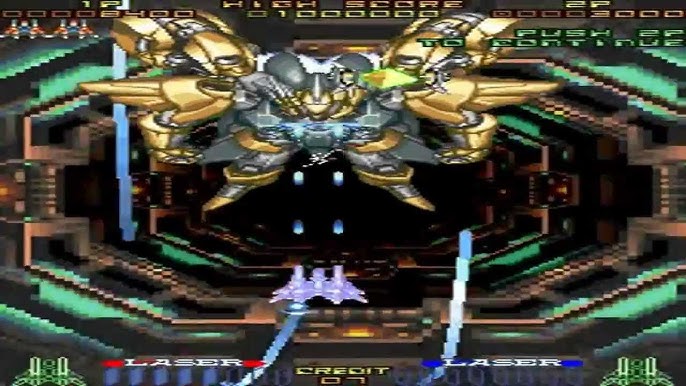
And that’s why I like it. Not because it is some elaborate cathedral of systems, but because it commits so fully to a sharp, legible, almost stubbornly formal design. The game is a vertical shmup, yes, but that description undersells the pleasure of watching it weaponize depth. Enemies above you appear brighter, enemies below darker, and the whole screen seems to obey this weird little visual grammar that keeps your brain from wandering off in search of easier employment. Backgrounds swirl and scale, nebulas bloom, planetary horizons hang in the distance, and the game repeatedly reminds you that the action is happening in a place, not just on a black void politely decorated with bullets. That was not rare in the era, but it was not cheap either, and RayForce spends its hardware like a confident person spending someone else’s money.
Precision, then panic
The central pleasure here is the way the game lets you feel clever right before it makes you feel exposed. At first it seems almost blood simple, which is a phrase I would never use for most shoot-em-ups unless they’d been reduced to the moral level of a kitchen appliance. Dodge, fire forward, lock on below. Fine. Straightforward. Then the game starts piling on enemies, stage after stage, and the clean little arrangement becomes a pressure cooker. The lock-on mechanic is elegant precisely because it is so readable, but readability does not equal mercy. You still have to position yourself, time your attacks, and keep track of what is coming from where while the scenery does that old arcade trick of looking like a military-industrial fever dream. By the end, bosses have grown nastier and the game’s entire temperament shifts from crisp demonstration to desperate argument.
This is where RayForce earns its reputation instead of merely wearing it. A lesser shooter would have stopped at being clever. This one escalates. The difficulty curve is not subtle, and I do not mean that as praise wrapped in irony. I mean it literally: the game gets harder, busier, meaner. That may sound obvious, because of course a shmup gets harder, but a lot of them confuse intensity with actual construction. Here, the escalation has shape. You can feel the game tightening the screws. It is not just throwing more things at you, it is turning your own confidence against you, which is the sort of cruelty old arcade design specialized in when it was not busy asking for another coin.
I’m not going to invent elaborate scoring theory where the provided research gives me none, because that’s how people end up turning reviews into fan fiction with punctuation. What I can say is that RayForce makes its case through structure rather than labyrinthine systems. Its stages move through varied environments, space fortresses, planetary surfaces, trenches, and the like, and these are not just postcards. They are part of the game’s rhythm. You are always being reoriented, from the open to the enclosed, from the floating to the tunneled, from the abstract to the aggressively architectural. It keeps the player from settling into a single defensive posture. That matters in a shooter, because boredom is death wearing a helmet.
The hardware showing off, with a pulse
The arcade original ran on Taito’s Cybercore hardware, which by the time this game arrived was already a couple of years old, and yet the thing still manages to feel technologically smug. The graphics are crisp, detailed, and full of rotating and scaling effects that could easily have collapsed into gimmickry in weaker hands. Instead they create motion that feels costly. Asteroids break apart, giant ships get torn open, towers collapse, and the game sells destruction with the kind of relish that arcade boards always had when they wanted to tell you, no, really, this is what money looks like when it becomes light.
There’s also a reason people keep mentioning the soundtrack whenever RayForce comes up, and it isn’t just ritual. The music is excellent, at least according to the sources I trust here, and the game clearly benefits from that kind of melodic propulsion that makes even routine survival feel like a mission. Shoot-em-ups live or die by momentum. If the audio is limp, the entire thing starts feeling like a spreadsheet with explosions. RayForce does not have that problem. It has the sort of BGM that keeps the fingers moving even when the eyes are starting to mutiny.
What I admire most is that the visual flair is not divorced from function. The dark-vs-bright layering of enemies below and above your plane is more than a neat effect, it reinforces what the game wants you to understand instinctively. You are reading depth as danger. You are seeing the space of the battle in terms the game can exploit. That is good design, not just pretty design. It makes the screen feel alive in a way that a lot of later polygonal clutter never quite managed, because they confused abundance with clarity and then wondered why players were squinting like suspicious librarians.
Saturn, hindsight, and the problem of looking old
The Saturn release, known in the West as Layer Section, is where the historical story gets a little messy. Sources describe mixed reception, with critics praising the quality of the design while also calling out its antiquated gameplay and stylistics. That reaction is understandable, even if it misses the point slightly. Yes, this is an old-school arcade shooter, and yes, it behaves like one with a firm belief in discipline and punishment. If you wanted an era of chatty upgrades, endless mode variations, and the kind of indulgent systems that make modern players feel like they’re being offered a buffet, this was not your salvation. It’s a lean game. It knows what it is. It does not apologize for not being another genre entirely.
Still, I can see why some players bounced off it on Saturn. In the late 1990s, “artful arcade austerity” could sound to some people like “game that forgot to bring the rest of the spreadsheet.” But time has a way of proving that elegance outlives novelty when novelty is mostly decorative. A retrospective ranking from Electronic Gaming Monthly later placed the Saturn version high, praising the dual-layer mechanic. I’m not going to overinterpret one list as divine law, but it does underline something true: the game’s reputation is not merely built on nostalgia fumes. There is a real design idea here, and it still reads cleanly.
That said, I’m not interested in pretending the game is above criticism because it behaves with admirable sternness. There are shooters that feel like they’re constantly teaching you something new. RayForce feels more like a very well-run exam. That distinction matters. The game’s minimalism is one of its strengths, but it is also where some players will find their ceiling. If the lock-on rhythm and escalating stage structure click, you are in business. If they do not, the game can feel unyielding in a way that the more expansive end of the genre can sometimes soften through sheer accumulation of toys. Here, there are not many toys. There is a laser, a gun, and the cold, humming conviction that this should be enough.
And often, it is enough. The problem is not that RayForce lacks content in the modern corporate sense, where “content” means ten hundred hours of chores stapled to a progression bar. The problem, if you can call it that, is that its pleasures are so specifically tuned to arcade-era concentration that they can feel severe to anyone arriving with broader expectations. It does not seduce. It drills. It does not coexist with your attention. It demands it, then rewards you with the satisfaction of surviving something that seemed too tidy to be dangerous until it wasn’t.
Why it still matters, and why that is not the same as being easy to love
Part of the game’s afterlife has been availability, or rather the lack of it. The sources here make clear that official re-release channels have been spotty and that copies can become expensive on the secondary market, which has done the usual thing to perception: made the game feel more sacred than it probably wants to be. Scarcity is not quality, though the market loves to act as if it is. I mention this only because it has distorted the conversation around a lot of older shooters. People start treating them like relics first and games second. RayForce does not need that help. It is already strong enough to survive plain language.
Is it the best game in its trilogy? Sources suggest it is arguably still the best, and I can believe that without needing to turn it into mythology. It has the cleanest hook, the most confident visual identity, and the kind of stage-to-stage escalation that makes its relatively spare mechanics feel like a feature rather than a limitation. But I also understand the criticism that it looks and feels of a certain era. Because it is of that era. The trick is whether you want an arcade shooter that remembers what the arcade was for: not endless comfort, not convenience, not a tutorial about itself, but a sharpened loop of comprehension, execution, and failure.
I do. Mostly. I like that the game trusts a simple structure and then makes that structure feel expensive. I like that the lock-on laser creates a spatial argument every few seconds. I like that the presentation is lush without becoming swampy, and I like that the soundtrack has the sense of forward motion the rest of the game needs. I do not especially love every moment of its severity, because sometimes severity is just another word for refusal. But here the refusal has purpose. It is not pretending to be deeper than it is. It is being exactly as deep as the mechanics require, then using speed, layering, and escalation to make that depth feel larger than its parts.
So here’s my verdict, without the museum-glass hand waving: RayForce is for players who want a shooter that respects clarity, pressure, and pure arcade craft, and who do not need their nostalgia packaged with apology. It is not for anyone who needs a broad feature list to feel engaged, or for players who mistake historical importance for automatic delight. It deserves its reputation, yes, because that reputation rests on genuine design intelligence rather than legend alone. Its strengths absolutely outweigh its flaws, though those strengths are specialized rather than universal. This is a sharp, hard-edged, beautifully organized piece of arcade architecture, and if you let it speak in its own language, it still sounds formidable.
Score: 8.5/10