NetStorm: Islands At War is what happens when an RTS refuses to behave like an RTS and, instead of apologizing, doubles down with floating islands, bridge-building, priest-snatching, and the sort of tactical cruelty that makes you wonder whether somebody at Titanic Entertainment had been quietly collecting grudges against ordinary real-time strategy conventions. This is the original 1997 Windows PC release, the one published by Activision, and it sits in that oddly admirable category of games that are not content to merely be different. It wants to be a little difficult, a little architectural, a little smug about space itself. Sometimes that is thrilling. Sometimes it is the kind of thrilling that makes you stare at the screen and mutter, with justifiable suspicion, “who designed this and what were they drinking?”
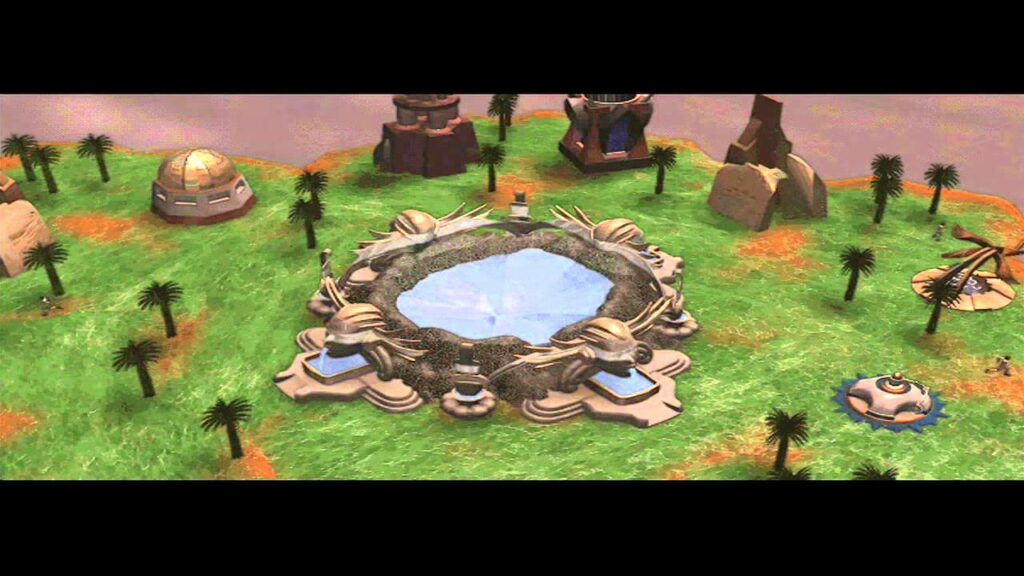
The answer, thankfully, is not “nothing.” NetStorm has an actual idea, and a strong one. It is a real-time strategy game built around floating islands connected by player-placed bridges, where the map is not just terrain but a hostile puzzle box. You do not simply expand in the usual way, laying a little town square of buildings while your tiny army runs around having opinions. You extend outward tile by tile, because distance, angle, and line of approach matter. The game is about territory, yes, but territory here is an argument. Every bridge piece is a decision, every gap a problem, every route a possible disaster. That alone puts it in a more interesting place than the average 1990s click-fest, which too often confused speed with sophistication.
And then there is the business with the priests. NetStorm’s central multiplayer objective is not merely to flatten the other side’s base, though that can certainly become part of the argument. The real point is to capture enemy high priests and sacrifice them to the Furies to gain power and technology. That is wonderfully ugly design. It is also wonderfully clear design. The game understands that a good competitive objective should force conflict to concentrate, not just sprawl. If a match in a conventional RTS can sometimes feel like accounting with explosions, NetStorm turns the whole thing into a ritual abduction economy. You are not just attacking, you are hunting a spiritual hostage. That’s the kind of thing that makes a strategy game feel like a cult manual printed on a lunch tray.
Build, bridge, survive
The basic flow, as the available documentation and in-game tutorial text make clear, is wonderfully specific. You control a high priest, build structures, place bridge pieces, and work outward from your islands while automated defensive structures do the dirty work of firing at enemies and bridge segments within range. The interface is mouse-driven and very much of its era, with left click to pick up and drop objects, right click for options and information, and map scrolling handled through Alt or the middle mouse button. I can practically feel the beige plastic of the period through the description. This is not a game that wants to hide its machinery. It wants you pushing pieces around like some overcaffeinated board game deity, except the board is hanging in the air over a void that seems personally offended by your existence.
That emphasis on placement is where NetStorm is at its best. You are not managing a parade of units so much as a network of pressure points. The available sources describe combat as heavily shaped by placed towers, weapons, and structures that attack automatically, which means the game is less about hot-potato micromanagement and more about who can establish a shape on the map that the opponent cannot comfortably answer. That is elegant, in the meanest possible way. It also means that mistakes are expensive. A careless bridge can become an open invitation. A badly judged extension can expose your priest, your infrastructure, and your ego all at once. The game has the good grace to make every inch feel earned, and the bad manners to make every inch feel vulnerable.
I appreciate that. I also appreciate that the game does not pretend its ideas are elegant in the glossy, modern sense. NetStorm is chunky. It is awkward in places. Its movement between islands and the act of laying out routes can feel like managing a strange industrial miniature rather than commanding a battlefield. But that friction is the point. The game is trying to make spatial awareness into the drama, and it succeeds often enough that I forgive it the occasional stiffness. What it never becomes, thank the old gods and the newer ones, is generic. Even when it is being a bit clumsy, it is being clumsy in a memorable way.
The tutorial and early mission material visible in archival video reinforces another useful truth about the game: it is not trying to be a pure multiplayer abstraction, even if it is clearly designed primarily for online play. There is a single-player campaign, and there are tutorial missions, which is exactly what a game like this needs to avoid becoming a private language spoken only by the already converted. Whether those campaign missions are especially rich is harder to say, because the record is thin on specifics. What is clear is that the solo content exists to teach the player how to think in bridges, captures, and territorial choke points. That is sensible. If you throw someone into NetStorm cold, it probably feels less like strategy and more like being asked to assemble a siege machine while blindfolded and mildly insulted.
The multiplayer idea is the whole meal
Where NetStorm really lives is the multiplayer model it was built around. Up to eight players could play online through official servers, and those servers eventually went down in 2002, which is a sadly familiar ending for a game that depended on an active community and infrastructure that was never going to preserve itself through sheer righteousness. The available history suggests the official service lasted for several years before closure, and that matters because NetStorm’s design is inseparable from the social pressure of another human being trying to outthink you across a map full of gaps. It is the kind of game that becomes more itself when the other player is not just trying to win, but trying to trap you into bad geometry.
The sacrifice mechanic is the genius and the threat. Capturing enemy high priests and turning them over to the Furies for greater power and technology gives matches a nasty forward momentum. It creates a ladder of escalation that is more pointed than the usual “build more stuff, tech up, build bigger stuff” treadmill. You are encouraged to take risks because the reward is not just a resource bump, but the ability to climb into more dangerous territory. In practice, that gives the game a slightly religious fever, which is fitting in a game where strategy is literally mediated through sacrificial ritual. Even by 1997 standards, this was not the comfort food branch of the genre.
And yet, for all its invention, I would not call NetStorm a perfect machine. It is a brilliant idea filtered through late 90s RTS assumptions, and those assumptions can be a drag. The source material points to a game where the emphasis is on placement and control rather than large moving armies, which I admire, but it also means that if you come in expecting the ecstatic scale of Command & Conquer or the smooth flow of a Blizzard product, you may find NetStorm comparatively austere. Its pleasure is more cerebral and more positional. That is not a flaw on paper. In practice, it means the game asks you to care deeply about a very specific kind of tension, and if that tension does not hook you, there is not much decorative fluff to carry you along.
This is where its reputation as a “unique RTS” is both fair and slightly suspicious. Yes, it is unique. Plenty of games are unique in the same way a machine with one missing wheel is unique. The question is whether the uniqueness is expressed through a strong, playable loop or merely through novelty. NetStorm mostly clears that bar, but not by a mile. Its central loop is real and satisfying, particularly in multiplayer: expand bridges, defend routes, seize priests, sacrifice priests, unlock power, repeat under pressure. That is a strong loop. But it is also a loop that relies heavily on the player enjoying the game’s spatial logic and tolerating its particular rhythm. It is not eager to seduce. It expects you to submit to the map.
Look, sound, and the old computer mood
Visually, NetStorm presents itself in a 2D, top-down or isometric-like view of floating islands, with tile-based bridges and colorful sprite work that still manages to be readable amid all the hovering architecture. The archival video material shows a fixed 4:3 presentation, and that matters because the game feels like it belongs to a specific screen-shaped world. This is not a bad thing. In fact, the narrow frame suits the design, because the entire game is about the management of edges and routes. Widescreen would not automatically improve that, and modern compatibility fixes and workarounds discussed by community sites are exactly what you would expect from a PC title of this vintage that has not been treated to an official modern re-release. There is no official remaster or current storefront resurrection to hide behind here, just the old machine and the community that has refused to let it die of neglect.
The audio and interface do a lot of quiet lifting. The unit acknowledgments have that satisfying, slightly theatrical command-response flavor, the sort of voice work that makes a strategy game feel like an order of business and a tiny military soap opera at the same time. The interface itself is unapologetically mouse-centric, with map scrolling and object handling laid out in a way that says “we assumed you were willing to learn the ritual.” That fits the game. NetStorm is not user-hostile in the cheap sense, but it is not interested in pampering you either. It trusts that you can learn the logic of its world and rewards you when you stop asking it to behave like every other RTS under the sun.
That trust extends to the mood of the game. Floating islands are a simple fantasy hook, but NetStorm uses them well. The whole thing feels suspended, precarious, and a little ecclesiastical in the worst way. There is resource gathering, yes, but the game is much less about the fantasy of industry than the fantasy of strategic leverage. Everything looks like it could fall apart if you misjudge one bridge segment. That instability gives the game a unique atmosphere. It feels engineered for players who enjoy the anxiety of control, the sense that map dominance is never a state but a temporary condition maintained through vigilance and a little spiritual extortion.
The verdict, without the misty-eyed preservationist nonsense
Historically, NetStorm: Islands At War deserves its reputation as one of the stranger, braver RTS experiments of its era. Commercially, it apparently did not set the world on fire, with reported U.S. sales that make “cult favorite” sound less like a marketing label and more like an accounting entry. That outcome feels depressingly familiar. Games that build their identity around unusual spatial logic and hard-edged multiplayer systems rarely become broad crowd-pleasers. They become the stories people tell years later, after the servers are gone and everybody has gotten sentimental about the weird one nobody understood at the time.
I understand the sentiment, but I do not need to be sentimental to say the game is good. NetStorm is good because its central idea is strong and because it commits to that idea with enough confidence to make the weirdness feel structural rather than decorative. It is not a universal recommendation. If you want smooth pacing, instantly legible systems, or the comforting illusion that your army is the main event, this is not your island chain. If you like strategy games that turn geography into a knife fight, if you enjoy the tension of building where every route can become a liability, if you are willing to let an RTS be more about capture, sacrifice, and positional anxiety than about marching little men around, then NetStorm has something sharp and memorable to offer.
Its flaws are real. The campaign details are underdocumented in the surviving sources, the official online life is long over, and the whole thing can feel stern to the point of obsession. But the strengths outweigh those shortcomings because the game knows exactly what it wants to be. It is a bridge-building, priest-seizing, floating-island RTS with a nasty streak and a clean core idea. That is enough to make it still worth respecting, and, under the right circumstances, still worth playing. Not because it is famous. Not because it is rare. Because it is one of the few strategy games that makes terrain itself feel like the enemy’s accomplice.
Score: 7/10