The first thing to understand about NCAA Football 98 is that it is not the game most people mean when they say NCAA Football 98. That honor usually goes to the PlayStation version, the one with the cleaner paper trail and the louder afterlife. This review is about the PC game, the 1997 Windows build, the oddball in EA Sports clothing with FarSight Studios and MBL Research tucked into the credits like a pair of mechanics who showed up after the marketing photo was taken. And that matters, because this is not just a different platform. It is a different species of the same ambition: a college football sim that wants to feel like a broadcast and a playbook binder at the same time, while the late-90s PC waddles around under it, trying not to spill the Gatorade.
What you get is a game with real intent, some actual shape, and enough polish in the important places to suggest that somebody, somewhere, cared about football beyond the box art. But you also get a product that never quite stops reminding you that it is made of compromises. Its strengths are the ones that matter in a sports game, structure, mood, the basic pleasure of calling a play and watching it unfold on a field that looks, for the era, appropriately televised. Its weaknesses are the ones that quietly kill replay value, the thinness of long-term structure, the lack of a franchise mode, and the sense that this whole thing is content to be a respectable seasonal manila folder instead of a living college football obsession.
A game about Saturday, not about a whole career
The most revealing thing in the source material is also the least glamorous: this game gives you exhibition play, a Great Game mode, and season play, then stops. No franchise mode. No sprawling managerial fantasy. No endless accumulation of legacy and institutional memory. Just the season, the match, the bracket of a college football year, and the usual sports-game promise that if you keep pressing on, the sport itself will carry the experience forward. Sometimes that is enough. Here, it is enough to keep the game afloat, but not enough to make it feel inexhaustible.
That limitation defines the mood. This is not a game interested in becoming a little universe. It is interested in staging college football as a sequence of manageable broadcasts, each one a self-contained argument between playcalling and execution. You choose from all Division I-A teams of the 1997 season, line up in exhibition or season play, and go to work. There is a modest, almost workmanlike dignity to that. No nonsense about building a dynasty from the basement up. No sugar-rush of role-playing. Just football, presented with enough ceremony that it can pretend to be more than football for a few minutes at a time.
The problem, of course, is that this sort of restraint only feels noble if the game underneath it is rich enough to reward repetition. NCAA Football 98 does not collapse, but it also does not bloom. It plays the part of a legitimate sports sim, and there is value in that, but it rarely reaches the point where I want to clear my afternoon and disappear into its logic. I want to admire it more than I want to live in it.
How it plays, and why that matters more than the uniforms
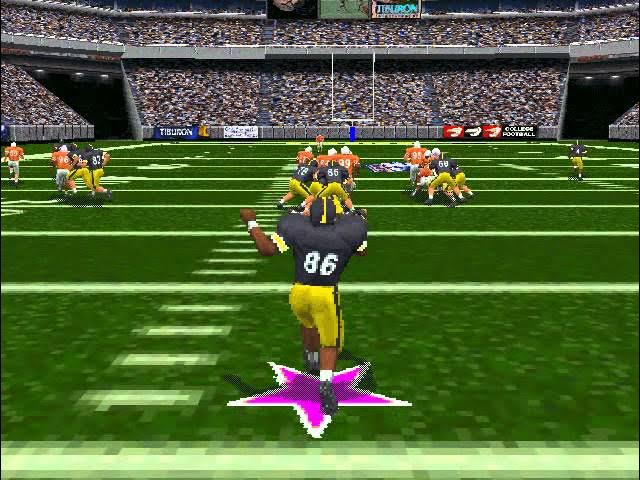
The actual on-field action is the part that decides whether a football game is merely competent or worth evangelizing in the school cafeteria. Here, the PC version shows the expected signs of a mid-90s sports sim trying to be both readable and active. You get playbooks. You call plays from multi-page lists of formations and calls. You control the active player directly once the ball is in motion. The HUD gives you the useful basics, score, quarter, clock, down, distance, yard line, the whole little ritual of pressure that makes football such a deliciously bureaucratic sport. It understands that every snap is a tiny administrative crisis.
That is the game’s best trick, honestly. It lets the paperwork feel dramatic. Selecting a play from a dense set of options, then watching the field spread out behind the quarterback like a problem set, can still be satisfying even when the animation is a touch stiff and the flow is more measured than explosive. There is a broadcast-style presentation here, and the camera options on PC support that illusion. This is a game that wants you to feel as though you are both the coach and the person in the truck replaying the shot. That dual fantasy is old, familiar, and still potent when it lands.
But the measure of a football game is never simply whether it can dress itself like football. It is whether the decisions have bite. The playbook system gives you enough structure to make choices matter in the moment, and the basic rules are all there, four downs, punts, field goals, kickoffs, the arithmetic of field position and time. Yet the source material does not support any grand claims about AI sophistication or tactical depth, and I am not going to invent those claims just because the sport is sacred. What I can say is that the game feels like one of those mid-era sports titles where the fun arrives in bursts, on good plays, in a long scramble, a clean pass, a defensive stop, a kick that barely clears the line of anxiety. The rest is the labor of making those moments happen.
That is fine. Sports games do not need to be operas. But the absence of deeper progression, combined with the season-only structure, means the game has to earn every hour the hard way, through repetition and feel. It gets some of that right. It does not get enough.
The college football frosting is better than the cake, which is rude but true
There is a very specific pleasure in college football games that pro football titles often fail to capture, and it lives in the noise around the sport. Team identity. Fight songs. The feverish sense that Saturday belongs to institutions, rituals, and alumni who can still remember where they sat in 1987. NCAA Football 98 at least understands the value of that atmosphere. The research notes fight songs for 25 of the biggest teams, and that detail is not trivial. It is the kind of thing that makes a licensed sports game feel like it remembers why its subject matters.
On PC, the presentation leans into that broadcast fantasy. The visuals are 3D, third-person, and built around a camera system that supports the illusion of watching a televised game rather than a toy field. The menus show graphics options, including resolution and rendering settings, which is the sort of PC-specific practicality that should not be exciting but is, because it reminds you that this version was actually built to live on a computer desk instead of being muscled over from a console and told to behave. The keyboard prompts are visible. The interface has that mid-90s Windows personality, a little plain, a little severe, and absolutely convinced that utility is a kind of charm.
Then there is the odd little detail that the game uses school names and colors but, in line with NCAA licensing norms, appears to lean on numbers rather than real player names. That is not a complaint so much as a reminder of the era’s legal choreography, where authenticity was always trying to sneak past the bouncer with part of its face hidden. It does not ruin the fantasy. It does, however, keep the game from becoming a full collegiate hallucination. You are near the real thing, not in it.
The PC version is the story, and also the warning label
Because the research is unusually clear on this point, I want to say it plainly: this PC version is not just a shadow of the better-known PlayStation game, and it is not the same implementation wearing a different jacket. It has its own credits, its own Windows presentation, and its own technical personality. That distinction matters because too many old sports titles get flattened into franchise soup, as if the box art alone were the experience. Here, the PC build deserves separate judgment.
And my judgment is that the PC specificity helps, but only so much. Yes, it has resolution and rendering options. Yes, it clearly lives inside Windows. Yes, the season mode can save to disk, which should be the bare minimum but still feels satisfying to see. These are signs of a game that knows where it is. But they do not magically deepen the design. They mostly make the game more legible, more configurable, more practical. They do not automatically make it more fun.
That is the trap with late-90s PC sports titles. They often look, in retrospect, like they should be the definitive versions, the ones with the bigger machine, the cleaner options, the serious desktop aura. Sometimes they are. Here, the PC frame is more of a delivery mechanism than a revolution. It helps the game feel like a proper computer release, not a hostage situation. It does not transform the underlying experience into something richer than its console cousin by default, and the available evidence does not support any extravagant claims about superior depth, AI, or physics. The record is too thin for that, and I have no patience for invented superiority.
What it gets right, and what it never quite learns
The best thing about NCAA Football 98 is that it understands the basic cadence of a college football game. Call, line up, read the field, execute, suffer, adjust, repeat. The season structure gives that cadence a framework. The presentation gives it a little ceremony. The playbooks give it enough strategic texture to keep you engaged if you enjoy football as a systems game rather than as a fireworks show. In a better world, that would be the foundation for a very sticky, very replayable sports title.
But the game does not seem especially interested in escalating beyond its own baseline. The lack of franchise mode is not just an absent feature on a bullet list, it is a creative ceiling. It tells you where the designers thought the game should end. They thought the season was enough, and perhaps for some players it was. I can respect that position while still finding it faintly underfed. College football invites obsession. It invites feuds, records, recruiting fantasies, decades of school loyalty, all the little delusions that make a sports sim feel like a second calendar. This game gives you the season and a few broadcast trimmings, then asks you to supply the rest yourself. Sometimes that works. Sometimes it feels like being handed a helmet without the rest of the uniform and told to be grateful.
I do not want to oversell the flaws. The research does not support a sermon about broken controls or catastrophic technical failure. This is not that kind of warning. What I am saying is subtler and, to my mind, more damning: the game is competent in ways that should have been the beginning of its identity, but not the whole of it. It is a usable football game with genuine atmosphere, and a usable football game is not the same thing as a memorable one. A sport sim has to decide whether it wants to be a serviceable match engine or a recurring habit. NCAA Football 98 lands somewhere between the two, then quietly takes a nap.
The verdict, without the nostalgia foam
I came away from NCAA Football 98 respecting it more than I loved it, and that is the right size of reaction. The PC version is historically interesting because it is a separate Windows implementation with its own developers and its own interface personality, not because it secretly redefines the genre. Its season structure, exhibition modes, and general college-football presentation are solid enough to hold attention. Its fight-song flourish and broadcast styling give it a pleasingly institutional smell, like old turf and copier paper. But it is also boxed in by its own modesty. No franchise mode, no great sense of long-term identity, no overwhelming evidence of depth beyond the fundamentals. It is a decent football sim that knows how to wear a school sweater and not much else.
Who is this for? People who want a straightforward late-90s college football game on PC, especially if they appreciate the era’s playbook-driven structure and can enjoy the ritual of a season without demanding a sprawling career mode. Who is it not for? Anyone looking for the sort of endlessly sticky sports sandbox that turns into a year-round obsession, or anyone expecting this title to be automatically superior just because the machine under it has a keyboard. Does it deserve its reputation? Mostly as a footnote, not as a legend. Do its strengths outweigh its flaws? Just barely, yes, but with the sort of margin that makes me keep my arms folded while I say it.
Score: 6/10