Marble Drop, the 1997 Windows puzzle game from Maxis South, is the sort of odd little CD-ROM artifact that makes me fondly suspicious of the entire late-90s PC ecosystem. Somebody at Maxis looked at a screen full of funnels, tracks, springs, cannons, and color-coded bins and decided, yes, this is enough of a fantasy. Not a kingdom, not a war, not even a household to simulate, just a mechanical toybox where the core human activity is pushing marbles into holes and praying the machine behaves. On paper that sounds quaint. In practice it is both simpler and more stubborn than it has any right to be, which is very much the Maxis way when Maxis is not building cities or annihilating your weekend.
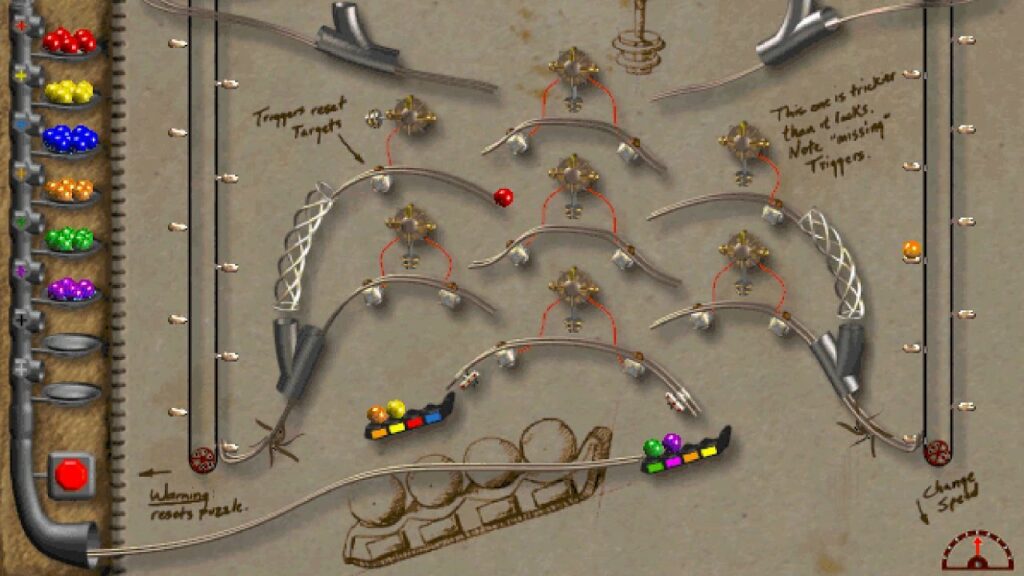
The first thing to say about Marble Drop is that it knows exactly what it is. It is not pretending to be a grand cerebral puzzle epic. It is an object-based contraption game, the kind of thing that sits somewhere between The Incredible Machine and pachinko, except with less slapstick engineering and more color-matching bureaucracy. You drop marbles into tiny funnels at the top of the screen, they roll through a single mechanical arrangement, and the job is to get each one into the bin that matches its color. That is the whole religion here. There are no elaborate story cutscenes to interrupt the ritual, no fake drama about some inventor’s legacy, no sanctimonious voiceover telling me that this pile of gears represents the human condition. It is a toy, and a pretty sincere one.
That sincerity matters, because the game could so easily have been smug about itself. Mechanical puzzle games often come with the smug expression of a child who has discovered levers and now wants everybody else to be impressed. Marble Drop mostly avoids that. It presents a series of self-contained contraptions, each one a side-view machine with funnels at the top and bins at the bottom, and lets the structure do the talking. The fun is in reading the apparatus, learning where the pathways bend, noticing that some gizmo has changed the route after the last marble passed through, and then realizing that the solution is not one perfect move but a sequence of tiny interventions. Springs. Cannons. Curly bits. The machine is a little Rube Goldberg opera, except instead of delighting in absurdity for its own sake, it insists on accountability. You put a marble in, the machine answers back.
The joy of watching a bad plan become a better one
What makes the game interesting is not that it is complex in the modern sense, because it is not. It is interesting because the complexity is legible. The player is not wrestling with a fog of systems so much as with a specific physical joke: the first marble changes the machine, so the second marble may need to live in a different world than the first. That is a good puzzle idea. It respects the player enough to let them understand why things fail. When the contraption sends a marble to the wrong place, it usually feels like a consequence rather than a betrayal. This is a game about reading motion, timing, and order, and those are nice, old-fashioned puzzle virtues. They have not stopped being virtues just because the industry later discovered progression bars and crafting trees.
I also appreciate that Marble Drop is not dressed up like an engineering simulator. The game is mechanical in theme, but it does not bury you in technical pretension. The appeal is immediate and visual: colored marbles, obvious destinations, a fixed side-view layout, and the sort of clean spatial logic that makes you lean closer to the monitor without quite realizing you have done it. That is a useful trick. The game invites you to feel clever before it has proven you are clever. Then, if you are not paying attention, it humbles you in the old arcade tradition, which is to say with a cheerful indifference that borders on cruelty.
There is, though, a real limit to the design. The central idea is strong, but it is also narrow, and the game never quite escapes the shape of its own premise. Every level is another variation on the same sentence: drop marble, watch route, adjust order, repeat. If that sentence works for you, excellent. If it does not, no amount of Maxis polish will turn it into poetry. The game’s best qualities are inseparable from its restrictions, which is the polite way of saying that it can start to feel like it has only one strong move. I admire a puzzle game that knows its lane, but I also notice when the lane has a speed limit.
That is where the comparison to The Incredible Machine becomes useful and dangerous. Useful because the lineage is obvious: both games are about understanding a contraption as a system rather than as a static picture. Dangerous because Marble Drop is not nearly as anarchic or inventive as that comparison makes it sound. It has a cleaner, more narrowly defined objective, which is both a strength and a restriction. The precision is welcome, but it also removes some of the playful mess that made the best old mechanical puzzles feel like experiments gone slightly wrong. Marble Drop is less a laboratory than a sorting office with a sense of humor.
Mouse, marble, repeat
The PC version, the one most securely documented here, is a mouse-driven Windows release from 1997, designed for Windows 3.1 and Windows 95. That era matters because the game feels like it was built for people who were still comfortable treating the desktop as a play space, not merely a place where taxes and office memos went to die. The interface is straightforward. You choose marbles and click them into the funnels. The whole arrangement is built around direct manipulation, which means the game spends its goodwill quickly if the player wants elaborate tooling, advanced control schemes, or the sort of fiddly precision that modern players like to call depth when it is really just the interface arguing with them.
Here, interaction is clean enough to stay out of the way. The game does not appear to have any grand input gimmick, and honestly, thank goodness for that. A puzzle about rerouting marbles does not need a heroic control system. It needs clarity. It needs the player to understand where the marble is going and why. On that front, Marble Drop appears to be well behaved. The contraptions are visible, the bins are obvious, and the basic logic is readable at a glance. The challenge is in execution, not in deciphering the developer’s idea of a joke.
What I cannot responsibly claim, because the available record does not support it cleanly, is a long list of secondary systems. I do not have firm evidence here of a robust scoring model, difficulty modes, a level editor, or some hidden cathedral of progression systems waiting behind the curtain. The sources are thin on those details, and I am not going to invent a fake second life for the game just because that would make the review feel fuller. The honest reading is simpler: this is a puzzle game whose value lives or dies on the quality of its individual contraptions and the satisfaction of making them behave.
Presentation, which is where Maxis usually remembered to wear shoes
Visually, Marble Drop has the charm of a well-lit toy box. The game presents a single machine per level, viewed side-on, with the structural parts laid out in a way that is easy to parse but still busy enough to feel alive. The marbles are bright and legible. The bins are color-coded. The machinery itself looks like something assembled by an engineer who took a tasteful amount of inspiration from cartoons. I would not call it elegant in any glamorous sense, but it has the practical grace of a puzzle interface that knows its job is to facilitate thought, not to audition for a museum wall.
There is a pleasant physicality to these layouts. Even without a sprawling simulation behind them, the contraptions suggest movement, momentum, and consequence. That matters because a puzzle game based on motion lives or dies on visual trust. If I cannot believe the marble is going where the machine says it will go, the whole thing collapses into noise. Marble Drop seems to understand that and stays visually disciplined. The result is not dazzling, exactly, but it is coherent, and coherence is an underrated luxury in the era of cluttered PC menus and software that treated every screen as an opportunity for decorative overreach.
Sound is harder to pin down from the available documentation, and I am not going to pretend I have a sacred archive of every chime and clunk. The video evidence suggests the expected soundtrack of clicks, impacts, and puzzle-game ambience, but the source material I have does not give me enough to make grand claims about audio design. So I will say the conservative thing, which is also the useful thing: the game appears to get by on the satisfaction of motion and mechanism rather than on some heavily marketed audio identity. Fine by me. A marble game does not need a concept album. It needs to sound like stuff is happening.
A neat idea with a finite shelf life
The place where Marble Drop starts to fray is the same place many like-minded puzzle games fray: novelty exhaustion. A strong premise is not the same thing as inexhaustible design, and this one has a fairly tight orbit. Once I understand the vocabulary of funnels, springs, cannons, and routing changes, the game has to work to keep surprising me. Sometimes it probably does. The sources make clear that there are multiple contraptions and that the pathing can change with each marble drop, which is exactly the kind of detail that can elevate a level from mechanical busywork to proper puzzle design. But the overall concept remains bounded. It is not a sandbox of chaos; it is a sequence of managed problems. There is dignity in that, and also a ceiling.
That ceiling is why I suspect some players, then and now, would admire Marble Drop more than they would love it. Admiration is easy here. The game has a tidy premise, a readable interface, and a healthy respect for cause and effect. Love requires a deeper well of surprise, and the available record does not suggest that the game is operating on some baroque hidden level of depth that never got its due. It seems more likely that this is one of those games whose pleasures are concentrated, not expansive. You get the trick. The trick is good. Eventually, the trick becomes a habit.
And yet I do not want to underrate the value of a well-made habit. In the late 1990s, when PC puzzle games could so easily become overdesigned or undercooked, there was something refreshing about a game that simply wanted to be a neat little machine and had the self-control to stay that way. Maxis, of all companies, probably understood that a small idea executed cleanly could still leave a mark. This is not the Maxis of sprawling civic anxiety. It is the Maxis of a compact mechanical grin, and that shift in scale is part of the charm. The company that taught people to obsess over traffic jams also knew how to arrange a marble puzzle without setting the whole thing on fire. Which, frankly, is a relief.
As for legacy and availability, the record here is a little patchy, which is fitting for a modest PC puzzle from this era. The original release is the one that matters, a 1997 Windows 3.1/95 CD-ROM from Maxis Software Inc., developed by Maxis South. Some online references are sloppy enough to misattribute the game to Sierra and to argue with themselves about the year, but the archival and credit evidence points back to Maxis with much greater confidence. There does not appear to be a widely documented official modern re-release, so today the game mostly survives in archives and unofficial wrappers. That is not unusual, just mildly tragic in the way so many competent mid-tier PC games are tragic: they were built to be sold on a disc, installed once, and then allowed to drift into the hobbyist underworld.
So where does that leave me? With a puzzle game that is smarter than it first appears, tighter than many of its descendants, and just limited enough to keep it from ascending into the upper pantheon. Marble Drop is for players who enjoy reading a machine as a problem and then solving it by understanding motion rather than by brute forcing retries. It is not for anyone who needs broad systemic variety, a big feature list, or the sensation that a game is constantly reinventing itself to keep up with modern attention spans. It does not quite deserve a mythic reputation, because it never really seems to have had one. What it deserves is respect, with a slightly raised eyebrow. The strengths are real. The limitations are real. The strengths win, but not by a landslide, and not without a little marble dust in the machinery.
Score: 7/10