Moto Racer is one of those mid-90s racing games that arrives looking like a dare and playing like a compromise. It wants to sell you speed, dirt, chrome, and the pleasingly juvenile thrill of a motorcycle doing something it absolutely should not be doing at that velocity. On the PC, in its original 1997 Delphine Software International and Electronic Arts incarnation, it mostly succeeds by being shameless about the one thing it understands: arcade momentum. It is not trying to be a motorcycle simulator, thank heaven. It is trying to be a sugar rush with handlebars. That distinction matters, because the game’s best moments come when it leans into reckless simplicity, and its worst moments come when it reminds you that structure, progression, and old PC design habits were often the price of admission.
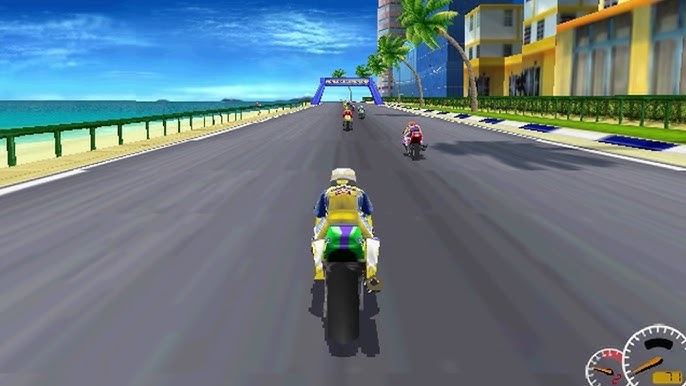
At first glance, Moto Racer looks like the sort of game that should have been on every demo disc in the world. It has the era’s favorite religion, polygonal speed. It has two kinds of bikes, road and motocross, and two corresponding fantasies, paved Grand Prix swagger and muddy off-road flailing. It has checkpoints, timers, and that wonderfully merciless arcade idea that the race is not about elegance, it is about surviving the route long enough to prove you deserve the next stretch. In theory, this is elegant. In practice, it is more like an old magazine ad come to life, all flash and confidence, with just enough actual game underneath to keep the illusion from collapsing immediately.
The gospel of speed, with asterisks
The core PC setup is refreshingly spare. Practice, Single Race, Championship, Multiplayer. That is the shape of the thing, and honestly it is enough. Practice lets you configure races, including how many laps you want and whether you are fighting the clock or up to 23 opponents, which is a delightfully brutal amount of company for a game whose handling is already busy enough. Single Race strips away the tailoring and gets straight to the point. Championship is the meatier progression mode, sending you through a career path of tracks and bikes, with unlocks along the way. Multiplayer on PC supports up to 8 players total over modem or network, which is one of those wonderfully specific relics of the era, when competitive civilization was held together by phone lines and optimism.
What actually happens on the track is more interesting than the menu language suggests. Moto Racer is an arcade racer in the strict old sense, meaning it wants immediate input, high speed, simple verbs, and a constant sense that the bike is either obeying you or about to become an aluminum obituary. The controls are compact, accelerate, brake, steer, wheelie. That wheelie button is not decoration, either, it is part of the game’s little vocabulary of absurdity. You are not merely riding, you are negotiating with a machine that wants to stand up and show off. That suits the whole design. Moto Racer is always just a half-step away from becoming a cartoon, and the game knows it.
The racing itself is checkpoint-based, which is both a smart arcade pressure system and a very old way to manufacture urgency. You are not simply trying to beat opponents, though you will certainly be doing that. You are racing the clock from checkpoint to checkpoint, and if you fall behind, the game does what arcade games have always done when they run out of patience: it kills your run without apology. That sounds harsh, but it is also the source of Moto Racer’s best tension. The game is at its strongest when you are improvising, shaving seconds, correcting a bad line, and trying not to get your head taken off by the landscape. You feel the velocity in your hands. Not in a realistic way, mind you, but in that deeply satisfying arcade manner where speed is less a physical measurement than a form of panic.
And yet, for all that swagger, Moto Racer is not exactly generous. It is simple, yes, but not always elegant. Arcade racing in the best cases gives you clarity, a clean handshake between input and outcome. Moto Racer gives you that often enough to be fun, then occasionally muddies the water with the sort of handling quirks that feel less like character and more like the ghost of a design meeting where someone said, “Can we make it feel faster?” and the answer was, “By all means, yes, and perhaps also less predictable.” The result is a game that can be exhilarating in a straight line and slightly annoying when the track starts demanding precision. You are rarely lost, but you are often reminded that momentum is not the same thing as control.
Road, dirt, and the old binary of cool
The split between superbike or Grand Prix events and motocross events is one of Moto Racer’s cleanest ideas. It gives the game a useful visual and mechanical contrast without pretending to be more sophisticated than it is. Paved roads reward one kind of rhythm, dirt tracks another. That sounds obvious because it is obvious, but obvious is not the enemy. Boredom is. The game understands that a motorcycle racer needs more than one surface if it wants to stay alive across multiple events, and so it builds its identity out of contrast, not complexity. There are, according to secondary evidence, eight tracks, though exact counts and names are not reliably documented in the sources I have. The precise number matters less than the fact that the game keeps trying to sell variation through terrain, weathered backdrops, and different racing moods, rather than through an exhausting pile of systems.
This is where Moto Racer earns some respect from me. It does not overcomplicate its pitch. It knows that motorcycle racing in an arcade context is partly about fantasy, partly about spectacle, and partly about the very human desire to go far too fast while pretending that this is a plan. The road events have a clean, reckless elegance. The dirt events feel looser, rougher, and more willing to turn the bike into a bucking argument. Neither mode is especially profound, but both are legible, and legibility is a gift in a genre that so often confuses technical density with fun. I have no desire to praise a racing game for merely existing in two flavors, but I will absolutely praise it for making those flavors distinct enough to matter.
Still, Moto Racer’s structure can feel a touch too antiseptic for its own good. Championship mode is where the game most obviously wants to be a proper long-form thing, with progression and unlocks and the faint odor of career mode seriousness. But the sources available do not document its scoring system or failure rules in detail, and that lack itself is revealing. This is not a game that invites reverent study. It wants your afternoon, not your dissertation. It wants you to blast through a sequence of events and feel accomplished because you unlocked the next thing. That can be enough, but it also means the game’s long-term appeal depends heavily on whether its racing fundamentals remain pleasurable after the novelty wears thin. Sometimes they do. Sometimes they do not.
Presentable, fast, and unmistakably of its moment
Visually, Moto Racer is very much a 1997 3D racer, which is to say it wears its ambition on a polygon budget and hopes you are too excited by movement to count the corners. The PC version supports 3D acceleration, and that matters because speed is the entire sales pitch here. The game’s environments are varied enough to keep the eye awake, with footage showing deserts, forests, snowy stretches, and other race-friendly landscapes that look like they were selected by someone building a road trip out of international postcard clichés. I mean that affectionately. Racing games do not need ethnographic depth. They need places that read instantly at 120 miles an hour, and Moto Racer gets that part right.
The interface is similarly practical. Timer, position, lap counter, speedometer, checkpoint countdown, all the little talismans of action-racing accountability are there doing their job. Nothing is especially stylish by modern standards, but the presentation has that old PC confidence where every element exists to serve the run in front of you. Menus are blunt, readable, and not ashamed of being menus. The soundtrack and engine noise, as observed in footage, push the right buttons, loud enough to sell the illusion that everyone involved has a lead foot and a minor insurance problem. I cannot pretend the audio is some lavish symphonic accomplishment. It is not. But it does what arcade racing audio should do, it keeps the pulse up and the sense of motion alive.
If there is a downside to this entire presentation, it is that Moto Racer can sometimes feel less like a world and more like a showcase. That is not fatal in a racer, but it does limit the emotional residue. You remember the rush more than the place. You remember the speed, the checkpoint pressure, the bike’s awkward flirtation with danger. You do not, generally, remember the tracks as living spaces. Again, this is fine up to a point. Not every game needs to be a memory palace. But the best racing games of the era, even some of the more shamelessly arcade ones, managed to leave a stronger stamp of personality. Moto Racer leaves a competent one, then hurries off to the next curve.
A strong premise, slightly undercooked at the edges
What keeps Moto Racer interesting, even now, is that it feels like a game made by people who genuinely understood the allure of speed and then made a few compromises in the name of getting it onto the shelf. That gives it a slightly conspiratorial charm. You can practically smell the late-90s optimism, the kind of attitude that said, yes, let us put motorcycles in 3D, let us do both road and dirt, let us offer multiplayer over networks and modems, let us unlock things in Championship mode and call it a career. The result is not a grand masterpiece. It is a sturdy, lively, occasionally stubborn arcade racer that knows how to get your attention and, mostly, keep it.
But I would be lying if I said it never wears thin. The checkpoint structure, while effective, can become repetitive. The handling, while energetic, can be a little too eager to remind you that arcade physics is a euphemism for selective realism. The campaign structure is functional rather than thrilling. The game does not always deliver enough nuance to sustain a very long love affair. It is at its best in bursts, in those sessions where you boot it up because you want speed and the old familiar cocktail of confidence and danger, then keep playing because one more race seems like a reasonable lie. That is a legitimate virtue. It is not a small thing. But it also means Moto Racer is more durable than dazzling, and more satisfying than it is truly deep.
There is also the question of version context, because with a game like this, context is not decorative. The research supports the original 1997 Windows PC release as the primary subject here, and that is the version I would judge first. The PlayStation version exists, and sources note split-screen multiplayer there, which the PC original lacks. That is useful to know, but it should not blur the main picture. The PC game is the one with the modem-and-network multiplayer setup, the one built around that era’s slightly feral approach to graphical acceleration, the one that feels like it belongs on a beige tower with a loud fan and a stack of shareware discs nearby. Later digital packages and collections exist, but they are packages, not reinventions. The bones are still the same game.
So where do I land? Moto Racer deserves respect for being focused, fast, and fully aware of the fantasy it is selling. It is for players who want arcade motorcycle racing without a lecture, who enjoy checkpoint tension, who do not mind a little roughness if the core sensation is strong enough. It is not for players who want simulation depth, modern polish, or a racing game that constantly discovers new tricks to keep itself interesting. Its reputation, such as it is, feels earned within the lane it chose for itself. The game is good, sometimes very good, but not because it does everything. It is good because it understands one thing clearly and usually delivers it with conviction. That conviction is worth something. The fact that it occasionally wanders into awkward handling and structural repetition is also worth something, unfortunately, and the score has to live in the tense little space between those truths.
Score: 7/10