NBA Live 98 on PC is the kind of sports game that makes me nostalgic for the era when a publisher could say, with a straight face and a giant laminated grin, “Here is basketball, now in 3D,” and half the audience would nod because, honestly, it did feel like a revelation for about five minutes. This is a 1997 EA Sports basketball game built around the 1997/98 NBA season, the fourth entry in the NBA Live line, and the PC version is the one that matters if you care about the particular blend of ambition and hardware swagger that defined late-90s sports PC gaming. It also, according to the record I have, supports 3D acceleration through 3dfx Glide, which is exactly the sort of detail that sends a certain species of old sports obsessive into a blissed-out trance. The rest of us just remember that basketball games of this era often looked like they were trying very hard to outrun their own polygon budget.
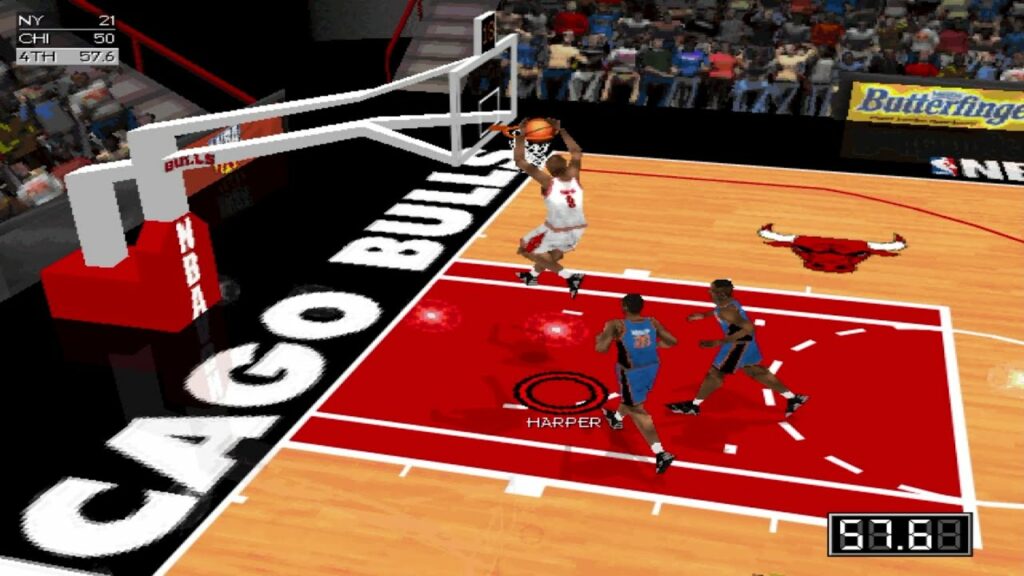
That is the central mood of NBA Live 98: it wants to feel modern, fluid, televised, and authenticated, and it mostly succeeds by moving faster than the games around it can argue with it. The pitch is obvious enough, but the interesting part is how aggressively the game leans on that pitch. This is licensed NBA basketball, complete with real teams and players from the season, but the real fantasy is not just “play as your favorite roster.” The fantasy is that you are inside a brisk, televised, slightly overproduced sports product where the offense can be pushed forward with a confidence the genre did not always deserve. RAWG notes a single-button pass to any teammate, and that small detail matters more than it sounds. Basketball games live or die by how quickly they let you make decisions under pressure, and this one is clearly trying to reduce friction. It wants the ball moving, the court opening up, and the action to feel like something you can actually shape instead of something you plead with.
That makes it a useful game, which is not the same thing as a flawless one. There is a real difference between a sports sim that understands pace and one that merely has fast animations. NBA Live 98 seems to understand that the best basketball games create a believable argument between spacing, timing, and panic. When the pass reaches the right man at the right moment, the game can look and feel sharp, even elegant, because it is doing the one thing arcade-adjacent sports titles often forget to do: making your choices feel causally linked to the shape of the play. The single-button pass system fits that idea neatly. It removes some of the finger gymnastics and lets the offense breathe. That can be a blessing, especially on PC in an era when keyboard control schemes could feel like they were assembled by a committee of certified nonsense merchants.
But a smoother lane to offense does not automatically mean a richer game. What NBA Live 98 gains in immediacy, it also risks in texture, because the move toward accessibility can flatten some of the friction that makes basketball feel like basketball and not just an efficient traffic simulation with sneakers. The available research does not let me pretend there is a deeper systems critique hiding in the shadows, so I will keep this honest: the game’s signature improvement is one of those practical, quality-of-life changes that sounds modest until you realize how often it affects every possession. That is the sort of design decision that reveals a developer thinking about the sport as a flow state, not just a list of animations tied to a license. I respect that. I also reserve the right to mutter at any basketball game that makes the court feel too tidy, because real hoop action is messy. The best sports titles do not merely smooth the mess away, they choreograph it.
The presentation is where the game makes its loudest claim to importance. RAWG credits it with improved graphics, including new player models and faces modeled after actual player photographs. In 1997 that was not trivial window dressing, it was part of the prestige economy of sports games. These things were selling the illusion of broadcast authenticity, and the industry knew it. You were not just buying rules and rosters, you were buying the uncanny promise that a digital athlete might resemble the one you saw on television enough to let your brain do the rest. The phrase “modeled after actual player photographs” sounds quaint now, but back then it was part technical achievement, part marketing spell, part sly blackmail aimed at your imagination. Look closely enough and you could probably see the bargain being struck, with polygon count on one side and aspiration on the other.
The PC version’s 3D acceleration support through 3dfx Glide only sharpens that reading. This was the era when hardware support could change the mood of a sports game in the same way a good television feed changes the perceived quality of a match. If you had the right setup, you were not merely playing the game, you were auditioning for the future. If you did not, well, the gulf between “enhanced” and “merely adequate” could be a very loud one indeed. I will not invent technical horror stories where the record gives me none, but I will say that NBA Live 98 belongs to a period when PC sports games were half software, half handshake with your graphics card. That alone gives the version a certain museum electricity.
And yes, there is commentary. RAWG says the PC, PlayStation, and Saturn versions include Ernie Johnson as studio announcer and Verne Lundquist for play-by-play, while also noting that the Saturn version lacks play-by-play commentary. That kind of version-sensitive detail is exactly the sort of thing old sports games used to weaponize against cross-platform assumptions. The PC release, then, sits in the more lavish camp, the one that wants to sound like a televised event rather than an abstract ruleset. This matters because presentation in a basketball sim is not decoration, it is part of the feedback loop. A good call, a recognizably broadcast-style voice, a sense that the game is narrating its own momentum, all of that feeds into how convincing the possession feels. You may not notice it in the first minute, but over a full session, the difference between “generic sports noise” and “someone is trying to sell me a Saturday night game” becomes real.
I also want to be careful here, because sports retrospectives love to inflate commentary systems into cultural milestones when, in practice, they were often just one more place for the game to flex its budget. Still, even if I’m not going to call this a landmark of verbal intelligence, I will say that the inclusion of recognizable broadcast names fits the whole project. NBA Live 98 is interested in the feeling of legitimacy. It wants the player to believe this is not merely an NBA-themed videogame, but an approximation of televised basketball compressed into a software object. That is a perfectly sensible goal, and the game’s strengths largely come from pursuing it without too much self-conscious irony.
Where the game becomes less charming is in the familiar late-90s way sports titles occasionally did: by promising modernity so earnestly that you can almost hear the marketing department taking notes in the room next door. The release year matters here, because 1997 was still a period of visible transition. 3D sports games were no longer novelty acts, but they had not yet fully settled into the smoother, more persuasive forms they would later take. So you get a game that is trying to be quick, credible, and flashy all at once, and the result can feel like a very competent compromise. That is not a damning statement. Compromise is the native language of sports development. But it does mean you should not approach NBA Live 98 expecting some grand, clean epiphany. It is a game that moves with purpose, not magic.
What I like most about it, from the evidence available, is that it appears to understand one of the oldest truths about basketball games: the sport is at its best when your hands and your eyes are in sync with the screen. The single-button passing sounds almost laughably simple until you remember how many sports titles were busy turning basic actions into cabinet-sized interface chores. By making a core offensive action more immediate, the game is signaling that it values tempo, decision-making, and motion over ritual. That is not nothing. It is, in fact, the sort of design improvement that can make a sports game feel less like paperwork and more like play.
At the same time, I cannot pretend the available record lets me crown this a masterpiece. The research is clear about a few things, and notably vague about others. I know the PC version, I know its Glide support, I know it sits in the 1997/98 season with licensed teams and players, I know it offers a single-button pass and improved player visuals, and I know it has commentary on the PC release. What I do not have is a pile of evidence about interface quirks, season mode depth, AI personality, or the subtle balance issues that often separate a merely good sports game from one that people keep in their heads for decades. So I’m not going to invent lore to make this sound more dramatic than it is. Based on what is verifiable, NBA Live 98 looks like a solid, important step in EA’s basketball evolution, but not necessarily the kind of step that wipes the floor with time itself.
That last distinction matters. Historical importance is the easiest thing in the world to confuse with quality, especially in sports games, where “this was an advance” gets repeated so often it starts to sound like praise. Sometimes the advance is the praise. Sometimes it is just the advance. NBA Live 98 seems to belong to the second category. It looks like a game that made the series feel more contemporary, more televised, more technically confident on PC, and more interested in reducing the latency between instinct and execution. Those are genuine virtues. They are also the virtues of a professional piece of software, not necessarily a beloved one. There is a difference, and old sports libraries are full of games that wear that difference like an expensive suit.
So here is where I land: if you want an early modern basketball sim from the era when PC acceleration and broadcast presentation were both part of the sales pitch, NBA Live 98 has real value. If you want a pristine, endlessly rewatchable classic, the record does not support that level of worship, and I am not inclined to grant it on vibes alone. The game deserves credit for speed, immediacy, presentation, and at least one genuinely sensible control idea. It also deserves the skeptical eye reserved for any sports title that confuses authenticity with profundity. This is a good basketball game by the standards of its moment, maybe more than good in places, but not some sacred hoop relic handed down by the arcade gods on a velvet pillow. It is sharper than that, and a little more practical, which is often how the best working sports games survive.
Score: 7/10