What Star Wars Jedi Knight: Dark Forces II really is, at least in the original 1997 Windows PC version I care about here, is the moment LucasArts looked at its own shooter lineage and decided the series needed a spine. Not just more blaster fire, not just another corridor full of angry men with bad aim, but a real fantasy of becoming something larger, stranger, and more mythic than a hired gun with a grudge. That ambition gives the game its peculiar electricity. It is a first-person shooter, yes, but one that wants to be a Star Wars legend with the paperwork filed correctly, the Force powers unlocked in sequence, and the lightsaber waiting like a trophy at the end of the tunnel.
That sounds grand, and sometimes it is. But let us not kid ourselves into thinking ambition alone made this thing beloved. The reason Jedi Knight still gets dragged back into conversation is that it landed at the exact point where PC shooters were learning to do more than merely sprint and shoot, and where Star Wars fans were hungry for a game that treated Force powers as more than decorative menu dressing. It is a sequel to Dark Forces, but it is also a sort of confidence trick, in the nicest possible way: it starts as a solid science-fiction shooter and then keeps widening the escape hatch until suddenly you are in a different kind of fantasy entirely.
The setup helps. You play Kyle Katarn, mercenary turned reluctant myth, pursuing the Valley of the Jedi in a story set one year after Return of the Jedi. That matters because this is not the sterile Star Wars of polite licensing. This is the expanded-universe version, the one with journals, ancient power, and all the wonderfully earnest lore barnacles that made 1990s Star Wars feel like a secret annex built behind the cinema. The game leans into that tone hard. It wants you to believe in the seriousness of the search, the old-school melodrama of hidden force relics and destiny, and the whole thing is delivered with enough straight-faced conviction that I am willing to meet it halfway instead of rolling my eyes into the carpet.
The shooter part is sturdy, the Jedi part is the real trick
The basic structure is straightforward enough for anyone who has ever spent time inside a PC action game from this era. You move through missions, fight enemies, and gradually gain access to Force powers and lightsaber combat. Sources are thinner on the exact minute-to-minute mechanics than I would like, which is part of the period’s charm and part of its irritation, but the broad design is clear: progression matters, and the fantasy of becoming a Jedi is not a cutscene reward, it is the backbone of the campaign. That alone gives Dark Forces II more shape than many shooters that proudly offered nothing but another crate maze and a clipboard full of objectives.
And yet I would not call it elegantly smooth. It is one of those 1990s games that clearly knows what it wants to be before it has fully learned how to be that thing. The early stretches still carry some of the old mercenary grime, the business of blasters and hostile corridors, but the longer it goes on, the more the Force becomes the point, the more the game insists that Star Wars is not only about shooting stormtroopers, it is about an escalating relationship with power. That is the smart part. The slightly chaotic part is that you can feel the design trying to balance the inherited shooter skeleton against the new mystical wardrobe. Sometimes the seams show. Sometimes the game feels like it is changing hats mid-sentence.
When it works, though, it works because it understands the difference between novelty and fantasy fulfillment. A lightsaber in a multiplayer match was not just a gimmick here, it was the headline. This was the first Star Wars PC game to bring Force powers and lightsabers into multiplayer, and that is the kind of feature that would have had teenage PC gamers writing imaginary treaties in the school bus aisle. The appeal is obvious even now. Blasters are fine. Blasters are respectable. But the instant a Star Wars game lets you swing a lightsaber at another human being, the whole arrangement changes. It ceases to be a licensed shooter and becomes a playground with theology.
1997 PC swagger, with a few chipped edges
The original retail release arrived for Windows PC in October 1997, though sources vary slightly on whether that was the 9th or the 10th, which feels exactly right for the era. That kind of tiny uncertainty is baked into the memory of PC gaming itself, where the box, the manual, the installer, and the patch note all lived slightly different lives. This was a 2-CD retail release, and later digital versions existed as well, but the game I am judging is the original PC form, the one that belonged to the era of system requirements that read like a polite threat: Pentium 90 MHz minimum, 16 MB of RAM if you were feeling cheap, 32 MB if you had some dignity, and a 2X CD-ROM drive because apparently patience was also a hardware category.
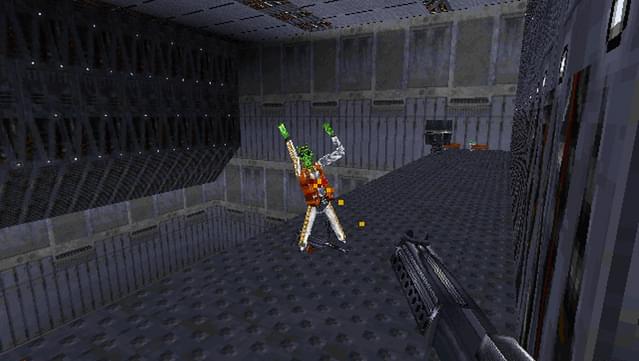
The technical texture of that period matters because Jedi Knight is not a nostalgic relic in the soft-focus sense. It is a full 3D shooter of the sort that still wears the era’s geometry on its sleeve. The presentation has that early 3D PC look, the one that seems endlessly eager to prove the computer is doing something expensive. In 1997 this read as progress, and to be fair, it still has a certain forceful honesty. It is not pretending to be cinematic in the later, more self-conscious sense. It is a machine built to make the player feel like they are moving through a hostile, engineered space with purpose. If that space occasionally resembles a box of screws and industrial mood lighting, well, welcome to the party.
The sound and interface specifics are not exhaustively documented in the material I am working from, so I will not fake an expert’s certainty here. What can be said, safely, is that the game was built for the PC as PC, with the usual baggage of the era. There was a 16-bit installer problem on modern 64-bit Windows systems, and 3D acceleration can cause crashes or black screens unless you are careful. That sort of compatibility nonsense is the price of admission when you revisit old software, and Jedi Knight wears it with the weary dignity of a man who knows he once impressed everybody in the room and is now being asked to boot through some very old doors.
Why it lasts, and why it is not above criticism
What gives the game staying power is not merely that it is a Star Wars shooter with a beloved hero. It is that it understands escalation. You begin in one genre register and end in another. You begin with a mercenary fantasy and arrive at myth. The progression gives the game a shape that many shooters of the period lacked. A lot of contemporaries were content to be efficient violence delivery systems. Dark Forces II wants to narrate your transformation, and that is a much stronger idea than people sometimes give it credit for.
Still, there is a reason I am not pinning a saint’s halo over the box art. A game can be ambitious and a little clumsy at the same time, and this one occasionally is. The core loop, as described in the source material, revolves around chasing clues toward the Valley of the Jedi while fighting through missions and unlocking powers. That is a perfectly solid structure, but it also means the game depends heavily on whether you find its mission rhythm absorbing rather than merely dutiful. When the momentum clicks, it feels like a pulp serial remade with better weapons and worse posture. When it does not, the game can feel like a series of obligations wearing a Jedi robe.
There is also the problem that historical importance can become a narcotic. People love to celebrate this game for being the first to do certain things with Force powers and multiplayer. Fair enough, it was. But first is not the same as best, and innovation is not a coupon that buys immunity from criticism. What matters is whether the game is still fun once the museum placard has been taken away. My answer is yes, mostly, because the underlying fantasy is strong and the structure has enough forward motion to keep dragging you through. But I would not call it frictionless, and I would not pretend every fight, every mission, every leap in power lands with equal elegance.
What it does have, in abundance, is personality. Kyle Katarn as a mercenary discovering Force powers is a better hook than the usual chosen-one sludge because it lets the game work against expectation. He is not already a glimmering temple child with a destiny tattoo. He is a man in the middle of an awkward transition, and the game mirrors that transition by gradually handing the player more tools, more authority, and more of the famous Star Wars mystique. That is good design, or at least design with a plan, which is more than I can say for a depressing number of shooters that mistook repetition for momentum.
The reputation is deserved, but not uncritically
In historical terms, Jedi Knight did well enough to justify the fuss. It was a critical success, and by the end of 1997 it had sold about 247,036 units in the US, with more than 155,000 by November of that year. Those are not just vanity numbers for a press release. They tell you the game found a real audience, the kind that recognized it was doing something a little more ambitious than the average licensed product. And yes, licensed products were often a low-rent swamp in that period, which makes this one look even better by comparison. But I do not think its reputation is merely a side effect of scarcity or nostalgia. The game earned its place by taking the Star Wars fantasy seriously and by giving players a sense of progression that mattered.
That said, the praise should be precise. I admire what Dark Forces II is trying to do more than I admire every individual thing it does. There is a difference. The game is strongest as a fantasy of becoming, as a bridge between shooter discipline and Force-wielding spectacle, and as a piece of 1990s PC design that knows how to make a player feel like they are unlocking something genuinely special. It is weaker when the old awkwardness of the era creeps in, when the presentation feels like an industrial compromise, or when its ambitions outpace the cleanliness of its execution. Which, to be fair, is a very 1997 problem. A lot of the decade’s best PC games were held together by determination, code, and a touch of witchcraft.
If you are coming to it now through the later digital releases, be aware that the research I have here points to the original Windows PC version as the proper focus, with later versions and bundled releases existing in the wild. The modern compatibility caveats are real, and if you are the sort of person who wants the old machine to behave itself on a current system, the game can still demand a little ritual work. That is not a design virtue. It is just the tax you pay for nostalgia’s continued occupancy.
My verdict is simple: Star Wars Jedi Knight: Dark Forces II deserves its reputation because it makes the Star Wars shooter feel like a process of transformation rather than a parade of blaster fire. It is for players who want atmosphere, progression, and the deliciously adolescent thrill of finally getting the lightsaber party started. It is not for anyone who wants spotless modern convenience, or for players who need every old PC shooter to be judged as if it were built yesterday. Its strengths clearly outweigh its flaws, but those strengths are specific ones, rooted in design ambition and fantasy fulfillment rather than pristine execution. In other words, it is a great idea that learned how to run, mostly, and sometimes that is enough.
Score: 8/10