I went into Marble Master, better known as Swing, expecting a quaint little puzzle relic from 1997, the sort of PC oddity that survives because a few people remember it fondly and everyone else has mistaken its title for something else. What I found was something more interesting and more aggravating: a puzzle game with a genuinely smart central idea, a nasty little streak of chaos, and just enough roughness to keep it from becoming the elegant machine it clearly wants to be.
This is the 1997 Software 2000 DOS and Windows release, and that context matters. Not because it excuses anything (I have been hearing that song since the dial-up era), but because this is exactly the sort of game that sat in the shadow of better-known block puzzles while trying to smuggle in one memorable twist. Instead of stacking falling shapes into neat order, you are dealing with colored marbles dropped onto balances and swings, where the weight of what you place matters almost as much as the match itself. That one decision changes the emotional weather of the whole thing. You are not merely arranging pieces, you are negotiating with gravity, imbalance, and the occasional vindictive little chain reaction.
A puzzle game with a grudge
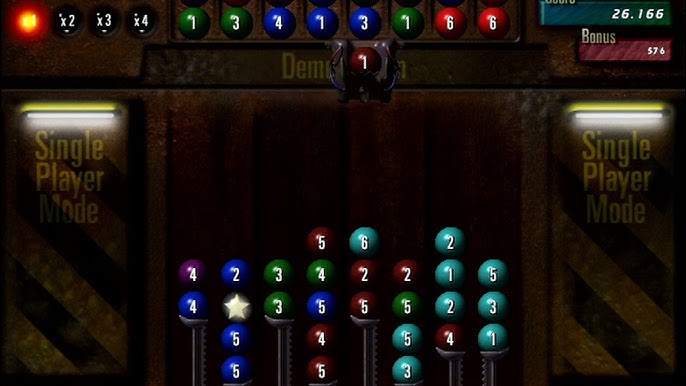
The core loop is easy to grasp and, for a while, surprisingly hard to stop playing. You guide an industrial-looking ball dropper with three keys, positioning it over a set of balances or scales and sending down marbles in different colors. Match three or more of the same color horizontally or vertically, and they vanish. So far, so civilized. But the game is never content to remain civilized. The scales tilt under weight differences, and when they do, they can catapult marbles into fresh positions, turning a tidy setup into a small geological event. On paper, this sounds like one of those ideas that would make a designer nod wisely and a player swear loudly. In practice, it does both.
That tension is the whole trick. Most falling-block puzzles are about managing space, timing, and pattern recognition. Swing adds a physical joke on top of that, then keeps telling the joke until you are no longer sure whether you are the punchline. Place one marble too many on the wrong side and the balance starts acting like it has a personal grievance. Sometimes that creates an opening, sometimes it blows apart the arrangement you were building, and sometimes it does both in the same breath. It is messy, which is exactly why it has character. Too many puzzles from this era aim for sterile perfection; Swing prefers the dignity of controlled embarrassment.
The research describes the game in slightly different ways, sometimes as marbles suspended on a swing, sometimes as a dropper over eight arms and scales, but the essence is consistent: you are playing with a system that is part matching game, part balancing act, part prank. That ambiguity even works in its favor. It feels improvised, like someone found a solid puzzle core and then bolted on a carnival contraption to see what would happen. The answer is, naturally, chaos. The good kind, when the game is being generous, and the annoying kind when it is not.
The pleasure of almost having it under control
What I like most about Swing is that it understands how satisfying near-failure can be. A lot of puzzle games are at their best when you are calmly in command. This one is at its best when command is slipping through your fingers and you are still somehow making the right move on instinct alone. The weight mechanic gives every placement a little moral consequence. That marble is not just a marble, it is a vote. Add another one here and the whole structure might collapse into a combo, or it might go horribly wrong and send your clean plan into the gutter. The game keeps you thinking in terms of mass and leverage, which is refreshingly bodily for a genre that so often feels abstract to the point of being clinical.
There is also real appeal in the way it scales up. The research notes that more colors and special or rogue balls arrive later, expanding the problem rather than replacing it. That is the right instinct. A puzzle game like this lives or dies by whether new elements deepen the vocabulary or merely clutter the screen. Here, the extra pieces seem designed to complicate your already delicate relationship with the board. Combos matter for points, of course, and in multiplayer they can be weaponized against the other player, which is exactly the sort of mean-spirited escalation that kept competitive puzzle games alive through the 90s. If you wanted serenity, you picked the wrong genre. If you wanted to ruin a friend’s afternoon with math and gravity, congratulations, you found your hobby.
The single-player structure is also a neat little spread of intentions. There is a mission or puzzle mode, a sudden death style time pressure mode, an arcade option, and a tutorial. That is a respectable spread for a game of this kind, and it suggests a developer who knew the central mechanism needed multiple framing devices to keep it from going stale. I appreciate that. I also appreciate that the game does not try to pretend it is bigger or grander than it is. This is not a grand narrative machine, and it does not waste your time trying to be one. It is a puzzle instrument, and a slightly eccentric one at that.
Where the charm leaks out
Still, let us not be sentimental idiots about it. Swing is clever, but clever is not the same as polished. One contemporary description mentions an annoying bug where the high score is sometimes not recorded, and inexplicable pauses that disrupt the flow. That is exactly the sort of flaw that turns a good puzzle game into an exasperating one, because score attack structure is built on the illusion that your precision matters and will be remembered by the machine. If the game occasionally forgets to acknowledge your effort, the whole contract starts looking suspicious. You can forgive a lot in an obscure 1997 PC puzzle title, but you cannot forgive it for acting like your triumph was a clerical error.
Even without that bug, there is an awkwardness to the rhythm that never fully disappears. Those pauses matter because this kind of game lives and dies on flow. The balancing mechanic should feel like a constantly evolving conversation between player and system, and instead it can sometimes feel as though the game is clearing its throat before delivering the next complication. That may sound minor on the page. In play, it is the difference between tension and friction. One is dramatic. The other is just the software hesitating while you sit there with your cursor and your hopes.
I also cannot help noticing how much of the game’s appeal depends on tolerating a degree of visual spartanism. The presentation is described as minimalistic DOS graphics, which is not automatically a flaw, but it does mean the whole concept has to carry a lot of weight by itself. Fortunately, the concept is sturdy. Less fortunately, there is not much else in the package to make the experience sing. The side-view setup does the job, the marbles are legible, and the scales communicate their state clearly enough, but this is not one of those puzzle games whose art direction flatters the mechanics into grandeur. It looks like a utilitarian contraption, because that is what it is. The theme around it, such as it is, remains suspiciously muddy. One database even lists a bike or bicycling theme, which sounds like a database having a brief hallucination. I would not build any interpretation on that without stronger evidence.
A 90s PC curiosity, not a lost masterpiece
Historically, I can see why Swing earns a place in the memory banks of puzzle weirdos. It is the sort of game that tried to move beyond the standard falling-block formula by making mass and balance part of the equation, which gives it a distinct identity among 1997 puzzle releases. It is also, as far as the research shows, a straightforward original PC release with no reliably documented ports or remasters to muddle the issue. That makes the DOS and Windows versions the relevant field of study, and it is in that territory that the game is most honestly judged. If you want to run it today, the surviving evidence points toward DOSBox, which feels appropriate, because of course the best way to commune with a mid-90s puzzle oddity is to wrap it in a preservation layer and hope the old machine spirits are appeased.
What I admire, genuinely, is that the game knows exactly which old design instinct to keep and which one to abandon. It keeps the simple readability of a classic arcade-puzzle structure. It abandons the fantasy that neatness is enough. Every move has weight, literally, and that gives the whole thing a texture that many more famous puzzle games never bothered with. There is a little cruelty baked into the system, but also humor. I found myself grinning when a planned setup became a disaster and then, against all reason, a better disaster. That is not nothing. Some games are only memorable because they are hard to categorize. This one is memorable because it makes you feel like a stagehand in a physics experiment that may or may not be on fire.
But I would stop well short of calling it a neglected masterpiece. The foundation is smart, the best moments are genuinely satisfying, and the multiplayer wrinkle of sending combo trouble at an opponent sounds as mean as it should. Yet the rough edges are real, the presentation is bare, and the technical hiccups, at least as reported, are exactly the sort of small sabotage that can sour repeated play. I respect the design idea more than I love the finished object. That is an important distinction. Respect is for the architect. Love is for the building you actually want to stay in.
Swing is for players who enjoy puzzle games that fight back with a gimmick that is not really a gimmick, because it changes the entire feel of the board. It is for people who can forgive an austere look if the underlying system has a nasty little spark. It is not for anyone who wants smooth, polished comfort, or who needs a puzzle game to be instantly generous and technically invisible. Its reputation, such as it is, seems deserved in the modest sense that it is a clever, unusual 1997 PC puzzle title with a memorable central hook. Its strengths do outweigh its flaws, but not by a heroic margin. More like by a clever, wobbling margin, the sort that keeps the whole thing upright just long enough to prove it knew what it was doing all along.
Score: 7/10