Take No Prisoners, in its original 1997 PC Windows form, is exactly the sort of game I used to circle in import magazines with a pen, then spend the next six months arguing about in my head. Not because it is elegant, or even because it is especially polished, but because it has that very specific late-90s PC confidence, the kind that says, yes, we have built a violent science-fiction contraption with a top-down camera, non-linear territories, vehicles, terminals, logfiles, co-op, deathmatch, and enough weapons to stock a small revolution. Please admire the ambition. Please ignore the dust.
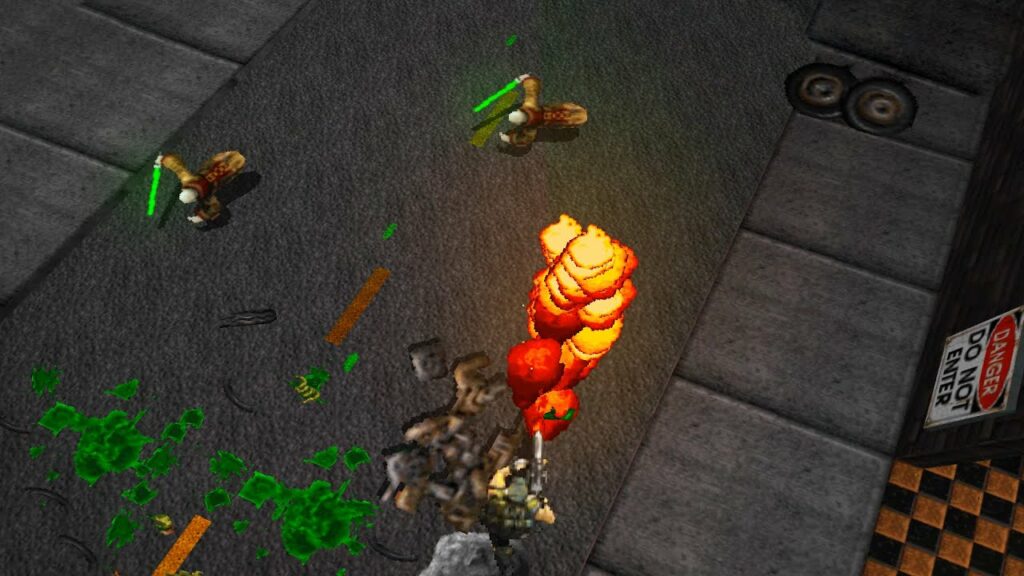
What you get is a Raven Software action shooter that refuses to behave like a plain old action shooter. You play Slade, a mercenary sent into a post-nuclear dome in San Antonio to recover a crystal, which is already a wonderfully pulpy setup, as if somebody took a stack of dog-eared genre paperbacks and fed them into a fan with a turbo button. The game then proceeds to bury that setup under mutant combat, advanced AI enemies, indoor and outdoor territories, and a floating overhead perspective that keeps the action readable while also making the whole thing feel slightly clinical, like you are watching a war unfold on a security monitor that has had a few too many cigarettes.
The kind of shooter that wants to be complicated
The easiest way to understand Take No Prisoners is to stop thinking of it as a twitchy arena shooter and start thinking of it as a top-down 3D infiltration game that just happens to be fond of very loud guns. The research points to 20 non-linear territories, which is a useful clue: this is not a game content to march you down a hallway and clap at the end. It wants you to poke around, choose routes, collect objects and keycards, consult computer terminals, read logfiles, and generally act like somebody trying to get something done inside a hostile dome rather than a tourist with an assault rifle.
That structure is where the game earns its keep. The overhead camera gives it a different rhythm from the first-person dogfights dominating the era, and that matters more than novelty for novelty’s own sake. With the action pulled back, the game can stage a messier, more tactical little war. Vehicles enter the picture. Puzzles exist. AI is mentioned as a feature rather than a pleading excuse. You are not just clearing space, you are navigating a fortified problem. That is a better fantasy than the average mid-90s power trip, which often boiled down to sprint, shoot, keyhunt, repeat, with all the narrative sophistication of a parking violation.
And yet, for all that design ambition, the game never quite stops feeling like a product of its era in the most specific sense: a game desperate to prove it is serious by stuffing itself with systems. Twenty-one weapons, twenty-two combat items, advanced enemy types, multiple paths to victory, multiplayer modes, technical flourishes for 3D accelerators, and an interface PDA that gives you briefings and passcodes while the world keeps moving. That last detail is almost aggressively 1997. The game does not pause when you open the PDA, because of course it doesn’t. Why would it? Clarity is for weaklings and later design trends.
How it feels to actually play
The good news is that the controls were described at the time as responsive, and that is the sort of praise that sounds small only if you have forgotten how many action games of the period handled like shopping carts with a loose wheel. Take No Prisoners apparently understands the first obligation of a shooter, which is that when I tell the avatar to move or fire, the game should not first consult a committee. That responsiveness matters even more in a top-down game, where the gap between intention and movement can become comic very quickly. If the camera is going to keep a deliberate distance, the controls had better feel crisp enough to compensate. Here, by the available reports, they do.
The camera itself is part of the personality. The game uses a low, overhead floating view that can become claustrophobic in enclosed spaces. That is a useful effect, because the post-nuclear dome setting should not feel breezy. It should feel like a sealed wound. The lower angle keeps the world moody, dark, and slightly threatening in a way that a cleaner, brighter viewpoint might have ruined. The downside, of course, is that this kind of perspective can also make spatial judgment irritating when the game decides you should care about exact positioning in a firefight. That is the eternal bargain with these overhead or semi-overhead shooters: readability versus intimacy, and the bill always comes due somewhere.
Still, the structural mix sounds lively. Weapons are not just numbers on a spreadsheet, they are part of the game’s promise of variety, and the names in the research tell their own story. A Tachyon Cannon. A Molotov. A Laser Rifle. This is not a game shy about ridiculousness, which helps a lot when the setting is otherwise grim enough to iron shirts with. The item count, the vehicles, the enemy variety, the non-linear territories, all of it suggests a game that wants sessions to feel improvised rather than scripted. That is the right instinct for a shooter about breaking into a dome full of mutants. I want a little disorder. I want the game to occasionally look as though it is making itself up as it goes.
Where it seems to falter is in the interface habits that were so often mistaken for depth in the era. The PDA not pausing the action is the kind of design choice that sounds mercilessly hardcore in a magazine feature and merely annoying at 11:30 at night when you are trying to remember a passcode while something is trying to murder you. That does not ruin the game, but it does reveal the old PC vice of treating friction as personality. Likewise, the reported criticism of the crossbow weapon makes me suspicious in the familiar way: every ambitious weapon list contains at least one item that exists mainly to remind you that not all variety is useful variety. Somewhere in there is a gun that looked good in a meeting and then spent the next three months disappointing everyone with its employment prospects.
Mood, texture, and the pleasures of being hard to look away from
Visually, Take No Prisoners is described as dark and moody, with a 320x200x16 base presentation and a blitter-driven look that keeps the textures sharp by turning mipmaps off. That sounds almost quaint now, but it is exactly the kind of compromise that made a lot of 1990s PC games memorable even when they were not technically beautiful. The image is rough, but rough in a purposeful way. In the right mood, that can be far more effective than a pristine render. If the world of the game is supposed to feel hostile, old hardware ugliness can become atmosphere rather than liability.
Of course, the technical story is not pure nostalgia perfume. The research notes that 3D accelerator support improved frame rate and lighting, which is shorthand for a very familiar late-90s situation: the game runs, but it runs better if you own the right box of wizardry. That is not unique to this game, but it is part of the experience, part of the period texture. You were not merely buying software. You were joining a small private war against compatibility, resolution, and the gods of driver support. In the present, the GOG and Steam releases complicate the picture further. The GOG release is documented as working with dgvoodoo2 for higher resolutions and 16-bit color, while the Steam release is specifically noted for missing features. That matters, because anyone approaching this today is not really approaching a single fixed object. They are approaching a 1997 game through modern packaging, and the packaging apparently has opinions.
The modern compatibility notes are almost a genre in themselves at this point. Need dgvoodoo2, nudge the resolution, smooth the frame rate, persuade the old thing to behave like it lives in the current century. This is the kind of aftercare classic PC games now require, and Take No Prisoners seems to be no exception. I would not call that a black mark against the original game so much as a reminder that our collective memory of the era is often cleaner than the actual software was. The myth is always polished. The executable is another matter.
Multiplayer, or the ancient dream of turning chaos into company
The multiplayer angle sounds, predictably, like one of the game’s best ideas and one of its more period-specific liabilities. The research confirms multiplayer co-op up to four players and deathmatch modes, with Internet play through RedOrb Zone, though performance issues are noted for slow connections. That is wonderfully on-brand for 1997, when online play was equal parts thrilling frontier and mildly embarrassing experiment. Even when the design is sound, the network layer is trying to trip over its own shoes.
Still, I can see why the game leaned into it. A top-down shooter with vehicles, non-linear spaces, and a big weapon roster is exactly the sort of thing that should become more interesting once human beings start making each other miserable inside it. Co-op would help smooth the edges, deathmatch would sharpen them, and both would exploit the game’s strongest trait, which is its willingness to let situations develop rather than simply erupt and end. The downside, as ever, is that a good multiplayer idea in the 90s often had to survive the practical comedy of modem-era infrastructure. Nothing humbles ambition quite like a slow connection.
So is it actually good?
Yes, but not in a way that will flatter everyone. Take No Prisoners sounds to me like a game with real mechanical curiosity, a strong sense of pulp staging, and enough tactical shape to distinguish it from the more obvious blast-everything PC action games of its day. I admire that. I admire the non-linear territories, the vehicles, the weapon variety, the way it apparently mixes shooting with terminals and logs and actual navigational thought. I even admire the moody presentation, because it seems to understand that a dome full of mutants should not look like a weekend paintball facility.
But I also cannot pretend its strengths erase the annoyances that come bundled with them. The unpausing PDA is the sort of quality-of-life oversight that feels less quaint than stubborn. The low camera can create tension, but it can also make combat a little fussy. The Steam version is noted for missing features, which is not exactly a sales pitch from the vaults of confidence. And the broader design, for all its inventiveness, still sits in that awkward mid-90s zone where a game can be full of ideas and still leave you mildly exhausted, as if every feature were trying to prove it deserves its own paragraph in the manual.
That, really, is the heart of it. Take No Prisoners is not a lost masterpiece, nor is it a charming footnote that only matters because the genre later went elsewhere. It is a legitimately interesting action shooter that has enough personality, pace, and structural nerve to survive contact with modern skepticism, but not enough elegance to transcend its habits. If you like your old PC shooters a bit grubby, a bit overbuilt, and just strange enough to feel like they escaped from a more interesting design meeting, this one deserves your attention. If you want a clean, frictionless blast of retro comfort, look elsewhere and let the dome keep its secrets.
It deserves respect, but not reverence. Its strengths outweigh its flaws, though not by a landslide, and certainly not by the sort of margin that lets a game coast on atmosphere alone. I came away thinking less about a forgotten classic than about a stubborn little artifact that knew exactly how to be more interesting than it was convenient. In the end, that is a better legacy than simple competence. Not every game gets to be a masterpiece. Some games settle for being a good argument, and Take No Prisoners is very much one of those.
Score: 7/10