I have a weakness for games that look like they were built by people who wanted to prove something to the world and maybe settle a private grudge with genre convention. MageSlayer, the 1997 Windows action game from Raven Software, fits that bill beautifully and a little tragically. It is a top-down dungeon brawler in the broad, old, slightly sweaty tradition of Gauntlet, but it is also one of those mid-90s PC oddities that refuses to sit still long enough to become a clean category. It wants to be fast, grim, crowded, tactical, and theatrical all at once, which is a noble agenda, and sometimes it gets there. Other times it trips over its own ambition and faceplants into the old PC action habit of making you admire the idea while you are still negotiating with the camera and the clutter.
This is the 1997 Windows version, the one that sources consistently identify, the one Raven published through GT Interactive, the one with the dark fantasy packaging and the slightly overcooked promise of power. You pick one of four clan warriors and plunge into dungeon levels full of monsters, traps, puzzles, and the kind of environmental hostility that makes you feel less like a hero and more like a particularly determined pest control specialist. The frame story is deliciously operatic in the way only mid-90s fantasy game lore can be: Lord Thane, having long since made a mess of the world, has gathered the StarStone relics, and now the remaining clans send their best fighters to reclaim them. It is the sort of setup that sounds as if it was composed in a hurry during a lunch break by somebody who also had to hand in the box copy by five o’clock, but it does the job. The game knows what it wants you to do. It wants you to push forward into danger and keep pushing.
And, to its credit, that is exactly what MageSlayer does best. This is not a game of elegant balance or subtle resource management. It is a game of pressure, of accumulating trouble in a corridor until the corridor becomes a situation. Descriptions of the time and the archival summaries consistently emphasize large numbers of enemies, traps, secret doors, and a fairly relentless pace across roughly 30 levels. That sounds crude on paper, but in practice it gives the game a very specific rhythm: you enter a space, read it quickly, then spend the next several seconds deciding whether to stab, dodge, reposition, or panic. Sometimes all four. The pleasure here is not in carefully solving a room as if it were a tidy puzzle box. The pleasure is in surviving the room while your confidence is being slowly chewed apart by monsters and architecture.
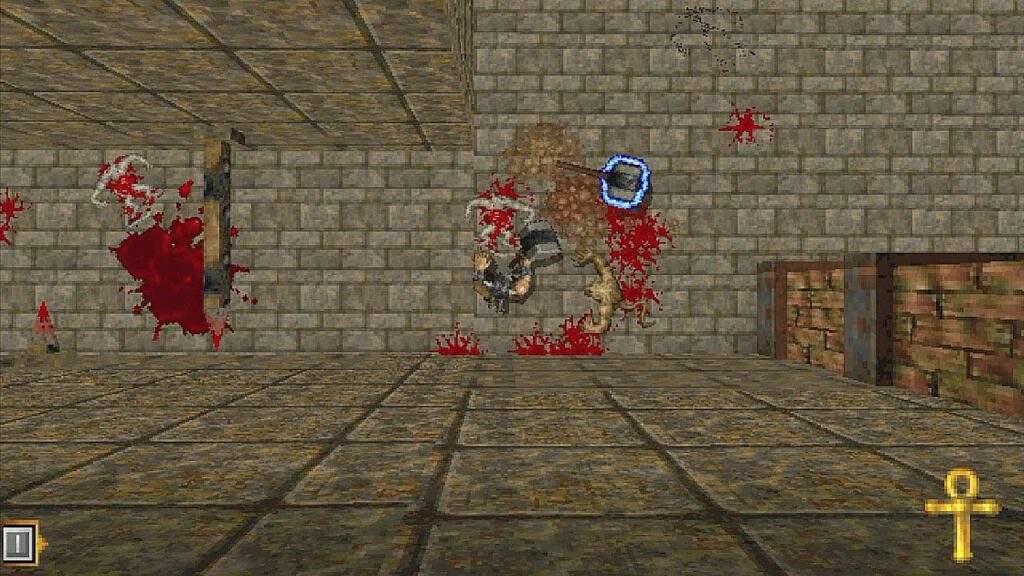
That is the important distinction, and it is what keeps MageSlayer from becoming a museum piece. Raven did not just slap a fantasy skin onto a generic overhead action loop and call it a day. The game uses the studio’s proprietary Vampire engine, which gives it full 3D environments under a top-down camera while retaining 2D sprite characters and monsters, plus dynamic colored lighting. That combination is not merely a technical footnote. It is the game’s personality. The level spaces have depth and verticality, so even when you are looking down from above, the dungeons feel like places rather than diagrams. The lighting does a lot of emotional labor too, painting the black stone and torchlit gloom with just enough color to keep the darkness from becoming a flat stain. It is moody in that peculiarly Raven way, which is to say it is less about realism than about producing the sensation that the room itself would like to eat you.
I appreciate that. I also appreciate that the game does not pretend to be delicate. If you are looking for a gentle, exploratory fantasy stroll, this is the wrong building. MageSlayer is crowded. It is busy. It throws bodies at you. MyAbandonware’s archival description talks about “dozens of nasty monsters” and “very furious (and bloody) fights,” and that sounds exactly right. The game belongs to the school of action design that believes a good fight should feel slightly out of control, like the designer started with a plan and then turned the enemy count knob until the screen began to sweat. When it works, the result is a hard-edged, satisfying churn. You are always moving, always adjusting, always thinking one step ahead because standing still is basically volunteering for a funeral.
The four classes, or clans, are central to the premise, and that alone gives the game a better spine than many of its overhead-action peers. The research consistently confirms four distinct warriors, though the exact specifics of their abilities and stat differences are not reliably documented in the sources I found. That uncertainty matters, because I am not going to invent the sort of neat class taxonomy that a manual might have clarified. What can be said, without guesswork, is that the game wants those choices to matter, and that framing alone improves replay value and identity. It suggests a design that understands the old arcade trick of making a simple loop feel larger by giving the player one of several ways to inhabit it. Whether the implementation fully delivers on that promise is harder to pin down from the sources alone, but the ambition is plainly there.
What MageSlayer does not have, at least not in any reliably documented way from the material at hand, is the kind of lavish systems support that would let it graduate from sturdy action game to outright obsession. I could not find solid source evidence for difficulty settings, a detailed save structure, or a clearly documented progression system, and I am not going to invent any of those because the internet has enough confident nonsense already. That absence does matter in a review, though, because it leaves the game exposed. A top-down dungeon fighter lives or dies on friction management. Too much friction and it becomes exhausting. Too little and it becomes wallpaper. MageSlayer sits in that volatile middle space, where the appeal is immediate but the long-term grip depends on how much you enjoy its particular strain of deliberate chaos.
There is also the matter of readability, that sacred and often neglected quality in action games. The Vampire engine’s 3D spaces and sprite-based characters create a look that is distinctive, but distinctiveness is not the same thing as clarity. In a game built around crowded fights, traps, and secret passages, visual legibility is not a garnish, it is the plumbing. When the lighting, architecture, and enemy density line up, the game has atmosphere to spare. When they do not, it can become a little too pleased with its own murk. I do not think MageSlayer is broken in this respect, but I do think it sometimes asks the player to do more squinting than necessary, and squinting is rarely a sign of genius. It is often just squinting.
Still, I cannot deny the charm of its presentation. Kevin Schilder’s music is part of the package, and the game’s dark fantasy identity is reinforced by Brom’s cover art, which is exactly the sort of collaboration that makes a 90s PC box feel like a small, slightly threatening object from another civilization. Raven understood, perhaps better than many of its peers, that fantasy action games live or die by mood. You can forgive a lot if the game feels like it was built inside a shadow and scored by somebody who knew the shadows personally. MageSlayer absolutely understands that assignment. It has the confidence to be grim without becoming dour, stylized without becoming a joke, and just lurid enough to keep the blood pumping.
Where I get less charitable is in the game’s relationship to the overhead action tradition it clearly loves. Calling it “Gauntlet-like” is not an insult, just a description with a long shadow. The trouble with that lineage is that it can become an excuse for repetition, for encounter design that assumes pressure is inherently interesting because the player is busy. Busy is not the same thing as engaged. MageSlayer often skirts that line. It has enough moving parts, enough monster density, and enough environmental complication to stay lively, but it also risks collapsing into a familiar pattern of sweep, pause, sweep, repeat, with the occasional trap or hidden door thrown in to pretend the dungeon has thoughts of its own. That is not nothing. It is also not enough to make every level feel like a revelation.
The historical context helps explain both the appeal and the limitations. Raven was already a name with weight in fantasy action by this point, and MageSlayer sits in that lineage while also wandering off into its own top-down corner. The move away from the more famous first-person territory is interesting because it shows the studio making a custom-tech, custom-viewpoint action game with the same insistence on atmosphere and violence. The result is not as famous as the studio’s more celebrated fantasy work, but it is perhaps more revealing. It shows Raven trying to build a different kind of kinetic fantasy, one where the player looks down into the slaughter instead of barreling through it. That changes the emotional register. You are less the hero in the corridor and more the manager of an escalating disaster.
Reception history, insofar as the available sources let us speak of it without improvising, suggests the game was regarded as solid rather than legendary, with reported scores around the low 70s to high 70s. That feels plausible to me. This is not the sort of game that usually produces fanatics chanting from the rafters, nor is it a forgotten embarrassment. It lands in that respectable zone occupied by many clever, imperfect PC action games from the era: admired by people who spent time with it, hazy to everyone else, and just distinctive enough to survive in memory as a shape rather than a household name.
The modern availability situation is, predictably, archival rather than official. I found no reliable evidence of console ports or a contemporary digital storefront release, and the version that most consistently exists in the record is the original Windows game. That matters only insofar as it preserves the context in which the game should be judged: not as a later polished revival, but as a mid-90s PC artifact with all the compromises that implies. This is not one of those rediscovered classics that suddenly looks pristine in hindsight. It is a scrappy, moody, sometimes excellent dungeon bruiser whose age shows in exactly the places you would expect. The fact that people still bother to run it through wrappers and archival sites says less about universal acclaim than about a durable oddness. Some games earn preservation through greatness. Others earn it by being interesting enough that you keep poking the carcass to see what is still twitching.
And MageSlayer does twitch, wonderfully. It has a pulse. It has atmosphere. It has enough combat momentum to make a good session feel like a tiny campaign against the dark. But it is also a game whose virtues are inseparable from its limitations. It is not especially generous, not especially elegant, and not especially interested in handing you a polished, universal answer to the question of what a fantasy action game should be. It wants to be a hard, crowded, colorful little menace, and it succeeds often enough that I am willing to forgive the mess. Not all of it, mind you. I am a critic, not a mascot. But enough.
So who is this for? People who like overhead action with bite, who enjoy Raven’s dark fantasy mood, who can tolerate a game that is more swaggering than refined, and who do not require every system to be explained with modern hand-holding. Who is it not for? Anyone who needs crystalline readability, deep documented progression, or the kind of design economy that makes every encounter feel authored rather than accumulated. Does it deserve its reputation? Yes, but only as an underrated, slightly ragged specialist, not as an unqualified lost masterpiece. Its strengths do outweigh its flaws, though not by a landslide. It is a good game with a mean streak, a strong visual identity, and enough old-school friction to keep the elbows out. In other words, exactly the sort of thing I used to rent, play too late, and defend too loudly in magazine letters pages. Some habits die hard.
Score: 7/10