Lords of Magic, the 1997 Windows PC original from Impressions Games and Sierra, is one of those strategy games that arrives with the solemn confidence of a parchment map and then immediately starts acting like the whole continent is one bad decision away from collapse. Its selling point is not subtle: Urak, eight faiths, a world split into rival regions, and the Death Lord Balkoth looming over the whole arrangement like a first-class annoyance with supernatural benefits. What makes the game interesting, at least to me, is that it does not merely dress up a standard strategy campaign in wizards and stained glass. It tries to make the fantasy religion war itself the machine. That is a great idea. It is also the sort of idea that can either produce a minor obsession or a dignified pile of interesting failures. Lords of Magic mostly lands in the first camp, but it limps enough that I would not pretend otherwise.
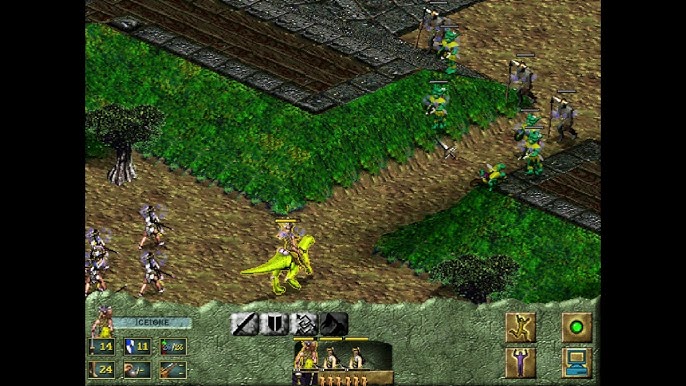
The original PC release is the version that matters here, because the later Special Edition is a separate beast. So, 1997 Windows Lords of Magic it is, the Impressions/Sierra fantasy strategy game whose basic fantasy is less about farming a kingdom and more about navigating a continent where belief systems are not decorative lore but strategic infrastructure. I respect that immediately. Games in this era loved to promise grand stakes, then reduce them to a few beige menus and a siege or two. Lords of Magic at least commits to its premise. The world of Urak, divided into eight regions and tied to eight faiths, gives the game a structure that feels ideological rather than merely territorial. That matters. It means you are not just moving armies around a map, you are participating in a soft apocalypse of competing cosmic club memberships.
The appeal, if you are the sort of person who likes your maps with theology attached
The high-level loop is clear enough from the available sources: explore the world map, build military and economic strength, and work toward the destruction of Balkoth, the Death Lord. That is a pleasingly blunt objective. No one is pretending this is a pastoral sim with an occasional goblin problem. You are here to gain leverage, expand influence, and eventually shove the antagonist off the board. The eight-faith structure gives that basic strategy routine a stronger flavor than the usual fantasy grab-bag. It is not just a generic kingdom-building exercise with dragons standing in for tanks. The factions are central, and the whole setup suggests a contest of incompatible worldviews rather than a parade of identical castles painted different colors.
That, to me, is where Lords of Magic still feels distinctive. The late-1990s PC strategy scene was full of games that wanted scale, systems, and consequence, but not all of them knew how to make their worlds feel like places instead of spreadsheets wearing cloaks. Here, the fact that Urak is split into faith-linked regions gives the conflict a kind of baked-in tension. A faction map is never just a faction map when the game keeps reminding you that the land itself is tied to belief. You do not merely expand. You intrude. You convert, contest, destabilize, and then, if you are doing well enough, start thinking like the kind of person who can bring the Death Lord down and call it a plan.
I can see why retrospective writers keep circling back to the game as an unusual precursor to later grand strategy and fantasy war design. It mixes turn-based structure with a broad, factional view of the world, and it does so before some later strategy giants made that blend more familiar. But history is not a participation trophy.
Being early is not the same as being clean, elegant, or especially kind to the player. The important question is whether the game turns its ambition into something satisfying to inhabit. My answer is yes, with reservations large enough to need their own postal code.
What it feels like to play it, from the outside looking in at least one sharpened complaint
What I can say, with confidence, is that the game’s identity comes from the back-and-forth between world-map strategy and its factional religious framework. That combination does real work. It implies a campaign rhythm that is more than marching from one objective to the next. You are supposed to build an engine, understand the map, and use the faith divisions of Urak as strategic terrain. That sounds rich because it is rich, at least in theory.
In practice, I suspect the game’s appeal is partly in how much it asks you to keep in your head. These are the kinds of strategy games that reward players who enjoy feeling like they are filing away several petty geopolitical grudges at once. If that sounds exhausting, well, yes, of course it does. That is the point. The pleasure is in managing a complicated contest where the enemy is not just a stack of units but an entire cosmology that wants you dead, displaced, or converted. The game makes that seem important, and I appreciate any strategy title that understands the difference between “large” and “meaningful.”
But I would be lying if I said this automatically translates to grace. Big strategy games of this era often carried a faint whiff of overcommitment, the sense that every good idea had to arrive with some supporting baggage and a second-hand manifesto. Lords of Magic sounds like exactly that kind of creature. The concept is vivid, but the supplied sources do not establish a smoother or more intuitive execution beneath it. So my praise is for the ambition and the structural identity, not for some imaginary miracle of usability. The game seems to thrive on scope and theme, not on pampering the player. Which is fine, because I do not need my strategy games to hand me a warm towel and ask about my day. I do, however, need them to justify their complexity, and this one at least appears to try.
Urak, Balkoth, and the noble art of making a villain do the heavy lifting
The end goal matters here. Balkoth is not just a boss in the usual sense, he is the organizing principle. The sources are consistent on this point, and the campaign feels built around opposition to him. That gives the whole game a stronger spine than many fantasy strategy titles that scatter their attention across lore, unit trees, and map windows until the plot resembles a pile of loose spell components. Here, there is an actual enemy whose title alone does half the mood work. Death Lord. Excellent. That is the sort of villain designation that tells you immediately whether the game is trying to be playful, grim, or both. It is trying to be serious, certainly, but not so serious that it forgets the delicious pulp of it all. I approve of that balance. Fantasy strategy should always smell faintly of old paper, steel, and melodrama.
Urak itself, with its eight regions and eight faiths, gives Balkoth a stage worth threatening. The setting does not just decorate the conflict, it formalizes it. That is important because strategy games live or die by whether their worlds feel mechanically legible. A map with lore is nice. A map whose lore determines how you think about power is better. This is where Lords of Magic seems to have found a real identity rather than a marketing bullet point. If you remember the game at all, odds are that you remember the premise first, and that is usually a sign that the premise was doing serious labor.
Presentation, atmosphere, and the old PC strategy smell
What can be said is that this is a 1997 Windows strategy game from Impressions and Sierra, and that already tells you something about the era’s mood. These games often existed in a zone where interface, art direction, and world-building had to perform in unison because the hardware and the audience both demanded a certain seriousness. You were not buying a carnival. You were buying a boxed artifact that wanted to be taken as a map, a manual, and a minor oath.
That is why the premise resonates. Even stripped of detailed technical description, I can infer the kind of atmosphere the game is reaching for, and I think that matters. A fantasy war over faiths in a divided land needs presentation that sells scale without losing personality. The absence of stronger technical evidence in the supplied material means I am not going to invent complaints about frame rates or praise the sound design as if I had it under a microscope. What I can responsibly say is that the game’s concept clearly leans on mood, and mood is a big part of why this sort of strategy title survives in memory longer than its mechanics alone might justify.
There is also something inherently appealing about a strategy game that refuses to behave like a sterile systems toy. Lords of Magic wants gods, rival faiths, and a death-lord adversary. It wants your map to mean something beyond borders. That may sound like a late-1990s PC strategy flourish, but it is also a sensible artistic decision. If you are going to make me spend my evening thinking in turns, regions, and power blocs, then give me a reason to care about the squabbling. This game does, at least on paper, and paper is where it remains most convincingly itself.
The catch, because there is always a catch and usually it wears gaudy armor
My admiration has limits. Lords of Magic is the kind of game you admire for its ideas before you completely trust its execution. That is not a small distinction. Plenty of strategy games have fantastic premises and then collapse under the weight of their own systems, pacing, or interface decisions. I am not alleging specific failures here that the evidence does not support. I am saying the game belongs to a familiar and occasionally infuriating family, the family of titles whose ambition is obvious enough that you forgive them for making you do some of the labor.
And I do mean labor. Games like this can ask for the kind of patience that feels heroic the first hour and suspiciously like unpaid work by the third. That is the eternal trap of big, layered strategy design. If the game’s faction structure, world map, and strategic buildup are all well integrated, you get the bliss of long-form planning and a world that bends to your attention. If they are not, you get a beautifully framed bureaucracy. The research does not let me assign the game to one side or the other with fake certainty, but it does give me enough to say that the game’s reputation rests on genuine design intent, not random accident. I respect that. I do not automatically enjoy it. There is a difference, and good critics should be allowed to keep both thoughts in the room.
The later Special Edition hangs over the conversation like a footnote with expensive shoes. It exists, it is separate, and one source says it includes the Legends of Urak quest pack, though that particular detail is not confirmed by official documentation in the supplied research. I mention it only because version boundaries matter. But the review here is for the original 1997 Windows release, and that is the one whose identity I am judging. Not the later cleanup, not the bonus content, not the possibility that someone, somewhere, made the thing a bit more generous. The original has to stand on its own merits, as all games should, and as too few actually do.
Verdict
Lords of Magic is for players who want fantasy strategy with actual conceptual bite, who like the idea of a world split into eight faiths and a campaign pitched against a Death Lord named Balkoth without irony flinching in the corner. It is not for people who want instant readability, quick gratification, or the sort of polished convenience that makes a strategy game feel like a well-run app. Its reputation is deserved insofar as it is remembered as a distinctive and ambitious PC strategy title with a strong identity, but I would stop short of calling it an untouchable landmark. What I admire most is the conviction. What I distrust, from the evidence available, is the possibility that conviction sometimes outruns the actual experience of playing it.
Still, I come down on the side of admiration. The game’s strengths, especially its factional fantasy structure and the way Urak’s eight faiths shape the strategic imagination, outweigh the vaguer concerns I cannot responsibly fill in from thin air. This is a game with a brain and a personality, which already puts it ahead of a lot of tasteful-but-faceless strategy entertainment. It may not be the smoothest way to spend an evening, but it is the sort of game that remembers why fantasy strategy exists at all, to make power feel mythic and myth feel like a map you can invade. That is worth something. Not everything, but something substantial.
Score: 7/10