Picture it: February 1993. Doom shareware disks are spreading faster than a chain letter, Jurassic Park’s CGI raptors are about to rewrite Hollywood’s DNA, and my mall arcade is a riot of neon and “BOOM-SHAKA-LAKA!” echoing from freshly minted NBA Jam cabinets. Into that audiovisual mosh pit tiptoes Shadow President, a DOS box so drab it might have been printed on recycled manila folders. Bizarre or classical? (Both: it’s C-SPAN 37 disguised as cyberpunk.) Underrated or overrated? (Depends whether you find balance-of-payments spreadsheets “thrilling.”) Essential or forgettable? Imagine Balance of Power mated with a nine-pound civics textbook, then taught itself ANSI graphics, vital to policy wonks, invisible to joystick jockeys. Yet here’s the twist: beneath all that beige, the game gifts you absolute power and dares you not to break the planet. Fun? Sort of. Important? Unequivocally, if only because it’s the one time I could annex Saskatchewan before recess.
Historical Context
Developer & debut. Shadow President was both developed and published by the fledgling studio D. C. True, Ltd., a boutique outfit whose very name sounds like a Capitol Hill LLC set up to lobby for corn subsidies. It was their first commercial release, and, frankly, their only claim to gaming fame until sequel CyberJudas arrived three years later.
Release windows. North America received the game in February 1993. Europe, however, had to wait until 1996, when UK label Empire Interactive slipped a PAL-boxed edition onto shelves sandwiched between budget compilations of Theme Park and dusty Amiga ports. (Three-year delay? International diplomacy moves faster.)
Contemporary rivals. The early-’90s strategy space was reshaping itself daily. Maxis’s SimCity (1989) had already turned civic plan-checking into a pop-culture event, proving that spreadsheets could be sexy when dressed in colorful sprites and catastrophic disasters.On the other end, Chris Crawford’s Balance of Power (1985) gave players a taste of geopolitical brinkmanship, but by ’93 its CGA palette looked like a retro throwback even then. Meanwhile shooter fans were busy chainsawing demons on Phobos. In that climate, Shadow President attempted an impossible magic trick: sell real-world diplomacy to teenagers intoxicated by BFG9000 fumes.
My first encounter. I spotted the game at Electronics Boutique, wedged between Railroad Tycoon Deluxe and a bargain-bin copy of Night Trap. The box promised “Simulation of Presidential World Power™”, less flashy than Mortal Kombat’s blood code, sure, but to a kid raised on nightly CNN footage of Operation Desert Storm, the idea of having the nuclear football one mouse-click away was irresistible. I slapped my lawn-mowing money on the counter, ignoring the clerk’s gentle reminder that Street Fighter II Championship Edition was “actually fun.” (No regrets. Mostly.)
Post-Cold-War mood. Crucially, Shadow President rode the wave of post-Soviet optimism, history’s “Peace Dividend” moment, when pundits thought spreadsheets and diplomacy would replace missiles. The game’s manual talks up the “New World Order” like a freshly minted social-studies syllabus, then hands you conventional, chemical, and nuclear arsenals anyway. Irony, thy name is Realpolitik 101.
Mechanics
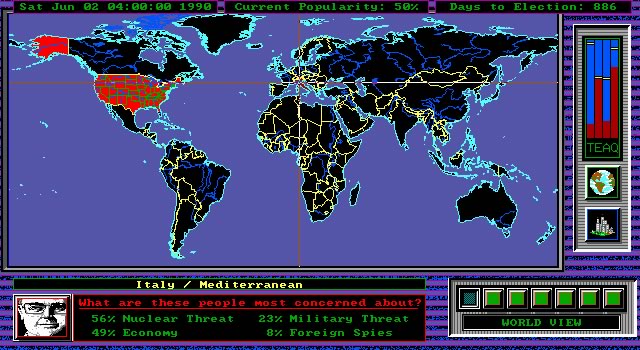
Booting Shadow President drops you on the Shadow Net desktop, a murky, green-on-black GUI that imagines what the Oval Office would look like if WarGames ran on Windows 3.0. Seven advisers (State, Defense, Intelligence, Economics, Domestic Affairs, Chief of Staff, Press) permanently litter the top edge of the screen, furiously flashing red when Libya sneezes. These advisers are more than flavor text; ignore State’s plea to condemn a coup and they’ll resign on live TV, tanking your approval faster than a parody Twitter thread.
Data under the hood. Every nation, yes, all 170+ of them, draws its starting stats from the 1990 CIA World Factbook: GDP, literacy, population, troop strength, even disease levels. That authenticity is why your first session feels suspiciously like a Model UN cram session. Try stabilizing Sierra Leone’s economy and you’ll find yourself Googling diamond exports in real life (today we call that “emergent learning”).
Time is a weapon. Five tempo keys throttle history itself. One click and a month whooshes by, inbox bloated with cables: “Trinidad condemns the Dominican Republic.” “Somali militia pillages aid convoy.” “Japan requests naval drills.” Pause the ticker and you become a conductor orchestrating coups, humanitarian aid, or gun-boat diplomacy all at once. Paradox Interactive would later perfect that pause-plan-unpause loop in Europa Universalis; Shadow President was there first, just with fewer tooltips and more DOS beeps.
Popularity: your oxygen meter. Starting approval sits at a healthy 60 percent. Dip below 50 and impeachment subpoenas flutter in; slide under 30 and assassination attempts trigger a grainy cut-scene of your presidential limo going full convertible-Dallas. Elections hit every four years if you keep the setting toggled on. Want a stress-free sandbox? Turn them off and watch Congress transform into a rubber stamp; turn them on and suddenly you’re begging Ohio for votes with pork-barrel highway bills. Rhetorical question: how many Patriot batteries does a swing state need? (Answer: as many as your reelection manager thinks will poll well.)
Diplomacy & skulduggery. Click “Covert Ops,” drop a few million into clandestine funds, and pick your poison: coup d’état, sabotage, assassination, or just good old-fashioned election interference. Success chances display as maddeningly opaque percentages, think XCOM but with guerrilla insurgents instead of aliens. Fail a covert op and your Press Secretary will schedule a 9 p.m. apology tour.
Military kinetics. Fixated on seeing explosions? Shadow President will break your heart: combat boils down to two bar graphs, force strength and supply morale. Order U.S. troops into Kuwait and you’ll see tiny arrows march across an EGA map; hover for details and discover the real enemy is logistics. Yet that cold abstraction reveals a design thesis: war isn’t glamorous; it’s line items.
The fabled Canadian Blitz™. The community’s most infamous exploit stems from an oversight: Canada’s troop index clocks in absurdly low (historically fair?), so a U.S. blitz can seize Alberta before the Mounties brew their morning Tim Hortons. Approval briefly plummets, invading a neighbor is “frowned upon,” apparently, but rebounds when cheap oil floods Midwest pumps. Computer Gaming World’s July 1993 reviewer deadpanned, “Even invading Canada is more fun than the meetings.” If you’ve ever wondered why “Blame Canada” became a running gag, thank DC True’s balancing team.
Interface friction. Picture every Windows 95 confirmation dialog, combine them, and now imagine a Capcom quarter-eater where the only enemy is pop-ups. “Are you sure you want to sanction Suriname?” Click. “Are you really sure?” Click. Repeat until your mouse suffers PTSD. Yet the sheer noise simulates bureaucratic drag, the very friction a real administration faces. Shadow President weaponizes tedium as a game mechanic, which is either brilliant satire or proof the devs hated playtesting.
Easter eggs & edge cases.
- Initiate nuclear war. A grim cinematic shows ICBMs arcing across a starfield, then fades to your grim-faced military adviser: “I hope you’re proud of yourself.” Game over.
- Run the treasury dry. Without cash, even friendly nations start black-listing you; allies become loan sharks faster than you can say “IMF austerity.”
- Nudge Brazil’s democracy rating past 80 percent and you unlock a one-time carnival cut-scene featuring fireworks over Rio (bananas, but canon).
Who knew civics could be so full of weird little dessert menus?
Legacy and Influence
Despite steady critical praise, GameFAQs reviewers still pine for its unflinching realism and give it an aggregate 7.7/10 decades later, Shadow President missed the zeitgeist’s bullseye. Why?
- Aesthetic backlash. In ’93, VGA color explosions were the norm. Shadow President’s subdued palette felt like homework next to Wing Commander’s rotoscoped explosions.
- Marketing muscle. Maxis, Sid Meier, and id Software each had big publishers backing them. D. C. True had… earnestness. Empire Interactive’s belated PAL release couldn’t ignite fresh buzz in 1996 because Command & Conquer: Red Alert had already taught RTS fans that geopolitics should involve Tesla coils and Tim Curry accents.
- Gameplay austerity. Realpolitik rewards restraint. Click “nuke” and you lose. Click “invade” and the UN scolds you. Many players prefer red buttons that do red-button things.
Yet its influence echoes. Positech’s Democracy series lifts the popularity-versus-policy tug-of-war wholesale. Eversim’s Geo-Political Simulator / Power & Revolution practically reskins Shadow President’s adviser windows. Paradox’s grand-strategy stable, Europa Universalis, Hearts of Iron, adopted the pause-plan-unpause cadence and the idea that numbers on a ledger tell as gripping a story as any cut-scene. Even mainstream triple-A design borrowed its notion that “soft power” can be a victory condition (see Civilization VI’s culture game).
Academia, too, noticed. Political-science professors used Shadow President as edutainment long before “serious games” became a funding buzzword. The 1995 American Political Science Association conference ran a panel comparing in-class simulation exercises; the lone software demo? Shadow President, projected via overhead LCD panel to a room of polite scholars who giggled when Malawi requested debt relief. (True story; my adjunct uncle ran the projector.)
And let’s not forget CyberJudas (1996): same engine, but one adviser is secretly sabotaging you. Think Among Us meets House of Cards, minus the memes. That sequel cemented Shadow President’s legacy as a template for political intrigue in code.
Closing Paragraph + Score
Booting Shadow President today feels like unearthing a DOS-era time capsule whose contents are equal parts spreadsheet, nuclear football, and civics lecture. The UI is archaic, the learning curve rivals Mount Everest in kitten slippers, and fun often hides behind acronyms like GDP and UNHCR. Yet few games wear the weight of power so snugly. When that 3 a.m. pop-up screams “India mobilizes on Pakistan border,” your pulse jumps, not because of fancy shaders, but because the simulation convinced you these pixels matter. Is it still playable? Yes, with patience. Is it still relevant? Absolutely, in a world where a single tweet can rattle stock markets. My verdict: 7.3 / 10, a glorious slog, an accidental teaching tool, and, yes, an excuse to test whether annexing Canada remains the quickest road to re-election.